First Checkpoint Charlie Tournament – Lessons learned, points burned

by Tom Gall
November 29th the Screaming Eagles braved the snow and held their first Checkpoint Charlie tournament, 100pts, no limitations otherwise. The weather impacted the number of people that turned out but those that did had fun time and most importantly we started to see how people were approaching list building for competitive matches.
There was a fair amount of table talk centered on the use of missiles and how things may or may not be different then later era Team Yankee. As we learned through the course of the day however, there was far more than missiles to consider.
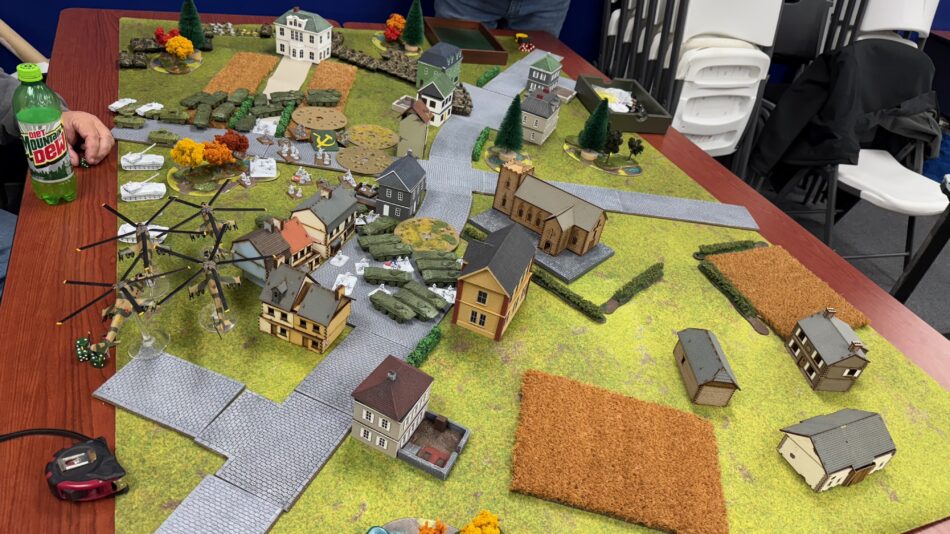
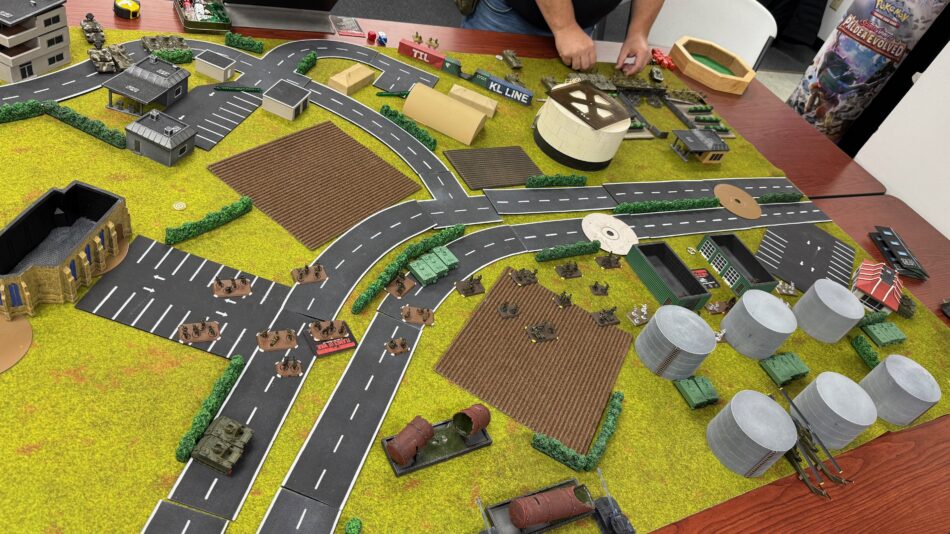
Let’s start out by looking at some pretty tables!


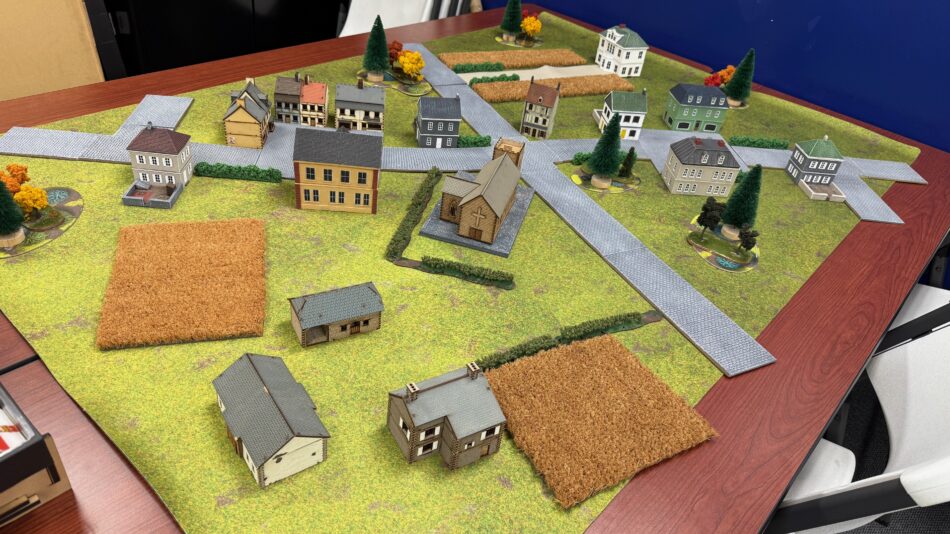
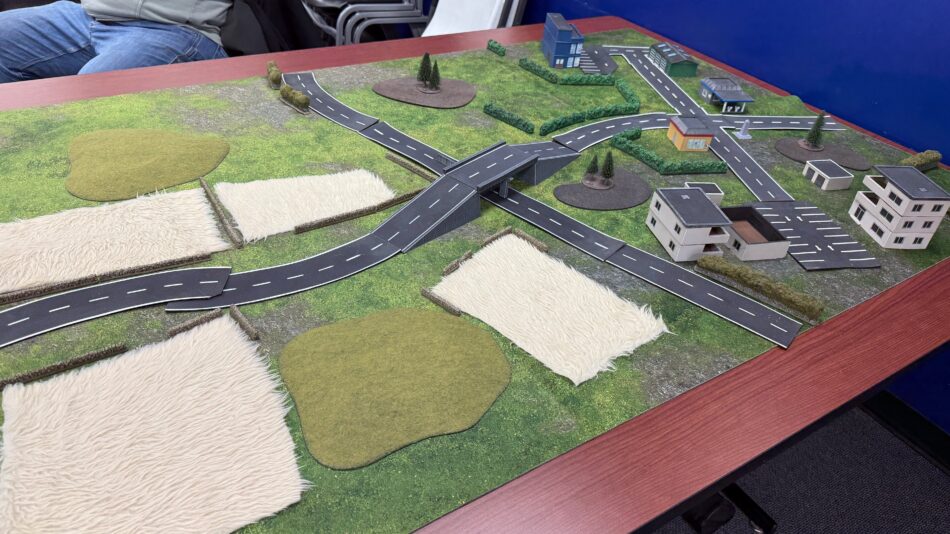
We just needed 4 tables, and with the Dreamers Vault location in Burnsville, we tend to be pressed for space. The crew does well with people bringing one or more tables each. The one thing about Checkpoint Charlie terrain is that terrain with a more late 60s or 70s flair is a bit different then your usual Team Yankee environment but not by much. My McPizzaKing for instance stayed off the table.

Day/Night
One of the notable differences between Team Yankee and Checkpoint Charlies is night operations. In Team Yankee those countries that have Thermal optics definitely can use them to their advantage when during certain missions you have a time of a day option. In a WARPAC vs NATO match, often a night action favors the NATO player.
Consider artillery, with the additional +1 penalty for ranging in, mixed with the fact that a lot of Soviet artillery is a 5 skill, ranging it at night over terrain is often impossible. Even for skill 4 VDV forces making use of your artillery assets becomes a challenge.
In Checkpoint Charlie however, there are some units that don’t even have IR! There are no Thermal optics. This makes night missions more challenging from an artillery perspective for all nations and thus as a result the current thought is it’s not a NATO advantage.
Since spotting units at night that haven’t fired is either a 1D6 or 2D6 (for IR) to determine how far you can see, which is on average 12″-16″, you’ll be in close when first opening up, but then completely visible to anyone that can draw an LoS to you during the turn(s) that you fired.
Where night favors NATO is in the general to hit calculation, as those units with a base 4 might need 7s (concealed, gone to ground, at night) which is a tall order. While WARPAC with its base 3 to hit might be 6s (concealed, gone to ground, at night). That’s a very nice advantage for NATO.
Air
In Checkpoint Charlie, anti-aircraft assets are a little less effective, a bit more expensive yet seemingly essential as strike aircraft and helicopters are both reasonably priced and decently capable for all nations,
Six Soviet Fitters for instance, at 12 points which includes the AT6 artillery template for S-24 rockets and 30mm guns at AT7 with a RoF of 3, can definitely get some work done. Balance this with the AA they might face, four American VADS are 8 points and four Chaparrals are 10 points. Both great AA units, yet the conundrum that players will face, do you spend 18 points out of your say 100 point budget to field that when the other player might not even bring any air and those points could be spent for three M48 Patton tanks. At least in the case of the VADS they can be used against ground targets.
Likewise consider four American Cobra helicopters armed with TOWs with AT18, come in at 17pts. Given hunter killer if the other side’s AA can be destroyed quickly, they can quickly become the most important unit on the board taking out high value vehicles.
The British don’t get to take advantage of Harriers and their 3+ arrival from Team Yankee. Instead they have F4 Phantoms, which at 16 points are capable, but they are not the auto include that Harriers are in Team Yankee.
As an American player would you choose four F4 Phantoms (18pts), four Cobras (17pts with TOWs), and then a further 18 points for both VADs and Chaparrals? That’s 53 points and I think out of balance for an average 100 point list. It doesn’t mean don’t bring air assets, but it does mean if you go all in on it, your ground forces will suffer and suffer dearly if the flyboys don’t deliver. Even then remember air units can not take objectives, so while air units can destroy things, they will never be the unit that wins the game.
As a Soviet players, would you spend 12 pts for six Fitters, 18 points for four Hinds (note you could go to 6), and then six Gaskins for 4 pts and four Shilka’s for 6pts? That’s more viable in my opinion.
This brings us to the one auto include of auto include units in the game for AA, that is the West German Gepard. At 9 points for three, with a cross of 2+, an AT11 gun with a RoF of 5/4 and 4+ FP. Fortunately for us all there is no way to field two platoons of these lovely beasts. West Germans are otherwise the same as other NATO forces, Cobras and F4 Phantoms are their only choices.
Broadly anti-aircraft units are generally more expensive in Checkpoint Charlie, which implies you won’t run into as much AA. This tempts you to build more helicopters and strike aircraft into your list to take advantage of a theoretical weak point. Take out AA assets early on, and then with air superiority take out priority targets as the game goes on. The one slight downside to the approach is that strike aircraft arrives only on a 4+ each turn. On average for a 6 turn game, you’ll likely only see them for approximately three turns. Potentially less than three in a meeting engagement situation with no aircraft during the first turn for the person that goes first. Where as helicopters as long as they keep flying they don’t need to roll for arrival but are also subject to more fire as weapons with guided and anti-helicopter keywords are more prevalent and effective.
For our local group the jury is still out. Gerards are an auto-include for the West Germans. The Soviets enjoy cheaper options and thus going all in with Air can be more reasonable.

Tanks!
The big change, NO LASER RANGE FINDERS. That did come up several times during the tournament.
Across the Checkpoint Charlie force options there are some interesting tank options. For the Soviets with the T-10M, T-72, T-64, T-62, T-55 and IS-3 they have lots of options. Though I have wondered why the T-54 wasn’t included since it comprised a reasonable percentage of Soviet forces even in the 1970s! For our initial tournament there was a distinct lack of Soviet armor. Part of this was due to the fact that boxes of T-10Ms were just starting to hit the store shelves. But likewise other models are in people’s collections and they weren’t on the table.
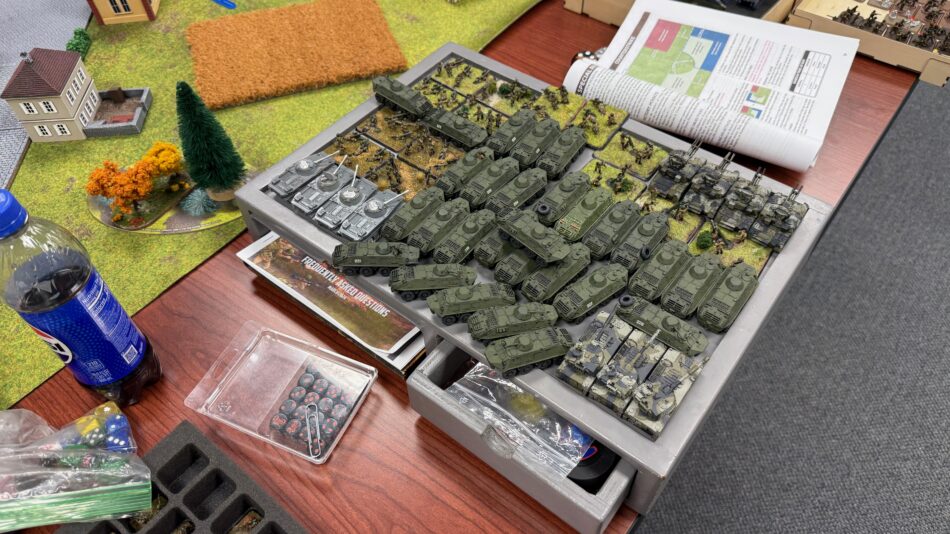
What happened was that Soviet players were trying to use Saggers as the backbone of their forces. I did a BTR-60 list and copious amounts of Saggers stands, it worked yet as with most infantry heavy lists, it’s a lot of moving parts and when you have to get across the table that presents time challenges especially in a tournament setting.
Next time, I suspect there will be more tanks on the table when it comes to Soviets.
On the NATO side, American tank formations were not to be seen. Again, people were turning to what they had on hand. The M-48 boxes hadn’t been out too long. Even then building a 100 point American tank formation is not easy. M-60 Pattons with their 15 frontal armor is certainly good kit, but it has to be able to deal with AT18 Saggers, infantry with RPGs and other tanks. People are skeptical that say seven M-60 Pattons in a 100pt list will get the job done.
The West German Leopard 1s we did see. With a moving RoF of two, this helps to make them a compelling choice, even though their front armor is only 8. While they won’t want to get into assault situations against infantry with effective AT, at range however they’re good. A platoon of four at 24 points seems like a sweet spot especially as a late game reinforcement.
No one played British that day which was unfortunate. The British tank options all strike me as something you won’t run a whole formation but as a single platoon they should be an effective force on the battlefield. The Conqueror with its frontal armor of 19 that will laugh at Saggers but only a RoF of one, is it good enough to be effective? Maybe!
Again for our local group, our initial games have been light on tanks, yet as people pick up boxes I expect to see them woven in.
Summary
For our group, Checkpoint Charlie has been very well received. People love the force options and the games are fun. Many changes across the different unit types are subtle and cause people to rethink/retune how they build lists. We haven’t see any obvious answers. I thought my BTR-60 Sagger-fest would do well, but it didn’t win a game, only resulting in draws the entire day. Better tactics? Better list? We’re all working hard to figure that out and no doubt you are as well.
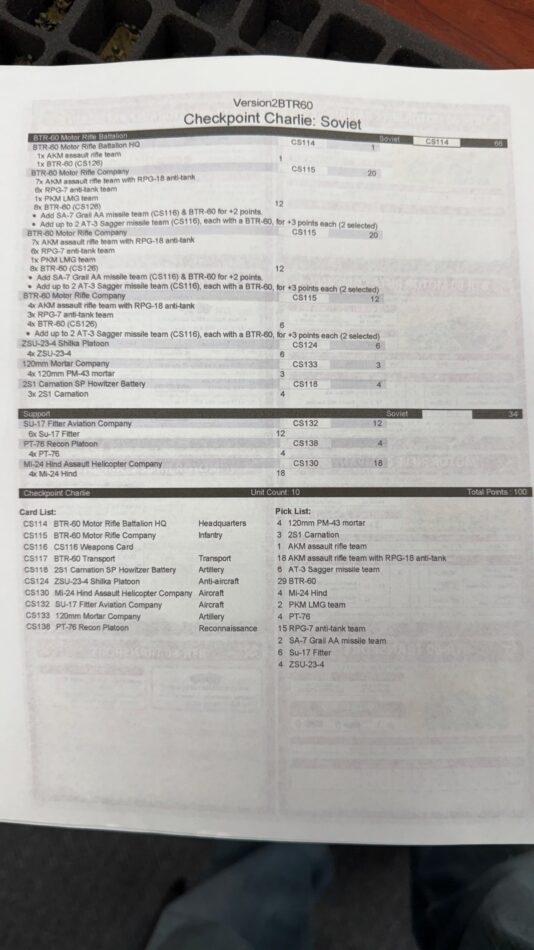
List
This is what I used for the tournament. A BTR-60 formation, amped up the Saggers, and then included Fitters and Hinds. Generally speaking the list was ok, it wasn’t losing games, but it wasn’t winning either, enjoyable to play!