First Look: Starcraft Tabletop Miniatures Game – Turn Sequence
By Aaron Kamakawiwoole
Hey Reader!
Today we’re looking at Archon Studios‘s unique turn sequence for the Starcraft Tabletop Miniatures Game (hereafter “Starcraft”). It’s simple, yet encourages tactical planning in each phase, like any good game should.
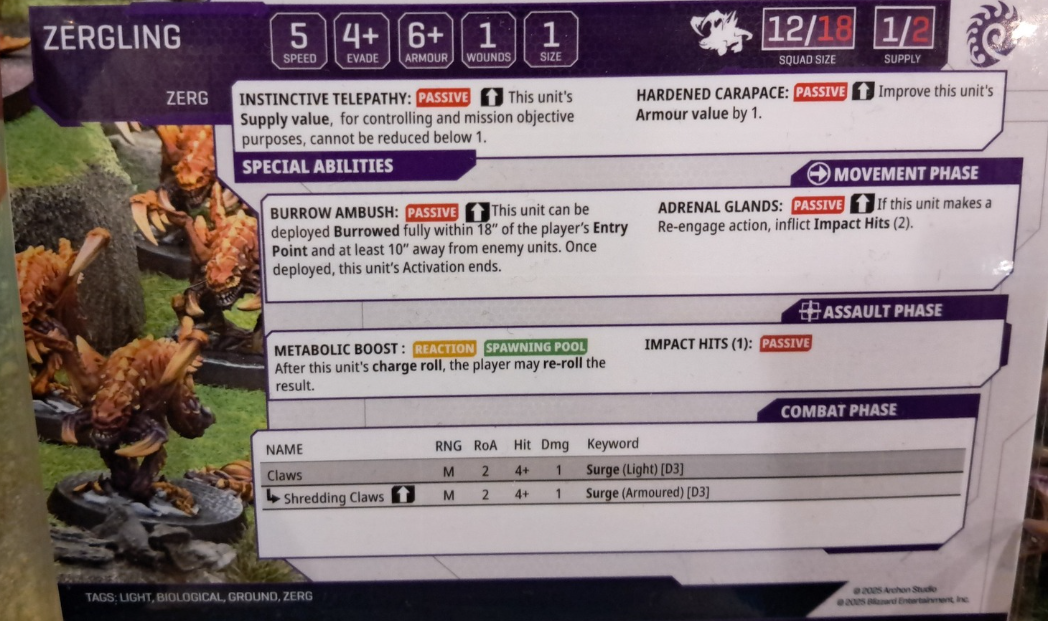
So today we’re looking at the three phases of the game through the lens of the humble zergling:
The Movement Phase
In the Movement Phase units maneuver across the board (though they don’t charge enemy units: that comes next). Their Speed Value at the top of the card tells you how many inches the model can move, and all other units end their movement up to 3″ further than that first model (though some units, mostly due to size of bases and/or number of models in the unit, might extend that range out further to 4″).
So movement is much akin to moving units in Star Wars Legion, though there’s no “unit leader”: you can move any model as your “lead model,” and the ending range for all of the other models is determined by that model’s movement.
This phase will be critical for melee armies that need to close distance, fragile units looking to escape enemy fire or assault, and units attempting to secure an objective on the board.
Some units also gain special abilities, which you see in the card’s Movement Phase section:

In this case, our humble horde of Zerglings can 1) start deployed further up (instead of coming in from the edge), and 2) if he is attacking a unit that tried to escape his assault on the previous turn, he has the chance to do some damage (2 dice looking for a 5+). Not bad!
Each player takes turns activating a unit in the Movement Phase; on Turn 1 players roll 2D6 to see who gets to activate first, and then play alternates from there. When one player is finished moving any units they want to move, they pass their turn.
After one player passes, the other player moves all of their units that they want to move, and we move to the Assault Phase.
The Assault Phase
In the Assault Phase, units may move again, charge enemy units, and fire ranged weapons. Relevant weapon choices and special rules for assaults will be in the Assault Phase section of the card:

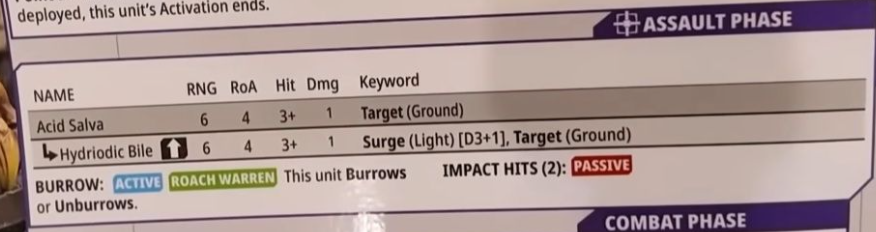
Our humble Zergling has no ranged equipment, so there’s no weapon profile in this section (though it is more reliable at charging, which is nice); the Roach, the Zergling’s big brother, however, gives you an idea of what a ranged profile looks like:
Players alternate activations in the Assault Phase, starting with the player who Passed first in the Movement Phase. When one player has performed all of the assaults and shots they wish to perform, they Pass. Then the other player resolves any more that they wish to resolve, and we go to the Combat Phase.
The Combat Phase
In the Combat Phase we resolve close combats: units alternate activations to attack each other in close quarters, with their melee weaponry present in the Combat Phase section of the card:
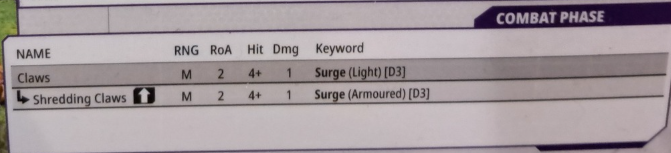
Notice that the Zergling has two options: one that can Surge against light targets (thus more likely to get past Armor Saves), and one that can Surge against armored targets. The latter is an upgrade: you pay additional points to take that option on the Zergling unit.
Starting with the player who Passed first in the Assault Phase, players alternate fighting in close combat until one player Passes (because they are out of combats to resolve). Then the other finishes the rest of their combats and we end the turn, resolving any end of turn elements.
Following Turns
The person who starts the next Movement Phase is determined by who has less Victory Points, so the player who is losing will always gain the initiative, hopefully swinging things in their favor. And if they can Pass before the other player does each phase, they might be able to maintain that initiative for the whole turn.
But that might mean not activating a unit that could move, shoot, etc., to gain initiative in a future phase. It’s a gamble, but one that keeps the game interesting.
If both players are tied for VPs, they roll 2D6 as in the previous turn, and play continues.
I love this, because I’ve been playing wargames for 15 years and I’ve seen plenty of games run away from myself or my opponent. And it’s hard when the game makes it impossible for you to have agency when you’re losing. This game turns that around, giving you ample opportunity to seize the initiative and fight back.
If this interests you, sign up for their newsletter so you can pre-order the game in the next few weeks!
Aaron Kamakawiwoole
YT: @ZurnCentral (Bolt Action) and @CentaurGaming (Starcraft)