
Tourney Recap: Learning Conquest First Blood in the Crucible
by Troy Hill
I had the pleasure of playing Para-Bellum’s newest version of their skirmish game: Conquest First Blood at Slice n Dice games in South Bend, Indiana (USA).
Hosted by Jay Walker as TO, the event occurred on Halloween day. What a choice; stay home and hide from Trick-or-Treaters or go play games? Fortunately, our neighborhood is full of grumpy old grognards who don’t allow trick-or-treating. So my wife released me for the road trip to South Bend.
Earlier this year, First Blood received a huge new revamp from Para-Bellum. Now in it’s third edition, this game no longer plays like a “lite” version of the flagship game Conquest: The Last Argument of Kings (TLAOK). Instead, First Blood is a flavorful cousin to the larger rank-n-flank game, but stands on it’s own for mechanics, synergies, and game play.
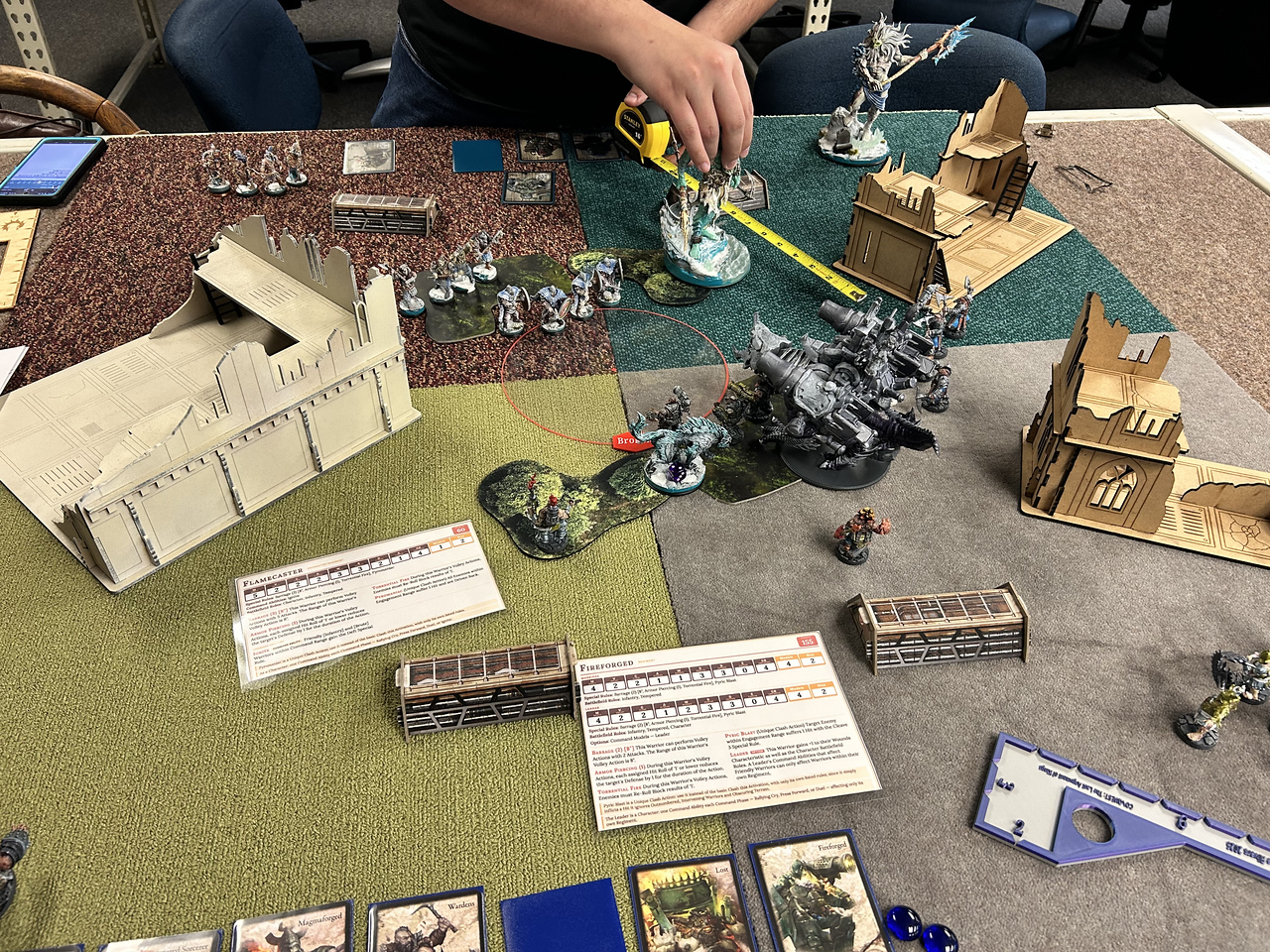
The players at the tourney were even able to play against (and in my case, be beaten without mercy by) the game designers, Jacob and Joel Rasmussen. The two designers make a good attempt to visit what tournaments they can in a days drive from their upper midwest (USA) home base.
As a new player, myself, I wanted to get a good feel for the game’s inner mechanics and meta strategies. Not because I’m a good meta player, but because I want to grow my Conquest community, and this game seems to have a good core of players growing as word of the new edition spreads.
Rather than make this just a tournament Bat Rep, let’s take a dive into the mechanics of the game.
First off: this is a skirmish wargame. Players build a warband with a Warlord, and units called regiments. Warbands may also include Heroes. The latter function similar to warlords.
In the army construction phase, players select one Warlord. They may select additional heroes. First Blood gives new life to the Hero models used in TLAOK. In First Blood, they act as sub-leaders under the warlord. Each can issue commands during the command phase, but lack some of the strength or firepower of a warlord.
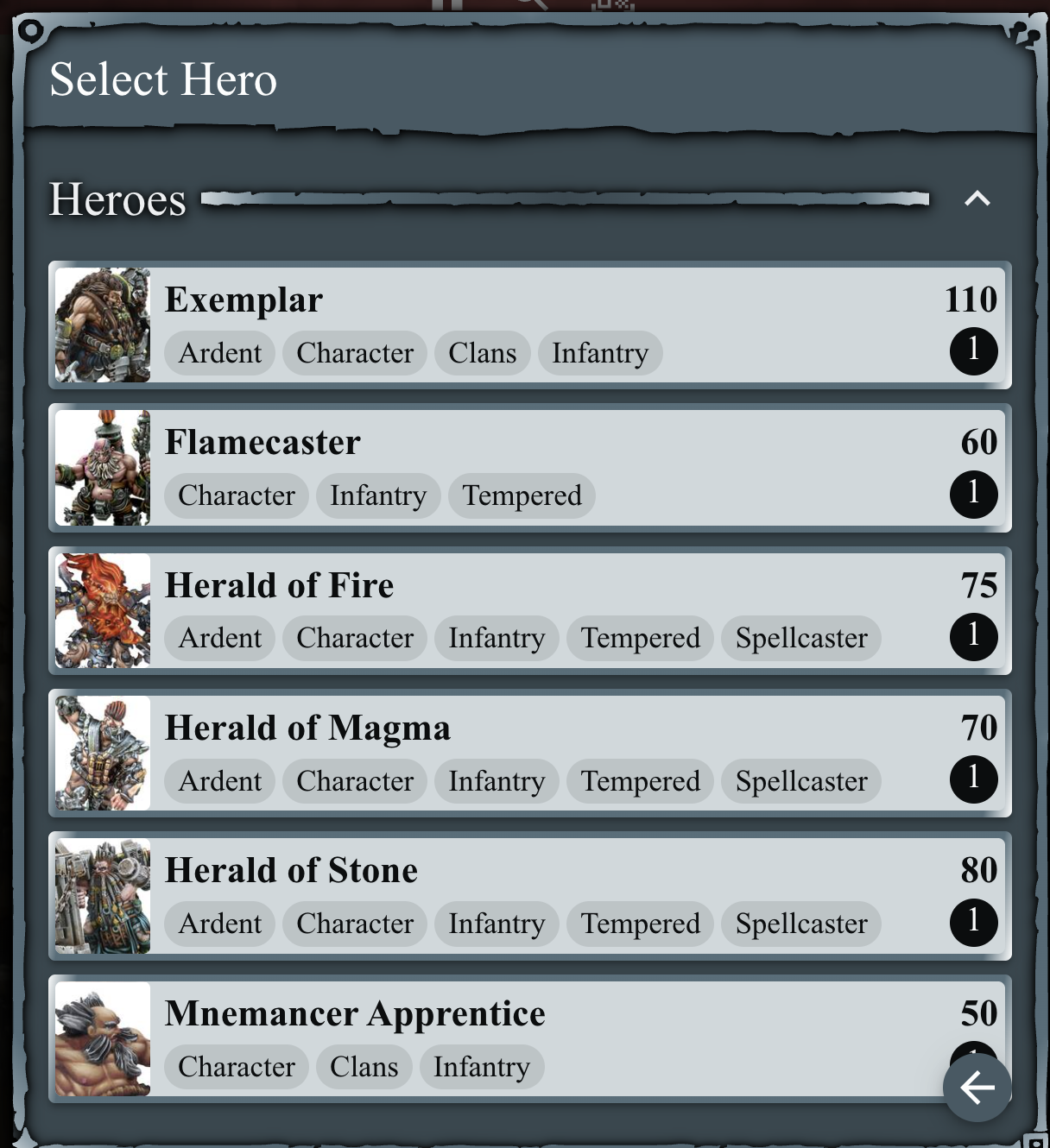
Once the Warlord and any heroes are selected, players start adding regiments of troops to the warband. Units are in two main categories: Mainstay or Restricted.
You must select one Mainstay regiment to unlock adding a Restricted regiment. One of the bonuses for each warlord is they add their “entourage” of a restricted regiment to the mainstay list.
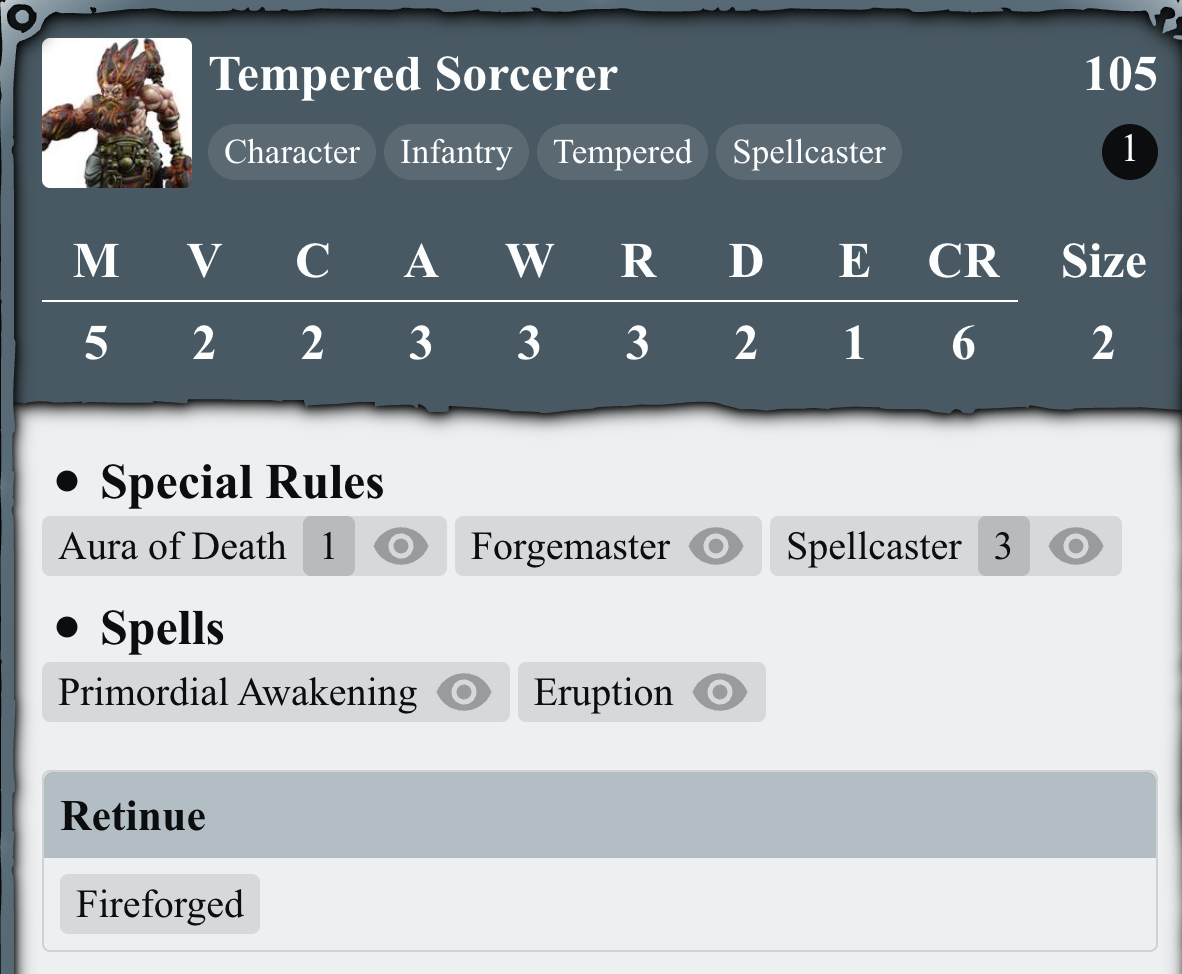
Here, in the profile for my Tempered Sorcerer Warlord, you can see that he adds the Fireforged unit as his entourage, moving them from the restricted list up to the mainstay list. Taking Fireforged, now unlocks a restricted regiment.
You can only select each regiment once, but can add additional warriors beyond the first four (for infantry) or beyond the first model for Brute sized warriors. Each Monster regiment, such as my Hellbringer Drake is unique in your force.
Playing a game: The Scenario
This is where the game shines. Setting up a casual game requires that the players choose three “Elements” that consist of one Mission, one Territory, and one Encounter.
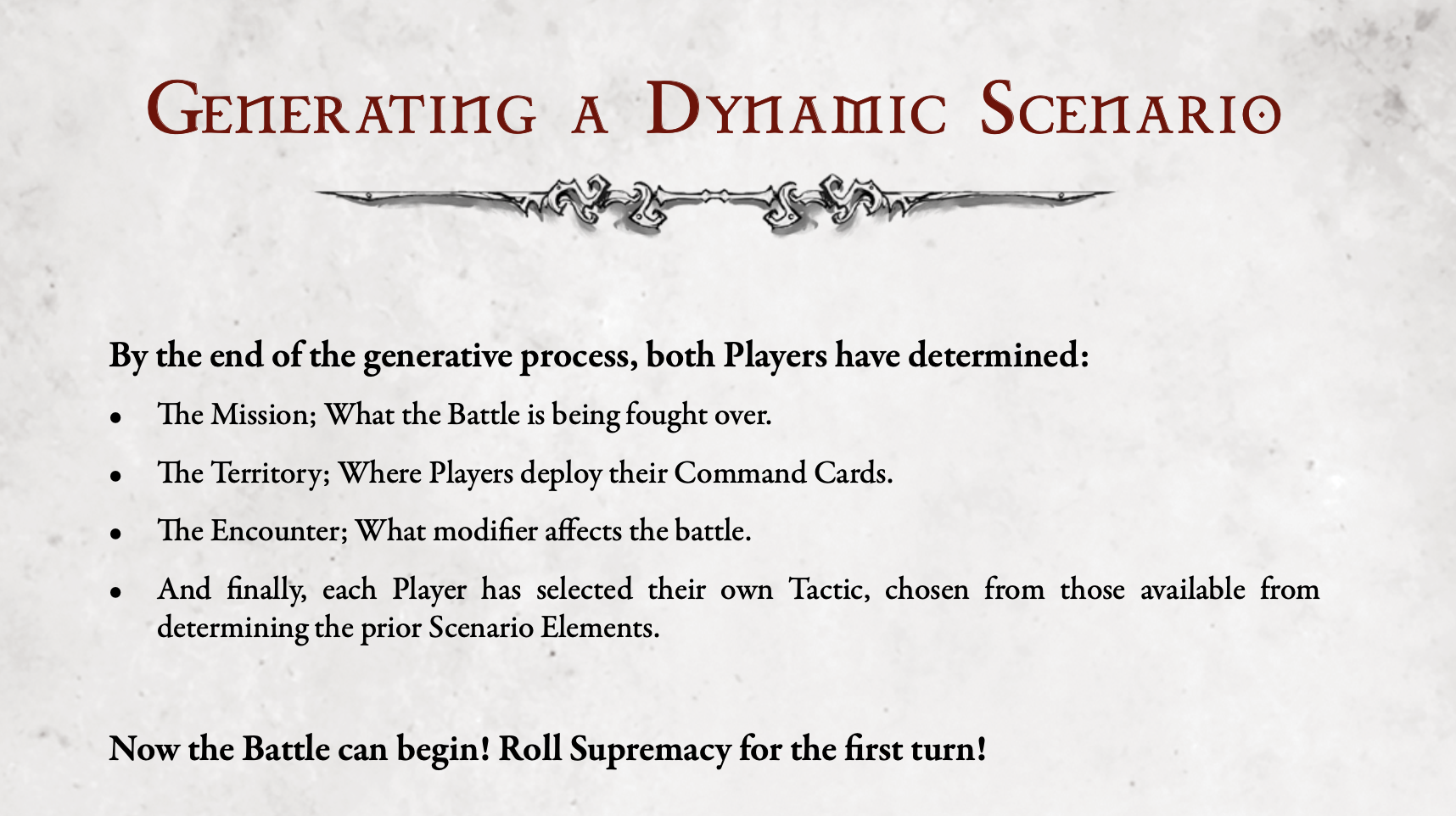
The mission shows where on the battlefield strategic objectives are placed. The Territory shows where the deployment zones are for each player, the Encounter gives modifiers to the scenario. In addition each of the three elements gives a potential Tactic – a set of special rules or conditions that affect one player’s force for the duration of the game. Players alternate choosing a tactic from the three elements.
In a casual game, these elements are randomly rolled as part of the setup. But, for tournaments, TOs preset the elements for each round. At the table, players then roll off for SUPREMACY (who goes first), and the first player chooses their Tactic first. The second player selects their tactic from the remaining two.
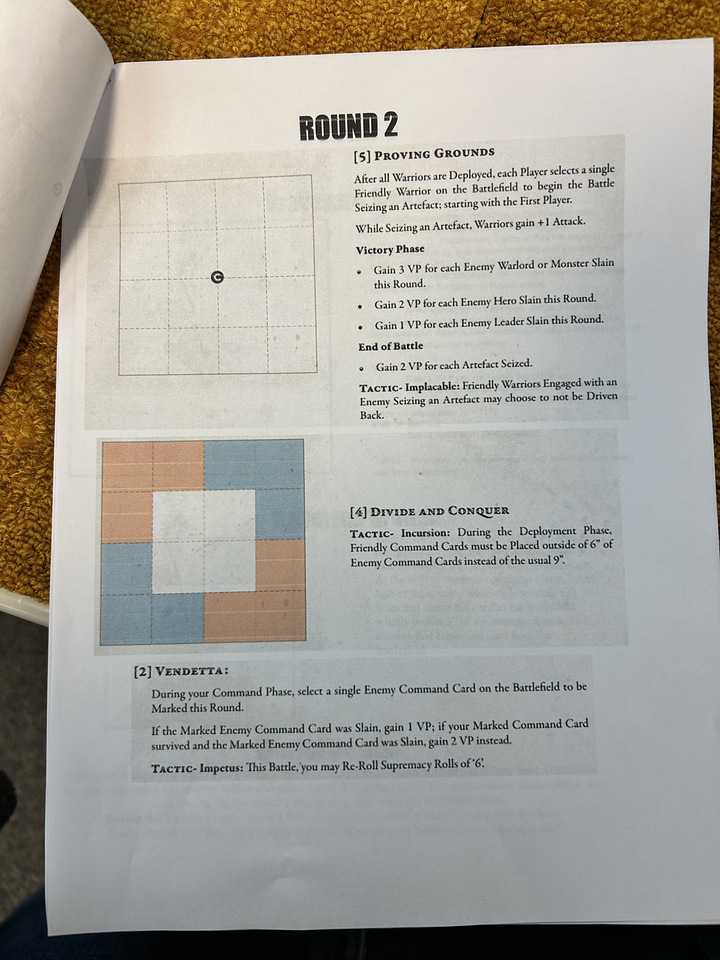
Deployment
Similar to it’s big cousin, First Blood uses the Command Cards for each Warlord, Hero, and Regiment. In deployment, players alternate placing a card face down in their deployment zones. Once all cards are placed, players then begin by revealing one card, and placing all models for that regiment within three inches of any edge of the card. This can be on the card itself.
After deployment, there is no longer a unit cohesiveness. The units activate as a whole, but only one model acts at a time. A regiment with four models would activate. The player would chose one of the warriors in that regiment, and perform its TWO actions for the turn. Once that model’s actions were complete, the player would select another model in the regiment, and so on, until all model in that regiment had their go.
Play then passes to the opponent, who activates a regiment (or Warlord, or Hero), alternating activations between players until all regiments have been activated.
The Actions
These include what you would expect: March (up to twice), Rally, Aim, Volley, Inspire, Clash. There are other actions that are situational. EG: in terrain with more than one level, a character can Climb to another level.
Commands
At the beginning of each game Round, the characters (Warlord, Heroes, and regimental Leaders) may issue commands to their troops. These include generics, Like Press Forward (which increases the second march action), Rally, or Duel. There may be other commands attached to each character or leader. The unique commands give each faction it’s own flavor in the game.
Combat and Dice
This is where the game radically departs from it’s cousin. Instead of rolling dice to match or better the Clash or Volley value of the character/regiment, First Blood uses a Comparative die roll.
For example, my Tempered Sorcerer above has an Attack value of 3, and a Clash value of 2.
When he performs a Clash action, I start with his three Attack dice. If he uses the Inspire action, I add a fourth die to the pool, etc. Once I have my dice pool set, I roll the dice. Sixes are auto failures, but may be affected by re-rolls.
Ones to fives are potential hits. If I roll a 1, 3, 5, and 6 after all rerolls, I’d discard the 6 as a failure. Then I would keep my two lowest dice (low is good in this game). Why only two? Because the sorcerer’s Clash value is 2. I can keep no more dice than his clash value (or his volley value when shooting).
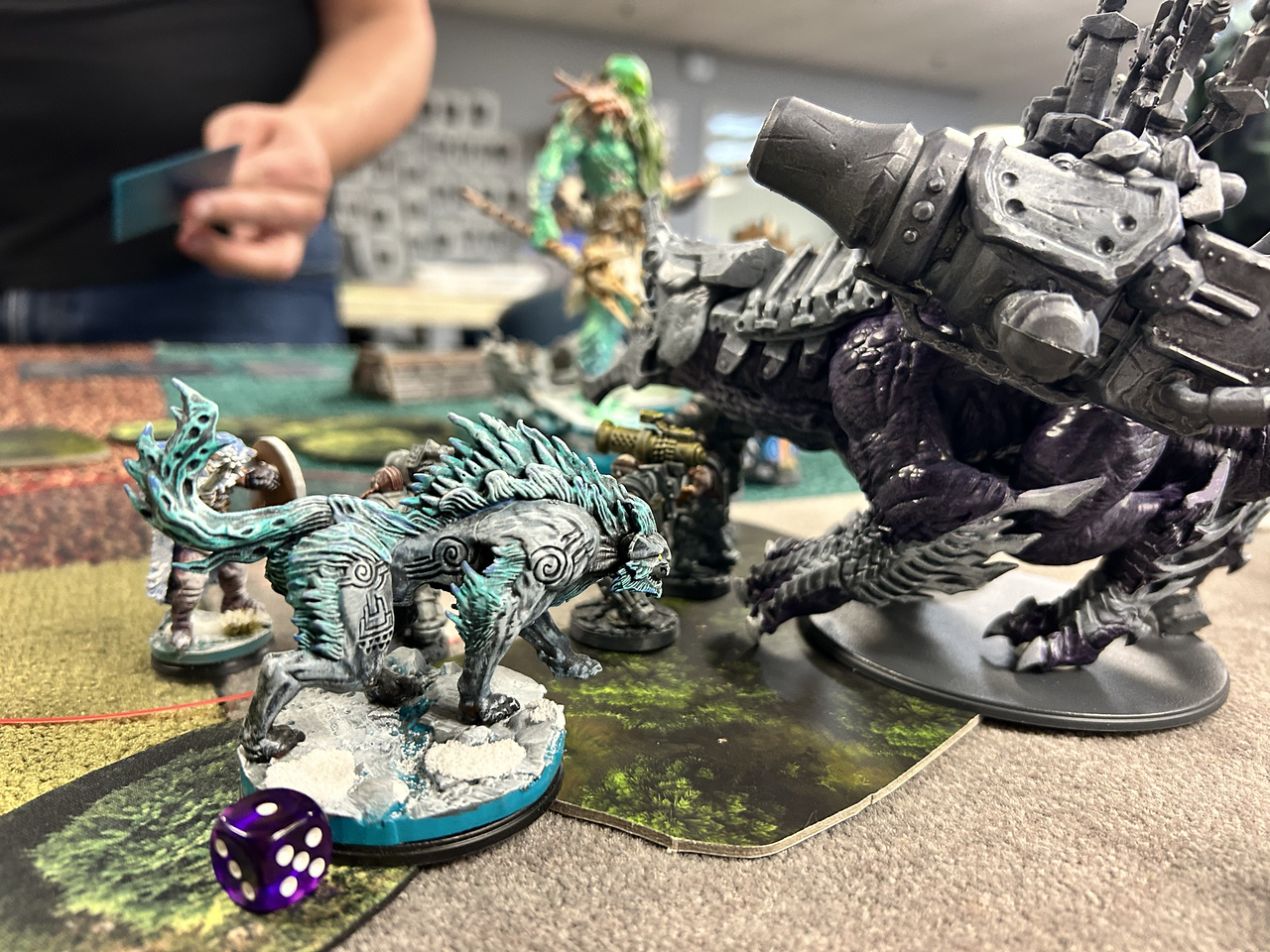
The opposing player then builds a defensive dice pool equal to either her defense or evasion, whichever is higher after modifiers. If the player has a pool of three dice, they roll and try to match or better my rolls. They get a 2, 4, and 6 (after rerolls). The six auto-fails. Leaving a 2 and 4. This is matching or under their Defense characteristic. So they keep both dice, and compare to my roll.
I kept a 1 and a 3. Their 4 is too high to deflect one of my dice, but their 2 can stop my 3. That leaves my 1 getting through their defense. Their model takes one wound. Since most models have only one wound, this triggers a resolve test. They roll one die, and try to get their Resolve (or under). If successful, the model shrugs off their last wound and fights on. If they fail, the model is removed from play.
Hopefully, that explains the core concepts of First Blood. In practice, I find the game fast paced, bloody, and fun.
The Tourney
In my quest for the wooden spoon, I failed. Not for lack of my opponents trying. I had my arse handed to me twice. It was only against Jay, the TO in round one, that my force prevailed. One win usually is enough to be out of the running for the wooden spoon.
To be fair, Jay was running as Ringer in the tourney, since we had seven players without him. He ran a force he wasn’t familiar with (his father’s Nords).
Since we were playing on Halloween Day, all forces HAD to include at least one Monster regiment. I brought my Helbringer Drake. He fielded a Sea Jotnar (giant with a big anchor it swings around in combat).
Round Two
I faced off against none other than First Blood designer Jacob! His W’adrhun beat my force unmercifully. Deployment in this scenario was each player taking opposite corners. I had the upper left, and lower right (from my perspective). Jacob had the other two. We had artifacts we had to grab, and score points with.
I parked my Wardens in the upper left as a delaying action, then added my Helbringer Drake. Jacob rightly anticipated that deployment and placed his own Apex Predator in the area.
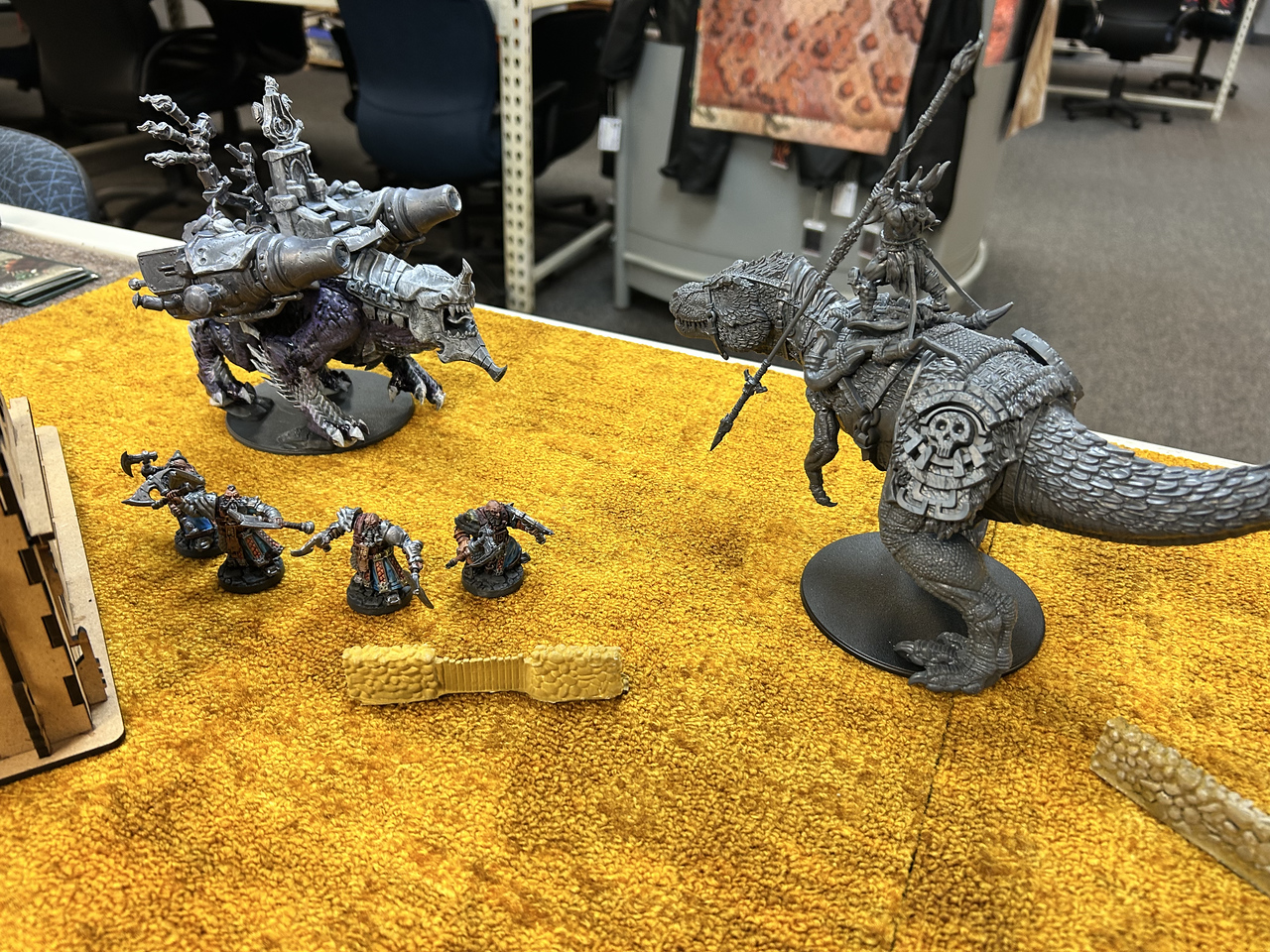
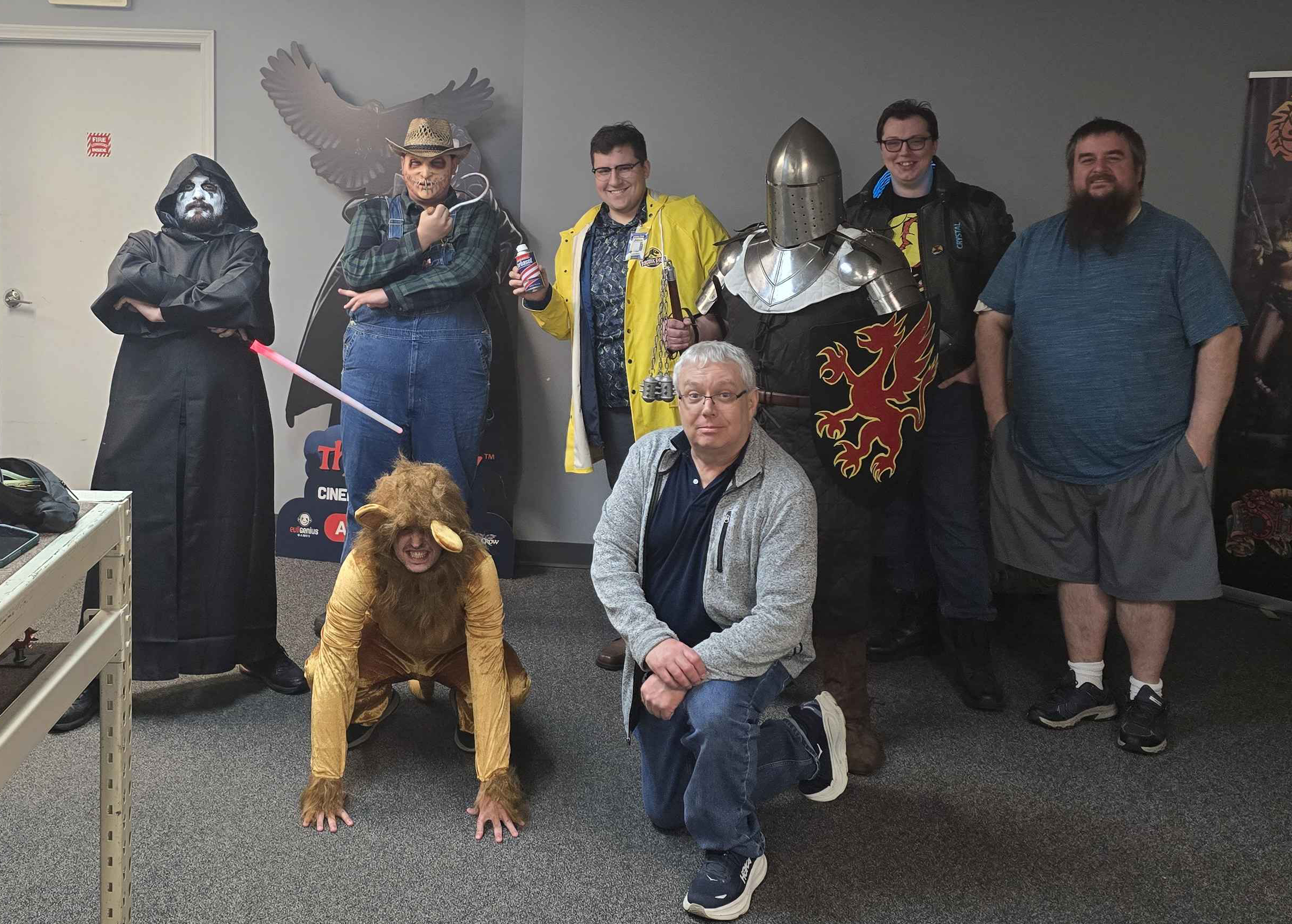
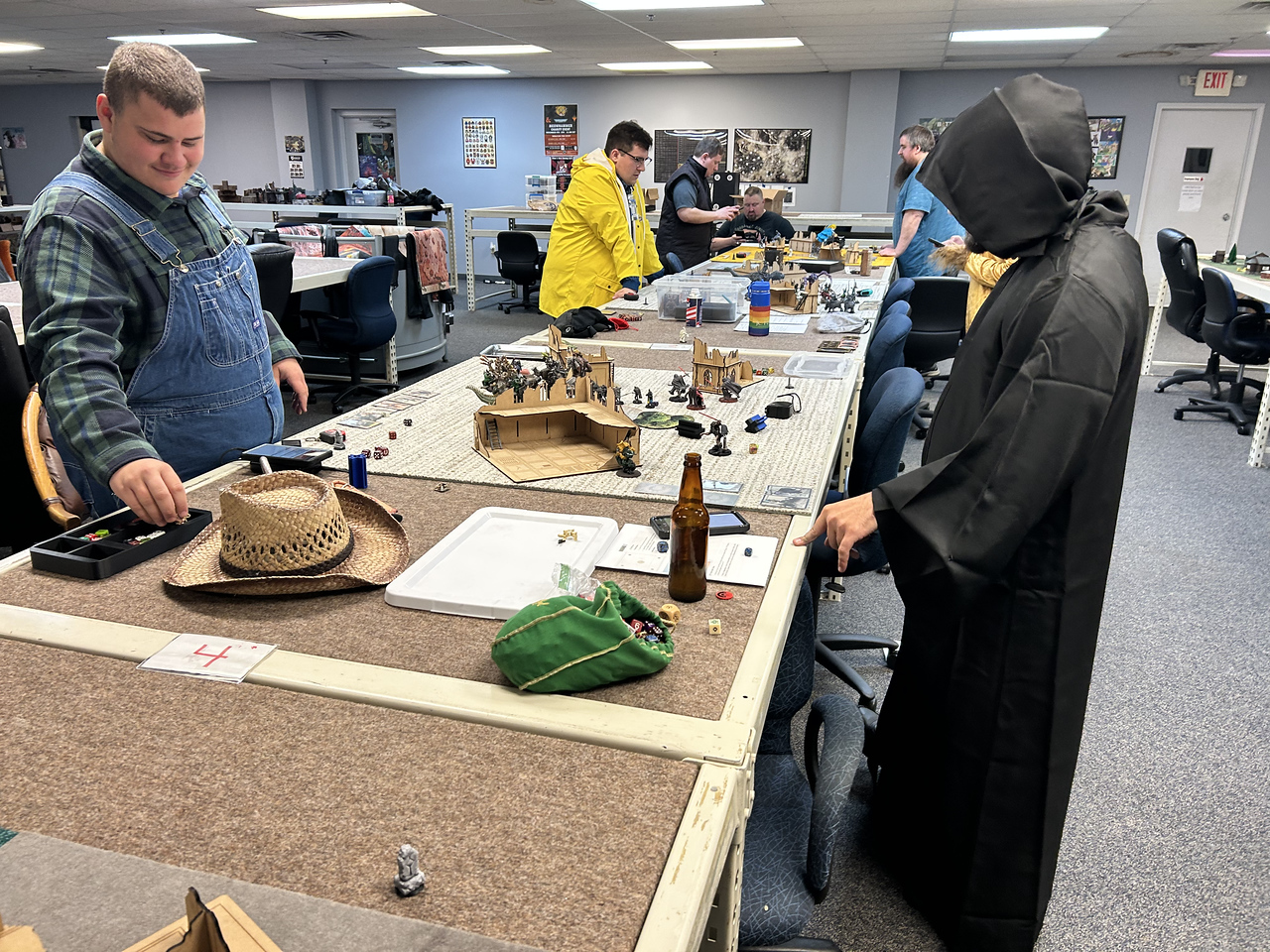
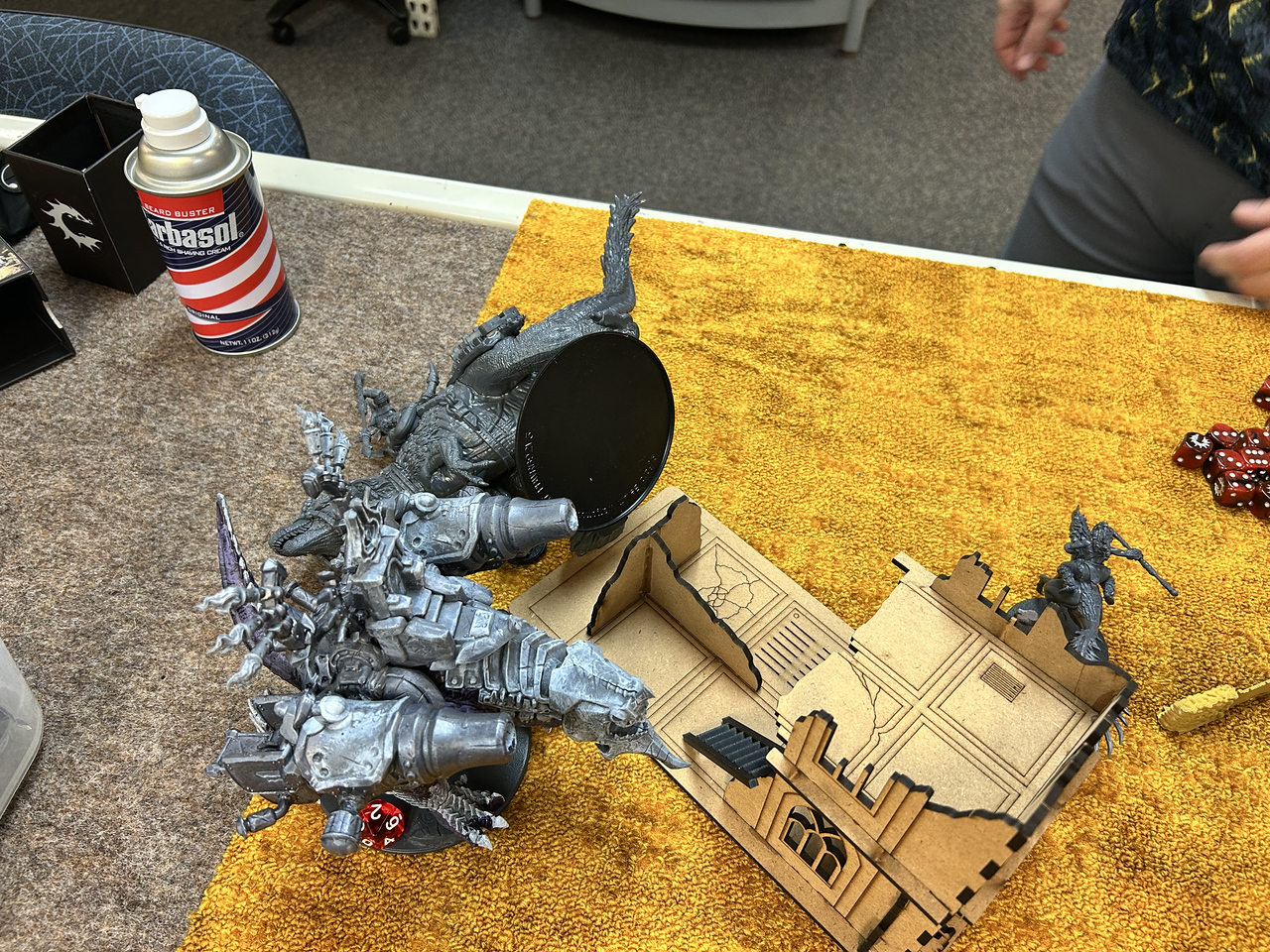
If you look at the player pic at the top of the story, Jacob is dressed as Dennis Nedry from Jurassic Park, you know, the guy with the Barbasol can, attempting to smuggle dino embryos off the island. It was fitting that he played the dino faction in the tourney.
I forget much of that scenario. However, I made my singular goal to take out his T-Rex before my drake perished. Thus ensued three round of my drake firing, then backing up. His T-Rex eventually caught up, and the dice gods smiled upon my drake. I made all the saves I needed to keep fighting, and my drake prevailed!
Round Three
I played Para-Bellum’s sales rep Hunter Rink. He’s the one dressed as the Sith Lord.
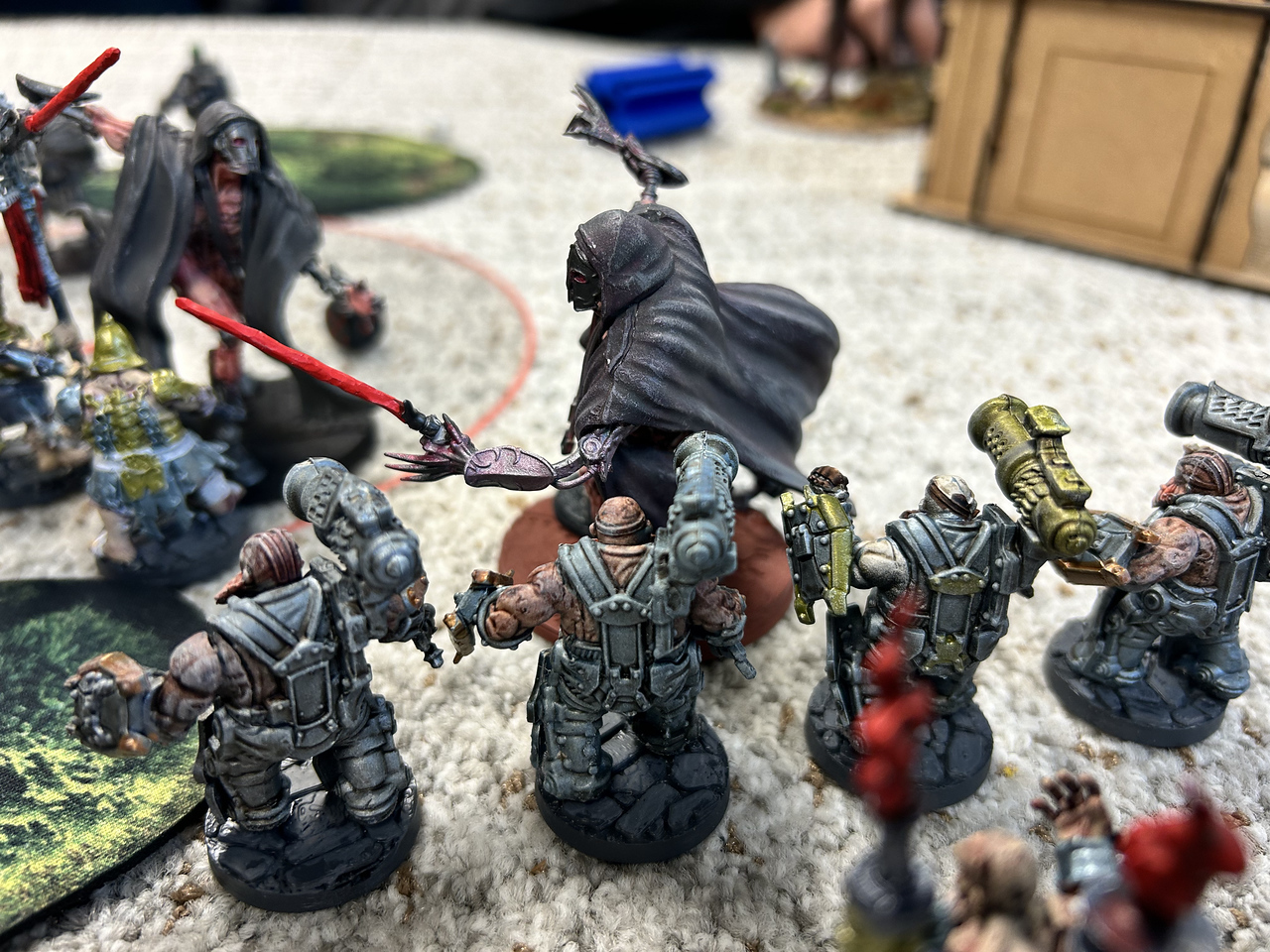
Hunter has an awesome army. He was playing the City States faction, but he was able to convert and paint his warband to represent the “Sithy States.”
Each figure had a strong Star Wars flavor, but stayed Para-Bellum world point legal by using only Para-Bellum parts.
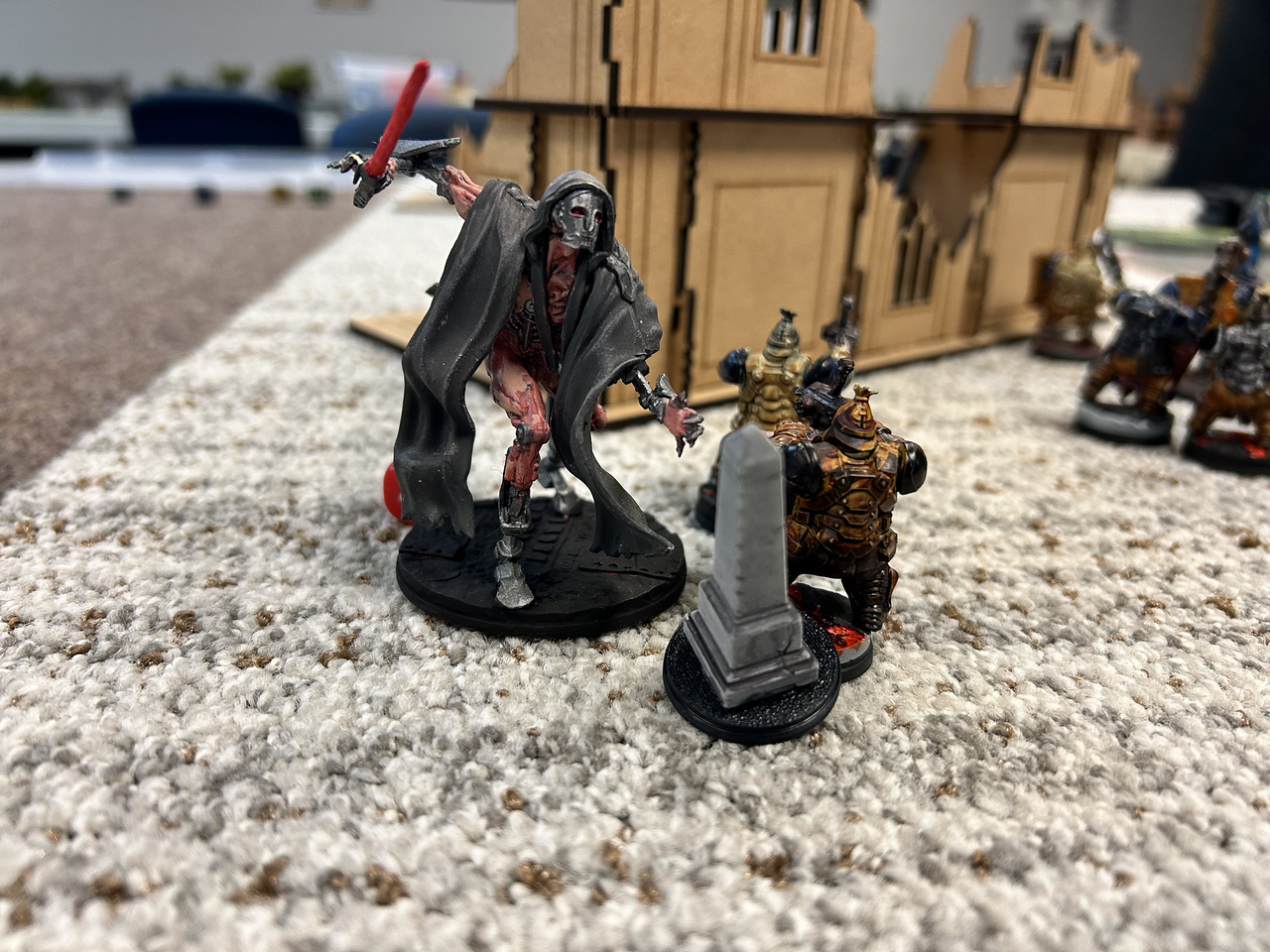
The final round was a Halloween themed custom scenario. We were supposed to grab the artifacts and beat each other’s forces senseless with them.
Hunter didn’t need to bother with the artifacts. His force was perfect for issuing duel challenges, and the tactic he chose took away his penalty for declining duels. I didn’t stand a chance. His force of light-saber wielding clockworks and sith warriors closed fast and I rolled a lot of defense rolls.
In the end, Jacob won the tourney. Jay came in last, but removed himself from the prize pool (fitting for the TO in that situation). I ended up in the middle of the pack. Nowhere near the wooden spoon.
I’ve got to get better at losing if I want the spoons.
Perhaps next time.
Thanks for the read. I’m learning the game as we speak and will be at an event this weekend!