Barbarossa Soviets : Crossing the Early War Flames of War T
By Tom Gall
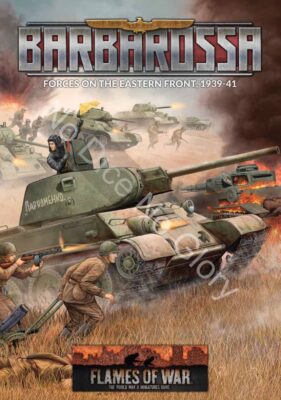
With the release of the book Barbarossa by Battlefront for Flames of War, Early War is about to substantially expand. While the German invasion in 1941 stepped foot into the expansive territory of the Soviet Union, Barbarossa brings a wide range of new units, new armies lists and new scenarios to early war (EW). No matter if you play entirely casual, join in on game night at a store/club or play the tournament scene, Barbarossa packs lots of fun between its covers.
Intro
The Soviet portion of the book is 58 pages of history, lists, special rules for Soviet forces, a basing and painting guide. Just like mother Russia, it’s a massive amount of material so as a result, I’ll come at this from the standpoint of several articles. The goal here is educate on what’s there, connect the dots on what will make for fun/competitive lists, discuss “auto” includes, and give you a strong sense of what it means to play Soviets if you don’t already.
Tanks
When the Germans invaded in the summer of 1941, the Soviet army was in a state of change. In 1937-1938 there had been a substantial purge of leadership which deeply impacted experienced officers. As the lessons start to roll in from the Spanish Civil War and the Polish invasion in 1939, Stalin and army leadership decided to abolish large tank corps and distribute tanks across the infantry divisions to support them. As more lessons were learned from seeing the German Panzer divisions in action in France and Africa, the Soviets decided this change was a mistake and thus mechanical corps were once again reorganized. This “chaos” is reflected in the stats for Soviet forces in Flames of War.
When the Germans invaded in June of 1941, the Soviet tank force was largely comprised of older designs, BT-5s, BT-7s, T-26s, T-28s, and T-35s. The iconic T-34 was but a year old and hadn’t replaced older designs. Likewise the KV-1 had entered service in 1939, so while it was at the front from the early days of the invasion, there were not substantial numbers.
Soviet tanks are largely hit on 2+ in Barbarossa. Skill is often Green 5+. And for a good number of tanks, you’ll find the “purged” remount of 5+. Taken together this represents well the operation state of Soviet tank forces. At first glance you think this is unplayable. Think again. Remember, quantity has a quality all of its own. While the stats might be challenging, you’ll get ALOT of them.
Sea of “T”
Let’s crawl through the arsenal and think in terms of usefulness and likely positioning in your force.
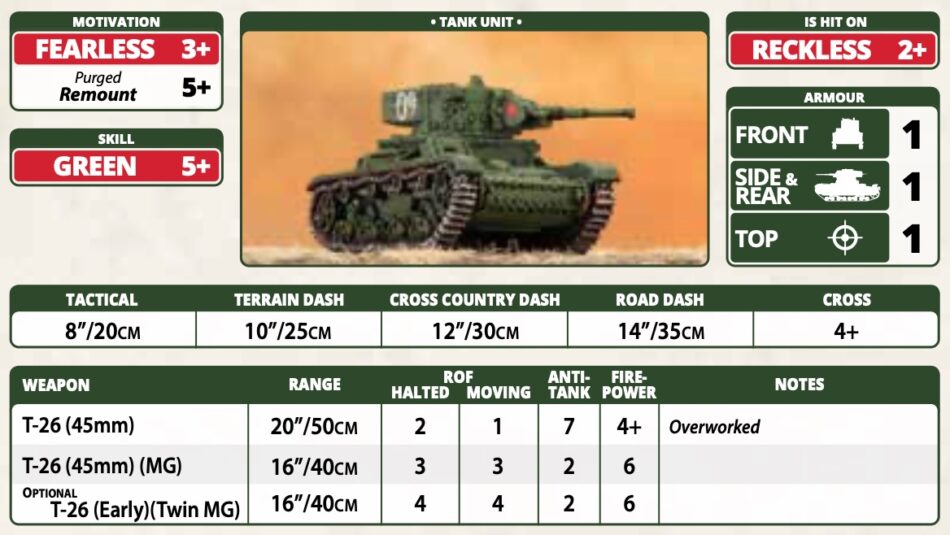
First up, the T-26, the most numerous tank in the Soviet army in 1941. It appeared in a number of different variants several of which are well worth your time. The 45mm variant is perhaps the most interesting with its overworked 45mm ATG. At AT7, that gun will get work done in early war. The T-26 tank company comes in number of 5 up to 16 tanks in the unit.
Not enough frontal armor? Ok!
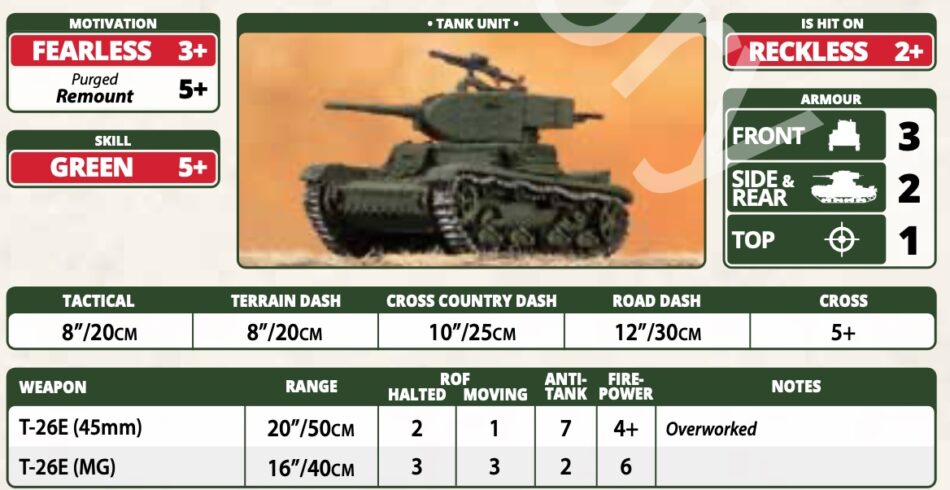
How about a T-26E then? Better armor sure, but up to a 5+ cross check. The unit sizes are the same you can field a T-26E tank company in number of 5 all the way up to 16. The point difference however is approximately 2.3 points per tank on the boring, standard T-26 and about 2.8 points per tank for the T-26E.
The next tank to consider is the BT-7 which also was present in the Soviet army in considerable numbers.
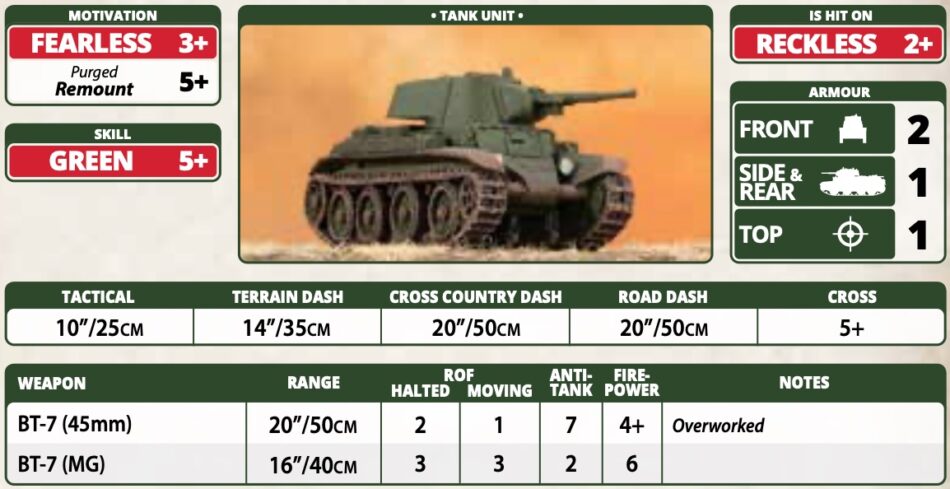
Not represented in the BT-7 stats was its ability to not have any tank treads and run on road wheels. The BT-7 was a fast tank, with a top speed of 53mph/86kmh and I’m not sure that’s reflected on the card. Regardless, the BT-7 tank companies can be fielded in sizes of 5 all the way up to 16 tanks. At approximately 2.6 points per tank, it’s a bit more expensive than the T-26 yet you’re getting a better frontal armor of 2 vs 1 as well as better movement stats. The 5+ cross check does give one pause as this impacts tank mobility. Being hit on 2+, I know I want to be seeking cover as much as possible.
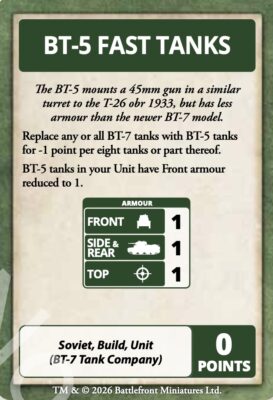
The BT-5 makes an appearance through a command card. A reduction in armor and one point per eight tanks isn’t a big savings for the loss of one point of armor.
Let’s look at a few variants of these popular tanks you’ll want to consider.
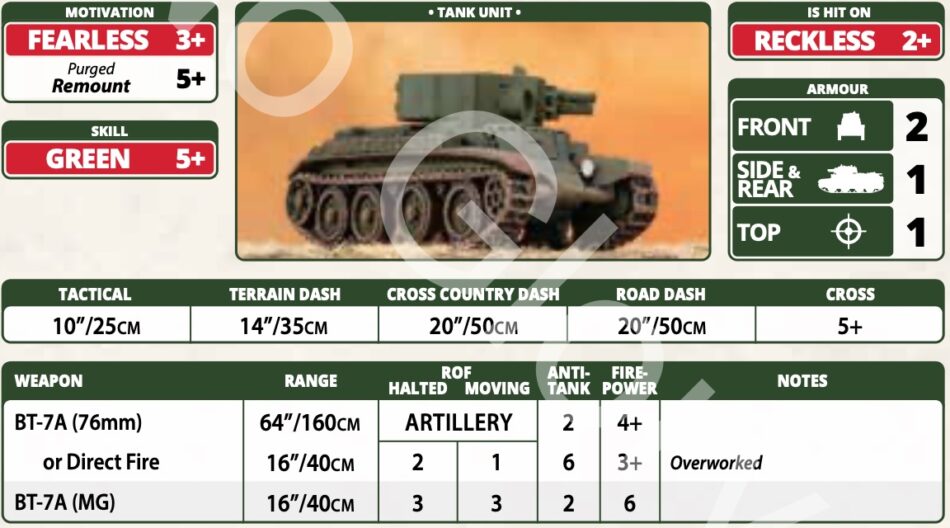
The BT-7A is a SP gun version of the BT series. Sporting a 76mm gun it is a capable artillery piece with a decent direct fire weapon at a 3+ FP which is not bad for early war. At 8 points for 3 or 16 points for 6, I’d say there is value in 3 for mobile artillery in tank form. For 16 points to get the ability for re-rolling misses I’m not sold, that is a big spend especially for a green skill unit that will struggle to range in.
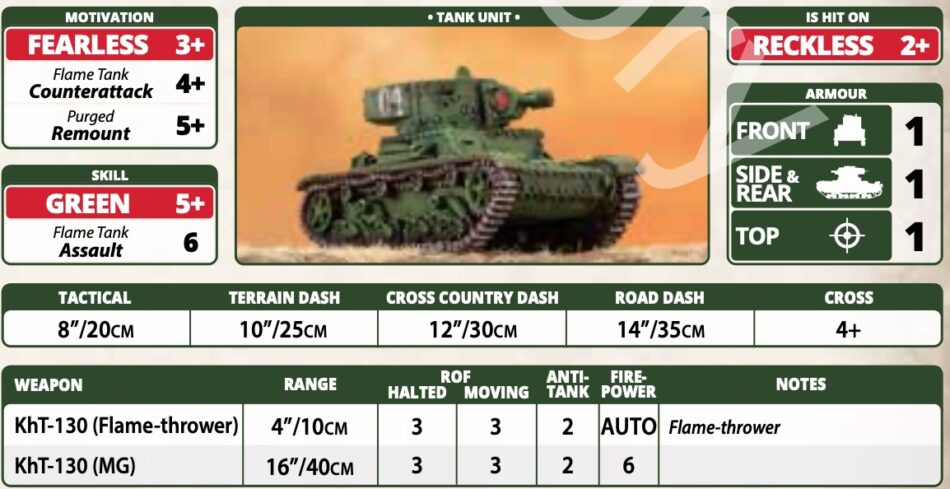
How about a little fire scarecrow? The KhT-130 is a T-26 variant that brings a flamethrower as its main weapon. Otherwise nearly the same stats as the T-26, you get a very good vehicle mounted flamethrower at a very modest cost of approximately 1.8 points per tank. Notice it is not overworked! The company can vary in size from five to ten tanks.
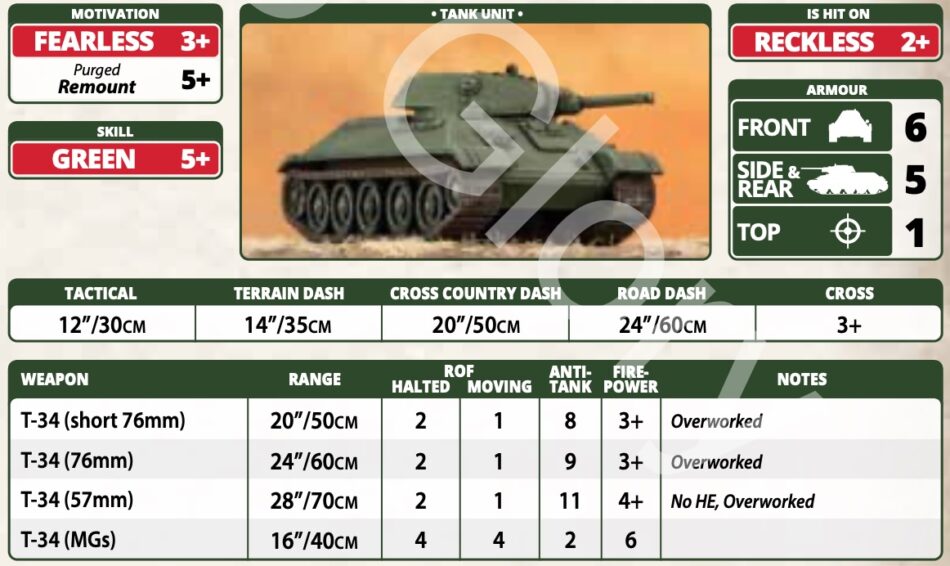
The iconic T-34 was present at Barbarossa and more than a bit of a surprise to the Germans as it was a very capable tank. In Flames of War, it is an impressive tank for early war. It comes in 3 variations between the short 76mm, 76mm and 57mm guns. At about 13.8 points per T-34 however, you’re not likely to be fielding that many. The 76mm version brings another four points in cost per tank and the 57mm version an extra five points per tank.
At this cost range, that’s a great amount of points to put into one unit. If there happens to be a German BunkerFlak or 88 on the table, these wouldn’t last long. A shame really as versus other early war armies, they could do well.
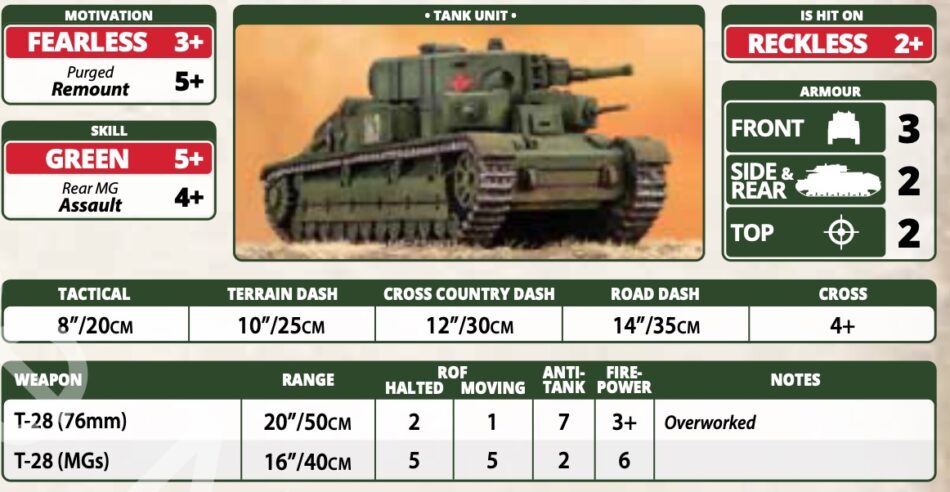
Staying with the big tank theme this brings us to the T-28, with its two machinegun turrets and 76mm gun. The stats are once again very familiar being hit on 2+, fearless and the purged remount. The T-28E variant is also present in the game which has a front armor of four. These cost roughly four points per tank and a company can be as small as four tanks or as large as ten.
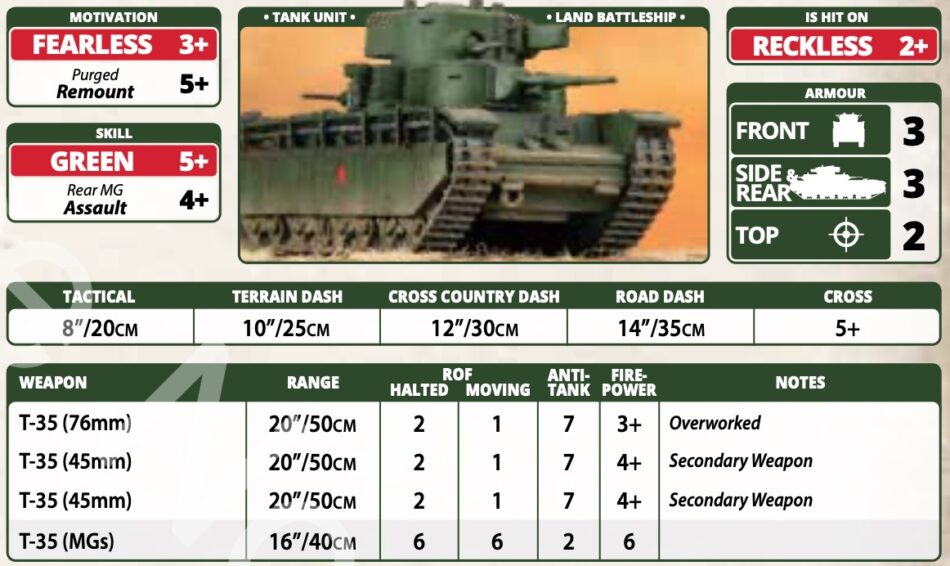
The biggest of the big is the T-35 which has land battleship status. It can still fight in assaults when it’s bailed out. It has oodles of machine guns, two 45mm guns and a 76mm gun in the top turret. At about nine points per tank, it’s fairly pricey.
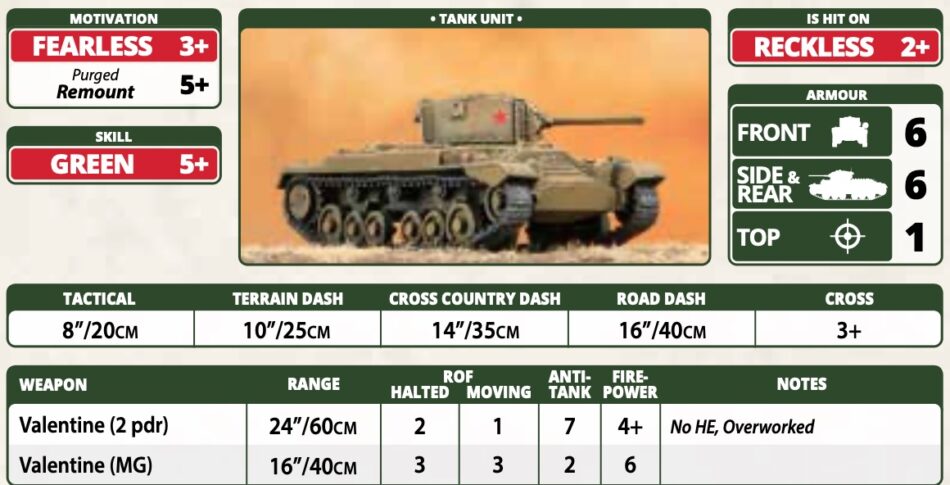
Next we have the first British lend lease vehicle that did start to show up late in 1941. The Valentine is a great early war tank, with its six armor rating all around. At about 11 points per tank, the question you’ll have to ask is do you want some high value units that are hit on 2+ and will have issues remounting? This is one of those tanks that I felt would be excellent assaulting infantry. It’s the other stuff that might be in support of the infantry that could be a problem.
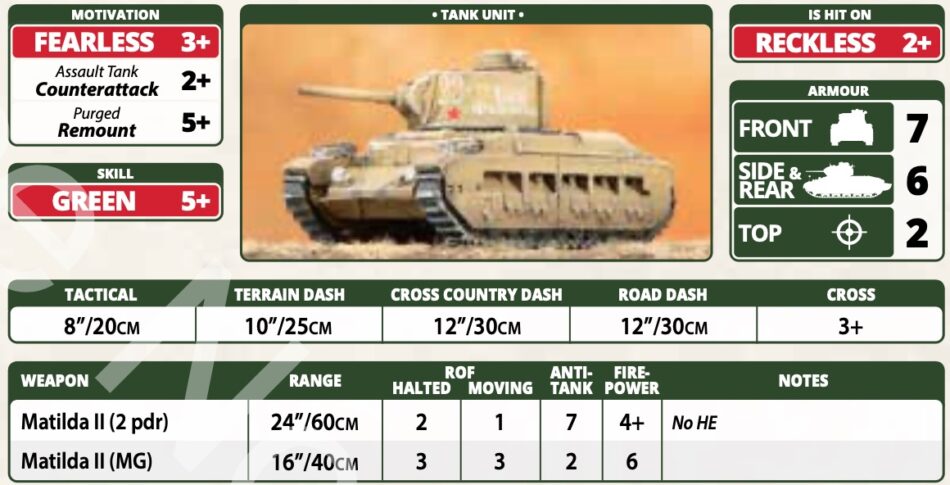
The British Matilda given to the Soviets for use is very similar to the Valentine but even better suited to an assault role. It is also one of the few Soviet tanks that does not have the overworked keyword. Having a 2+ counter assault and a two top armor, it should do very well in infantry assaults. You’ll still need to make 5+ skill rolls to destroy enemy stands, but that’s why you have lucky dice, right?
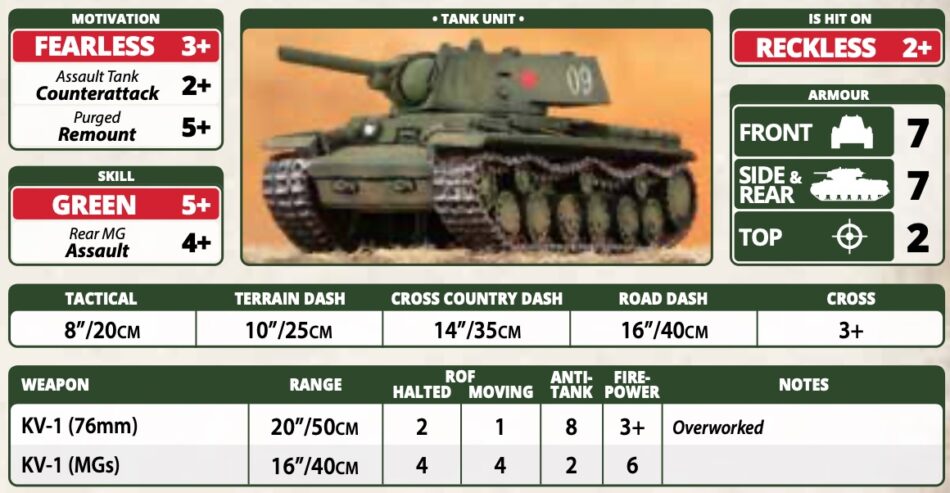
There is the KV-1, which is the less armored version that you are probably familiar with in Mid War and Late War. Still a front armor of seven plus a gun a FP of 3+ in Early War is quite good. Mix in the 2+ counterattack and a 4+ in assaults, again this is a very good tank. There is no KV-1 formation so in order to have it in your army is as a supporting unit. Brace yourself, it’ll cost you a whopping 23 points per tank. If ever there was an Early War “Tiger”, this probably qualifies.
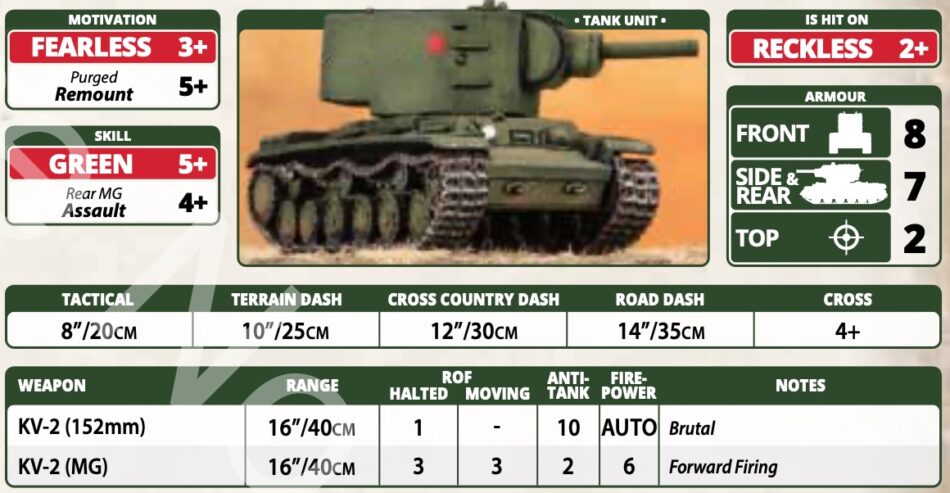
We can’t forget about the KV-2 with its 152mm gun and its antitank rating of ten. Perhaps another entry into the “absurdly” huge category, stat wise it does check out, plenty of armor to stop most enemy guns. A really big main gun, it’s fearless and a 4+ in assaults. It’s also very expensive, at 24 points per tank. It’s not able to shoot on the move with it’s main gun.
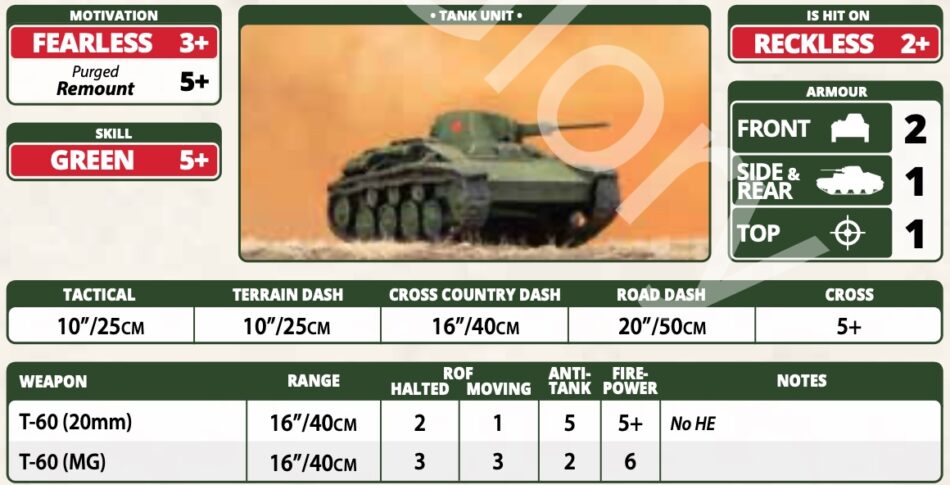
Last but not least is the T-60 a small recon tank that didn’t have a long operational history. With a 20mm gun with a low rate of fire and is No HE, as well as a 5+ cross, it is not overworked but with only an antitank of five it’s a good question how much of an impact that might have. At about 1.7 points per tank and with company sizes ranging from five to ten tanks, you’d want to consider what is this tank’s role?
Analysis
We’ve looked at 14 different tanks and that’s not even counting some of the variants. To me the best battle tank to take in numbers is either the T-26 or the BT-7. It comes down to cost in points. The BT-7 has a bit more speed and armor but otherwise they effectively the same as far a capabilities are concerned.
I think the expensive tanks like the T-34 might make for some fun one off games but I’m not sold they should be a your early war lists especially for competitive play.
The KhT-130 strikes me as an auto include unit. A fearless mobile flamethrower that doesn’t have overworked strikes me as something to try and work into my force in some number.
For an assault tank I think I’d turn to the Matilda as the one I want to field, it’s the point cost that might not fit into my budget. The T-28 would probably be my next go to.
The BT-7A looks to be a quasi reasonable selection for a mobile artillery choice. In the next article we’ll consider artillery and infantry choices that might have us having a very close look at Katyusha’s or other guns. A green 5+ skill roll is not a fun one to have to make just to bring in artillery without smoke.
Closing
Tank options for the Soviets in Barbarossa are positively plentiful with so many choices on the menu. A historical aficionado will definitely appreciate all the models Battlefront is putting on store shelves. Even if you don’t play Flames of War, these are great models to pick up for WWII Barbarossa era war gaming. A Soviet tank battalion list is a lot of tanks, and while you’ll take a fair amount of losses in an early war game, I’m confident you’ll have good odds for attacking and maneuvering stances.
Pick up a BT-7 or T-26 army box, you’ll be glad you did.