
Historicon 2025 – Let’s get medieval with the Art de la Guerre Tournament
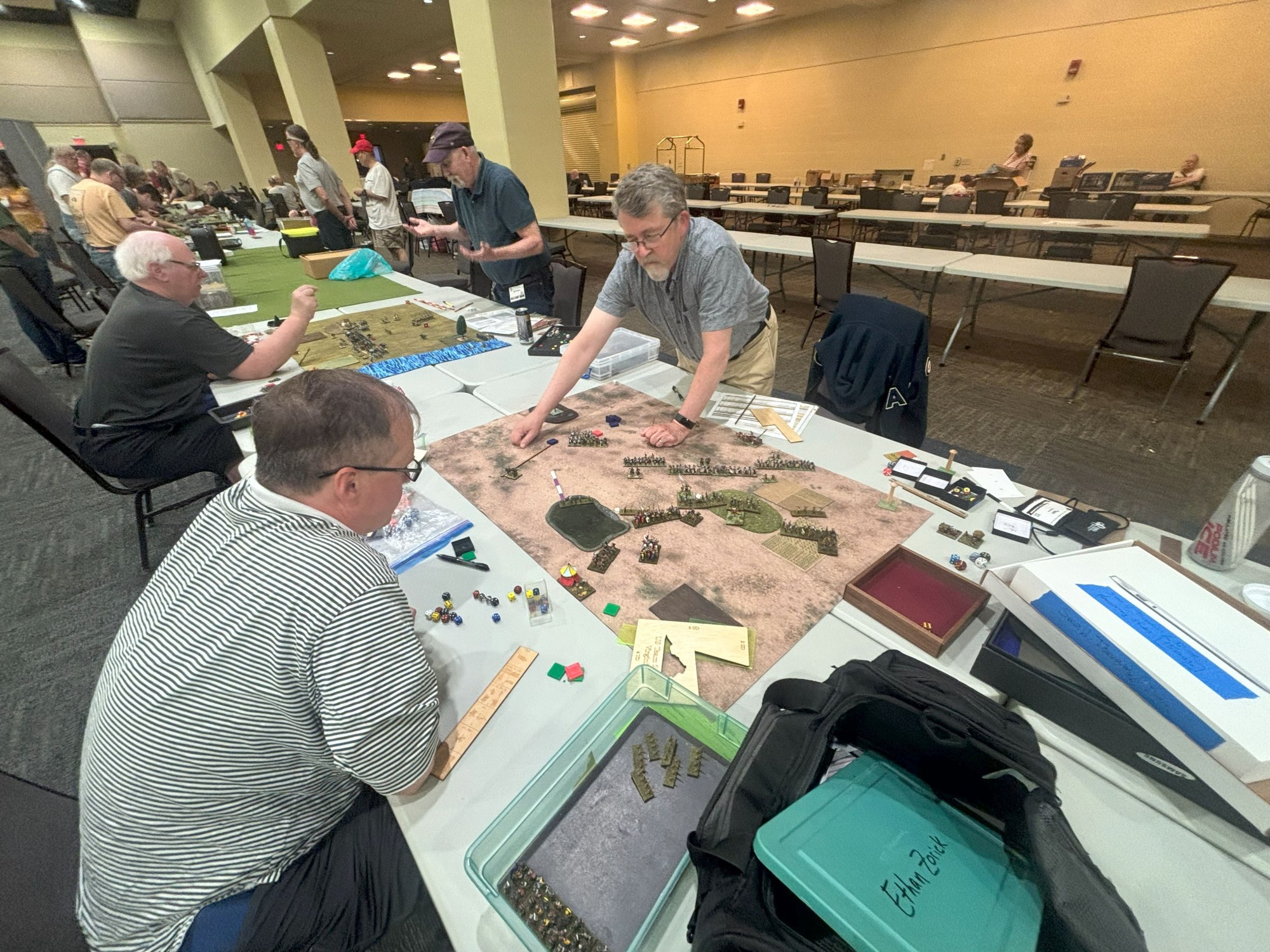
By Paolo Paglianti
When I found out I’d be traveling to Historicon 2025 for work, I took a look at the tournaments hosted at the event in Lancaster, Pennsylvania, and saw that there were no fewer than three Art de la Guerre tournaments— the 15mm ancient/medieval wargame that’s so popular both in the Old and New Worlds.
Although I played a few ADG tournaments in Italy a couple of years ago, I never really got into it too deeply, since the club I attend in Milan has remained loyal to DBMM, which—along with FOG—is something of a “parent” to ADG. But since the miniatures are the same and I have about 7,000 ancient and medieval 15mm figures at home, why not have a bit of fun?
So I asked Francesco Velotto, an experienced Italian ADG player, to help me create a list compatible with the tournament’s China and Far East theme. Here’s his list: Ming Chinese. Thanks Francesco! (Incidentally, he also works in the industry—his Fireforge is one of the best wargaming site in Europe).
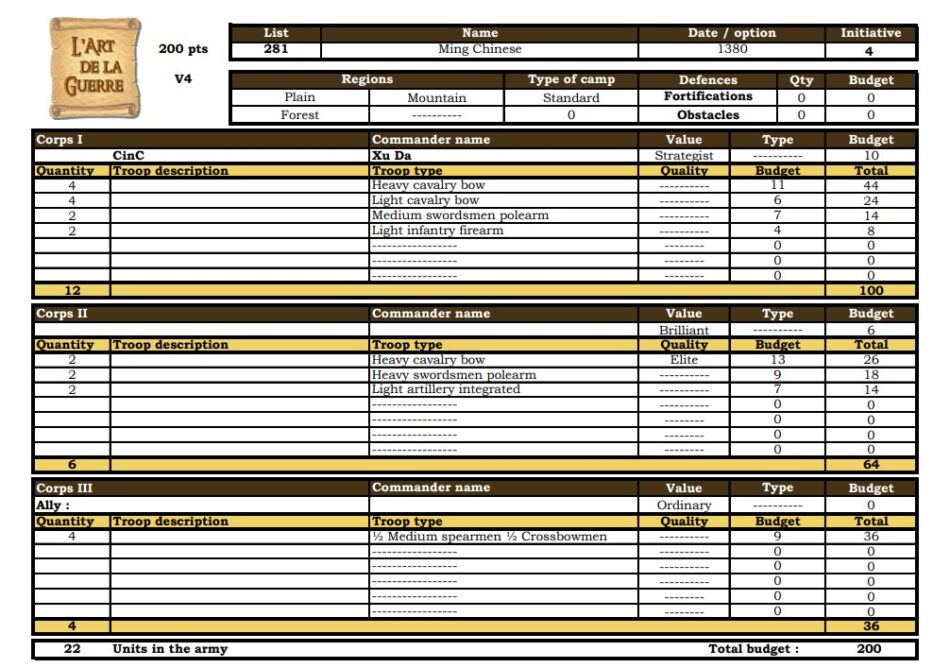
Then I gathered up my Chinese figures, added a couple of missing bases, and played a couple of prep games with my friends Lorenzo Mele and Ambrogio Carnaghi.
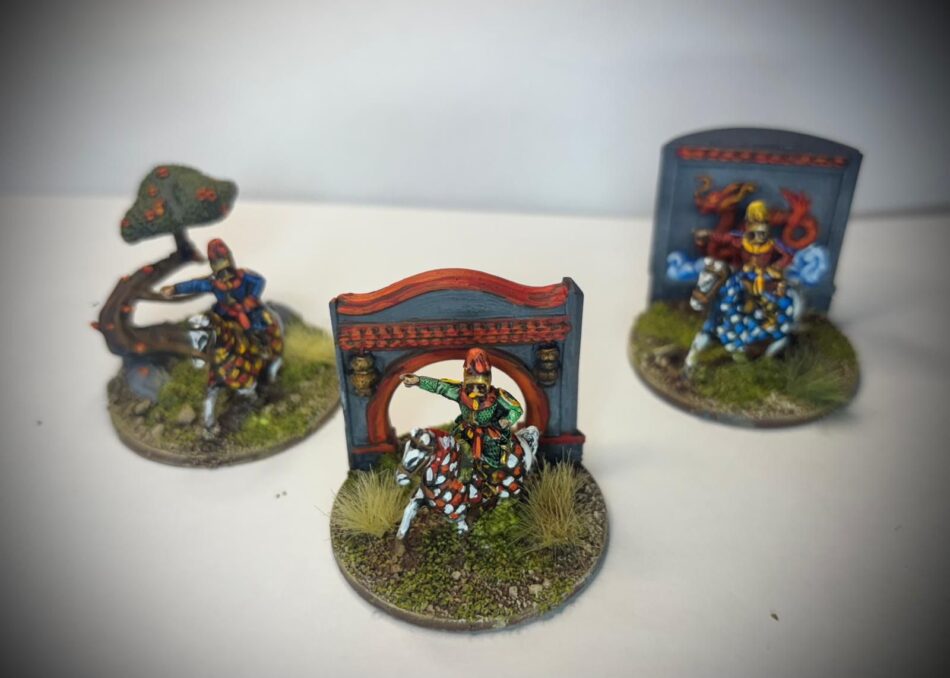
The three generals I painted for my ADG army, specifically for this tournament!
Then I packed everything up and headed to Historicon (where I also played a Bolt Action tournament, too!), with one goal in mind: not to make a fool of myself! Here’s how it went in the 26-player tournament organized by Steve Roper.
Game 1: vs. Phil Gardocki and his Koreans
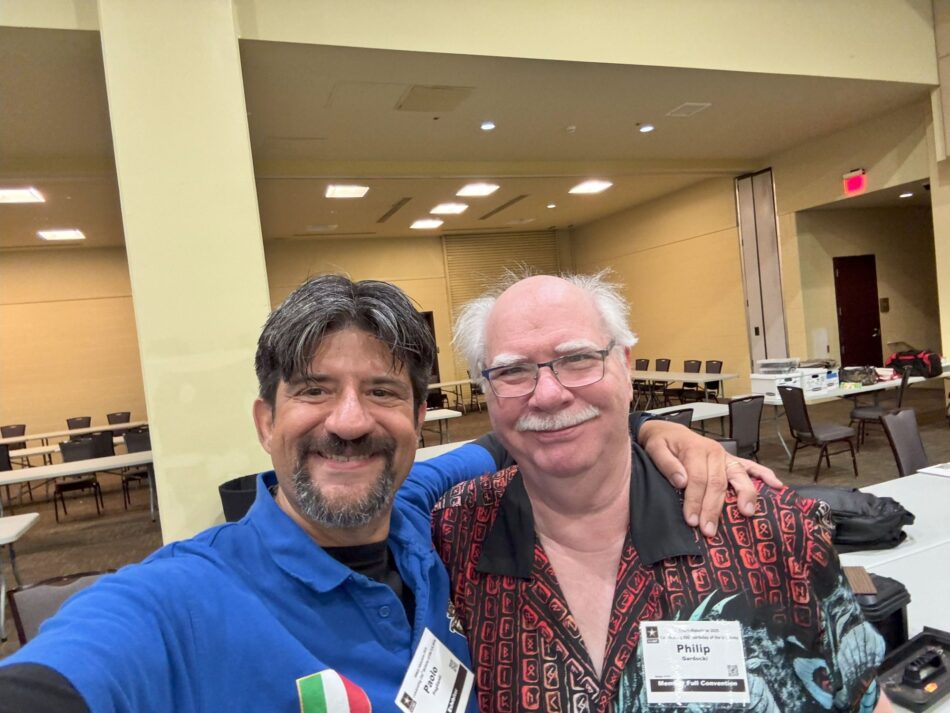
Phil is a super nice guy and also runs a blog where he writes battle reports, so it’ll be fun to compare his report with mine.
His list is very similar to mine: he has a small allied command with a couple of medium foot and light foot, a central block of six heavy foot with four integrated artilleries, and a strong wing of elite impact heavy cavalry. He won the initiative roll and obviously chose to attack.
Here’s the table after deployment:
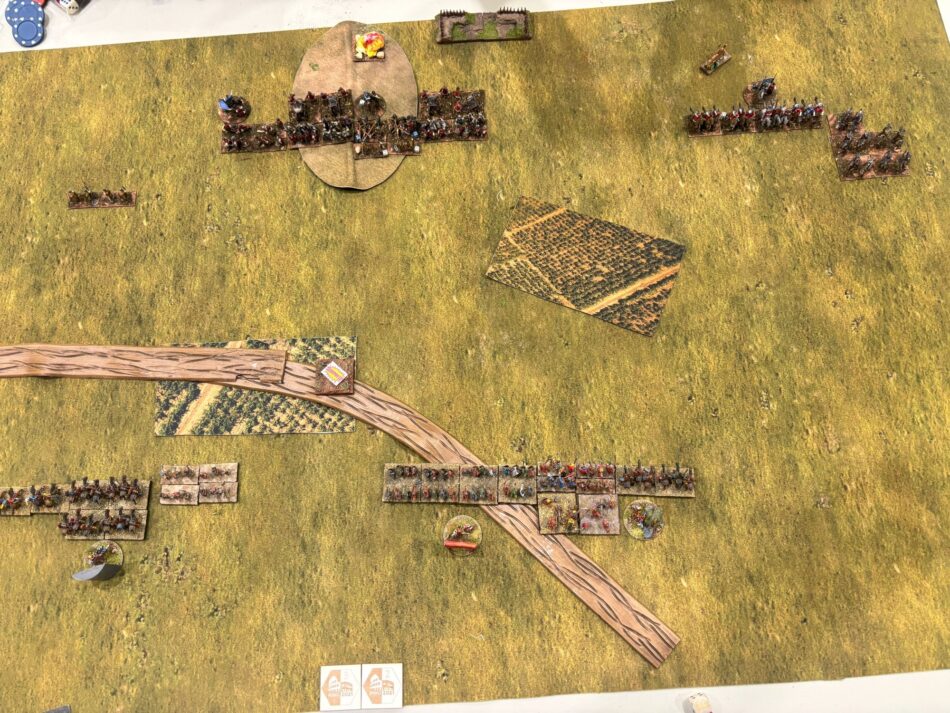
The two central terrain features are fields, which give me good anchors since Phil has no medium foot in his army. Luckily for me, his ally turns out to be unreliable in the first turn, so some elements I won’t have to care too much. Phil advances with his cavalry wing on the right and pushes his light horse as far forward as he can.
At the start of my first turn, I have to decide on a strategy. I could attack on the left, going after the unreliable ally with my cavalry wing and then trying to roll up the infantry line, leaving my right wing to its fate.
Instead, I send my LH forward to delay Phil’s infantry and start shifting my heavy cavalry from left to right, to flip the odds to 6 Cv against 4. Since the commander of the left cavalry wing is a Strategist, the plan works, while the mixed spear/crossbow medium foot approach the field on Phil’s right and secure it.
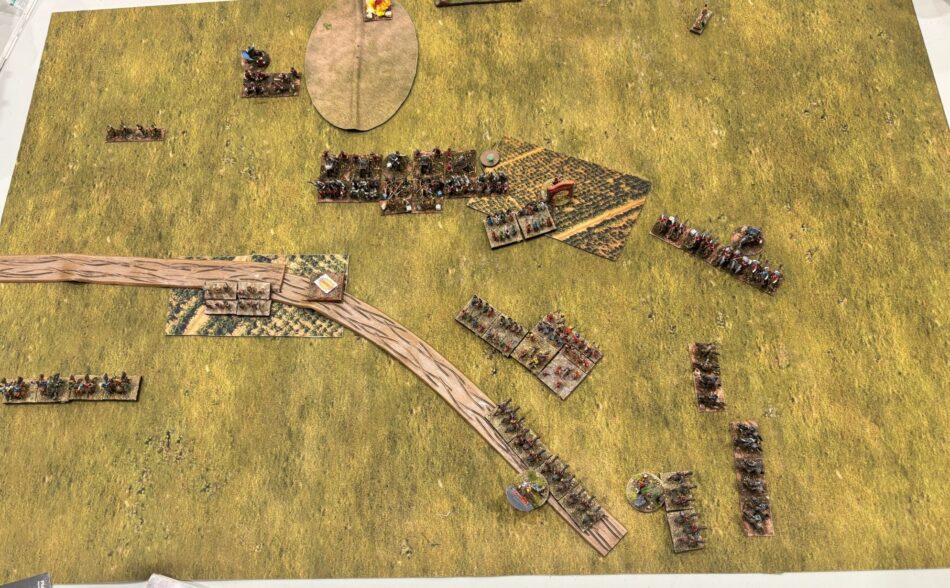
Here’s the situation after a few turns. On the right, my elite cavalry is trading blows with the light horses, while my ordinary cavalry are arriving. My heavy foot with integrated artillery are targeting Phil’s elite cavalry, and my crossbow-armed medium foot have taken control of the field and are firing on his heavy foot.
Phil goes all in and charges both my infantry and cavalry. But before reaching melee, his units suffer at least one hit each from my integrated artillery and medium foot—meaning they enter combat on even terms (the hit cancels the impact bonus). Meanwhile, to stop the fire from my medium foot in the field, Phil tries to attack them with his heavy foot.
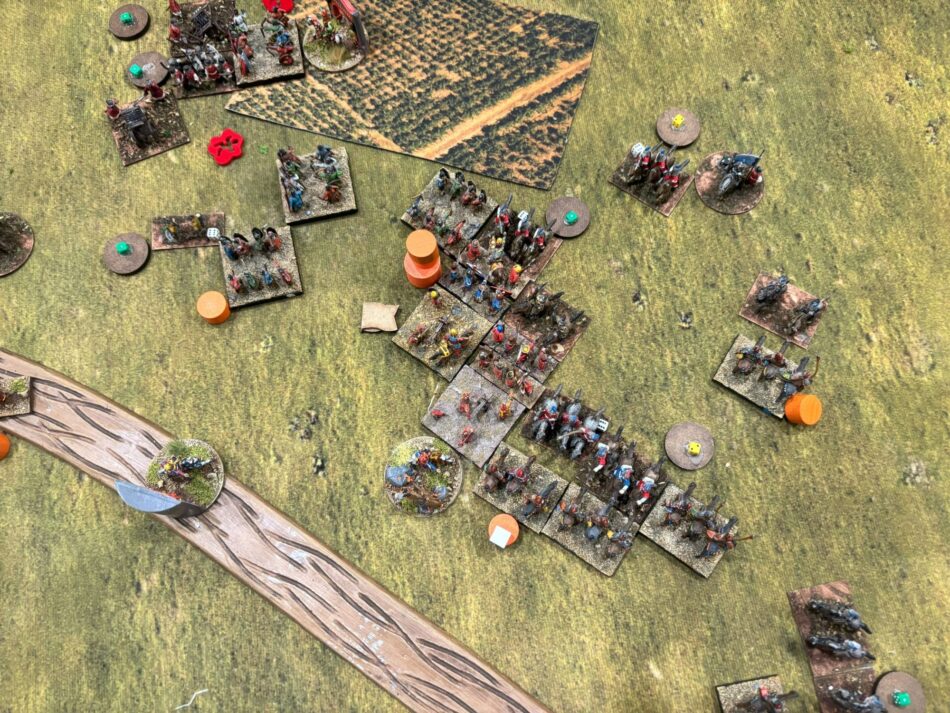
The plan worked very well: Phil’s Elite Cavalry created some holes in the Chinese line, but they are charged back by the supporting cavalry and with an exposed delicious flank on the right
Having held the first charge, I gain the upper hand in the second round of combat. With control of the field in front of us, both his infantry and cavalry lines have exposed flanks, which I naturally try to exploit. Within three turns I break Phil’s army—though luck definitely wasn’t on his side this game. Great match!
Game 2: vs. Michael Kennedy and his Northern Chinese
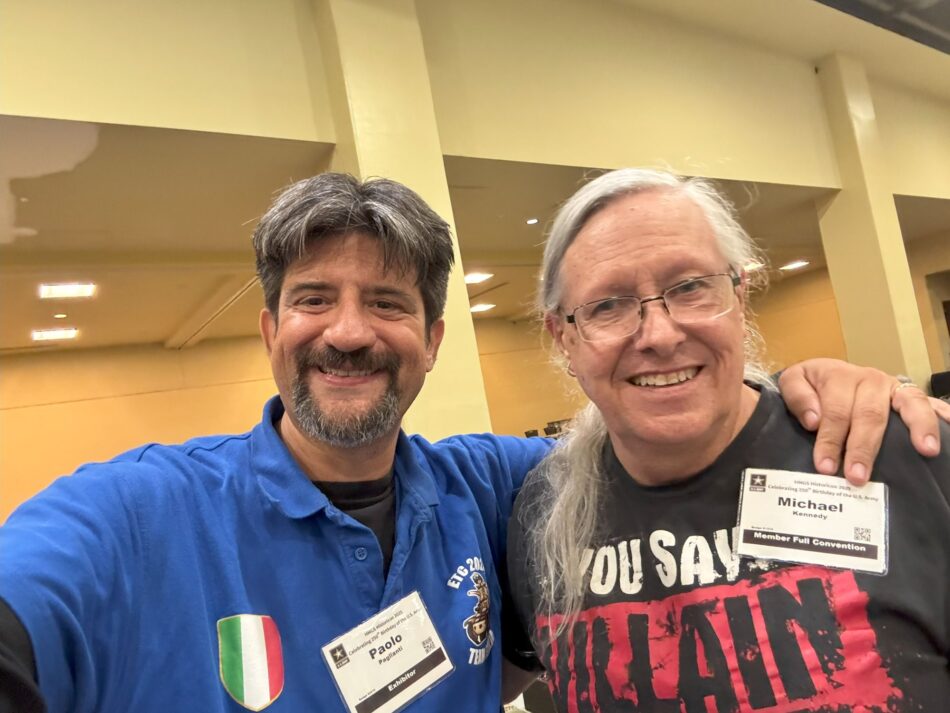
Here comes trouble! Michael, another very friendly and precise player, is fielding a Northern Chinese list, and from my DBMM games I remember how dangerous those cataphracts are! He also wins the initiative and chooses to attack. Here’s the setup:
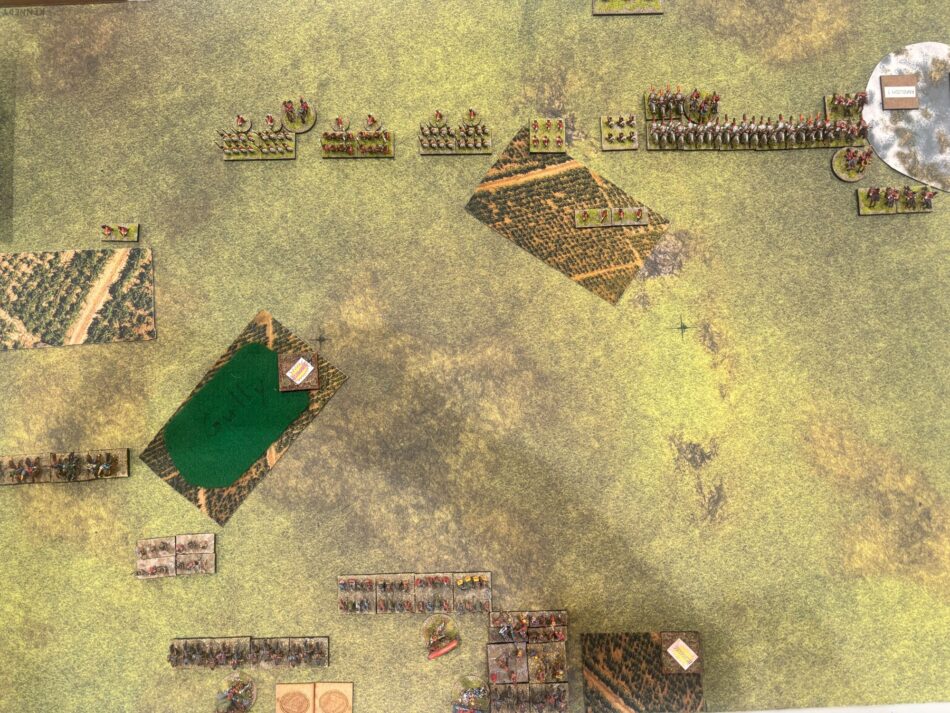
Unfortunately, I get unlucky with terrain rolls and end up with an awful plain in the center of the table—perfect for the unstoppable steamroller of cataphracts that Michael deploys on my right. In the center, he places a block of mediocre heavy foot in pairs spaced about 3 cm apart, creating a line twice as wide as the actual units. Clever tactics, I’ll copy that soon! Lastly, he has the usual mini-command of light horse on the right.
Michael’s plan is simple: align the steel wall of cataphracts and charge straight at my infantry line. My polearm heavy foot might hold, but my medium foot units have zero chance. So I decide to move my heavy cavalry to the right flank of the infantry line: if Michael punches through the center, maybe I’ll at least hit his open flank and score a few points before I collapse.
Here’s the situation after about an hour of play:
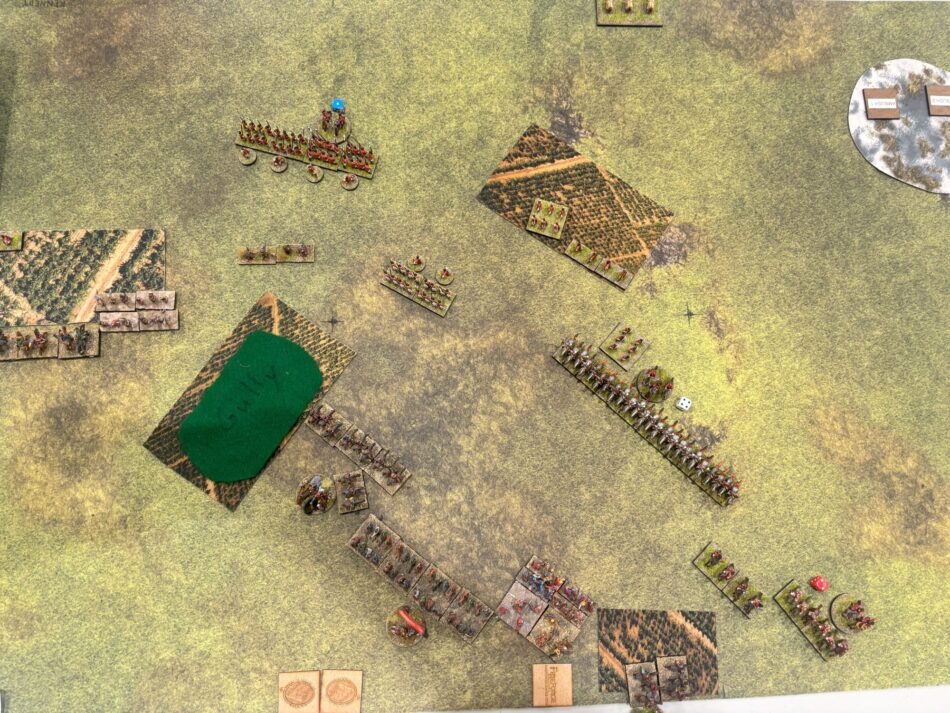
The Cataphracts are approaching fast, while my Elite cavalry has the brillant idea to enter the Field for an improvised pic-nic.
Trying to salvage the situation, I maneuver my medium foot into a small field at the base of my deployment zone. Unfortunately, being not very experienced in ADG, I mess up the movement and fail to pull my two elite Cv out of the terrain—they stay stuck in the field. One day I’ll learn!
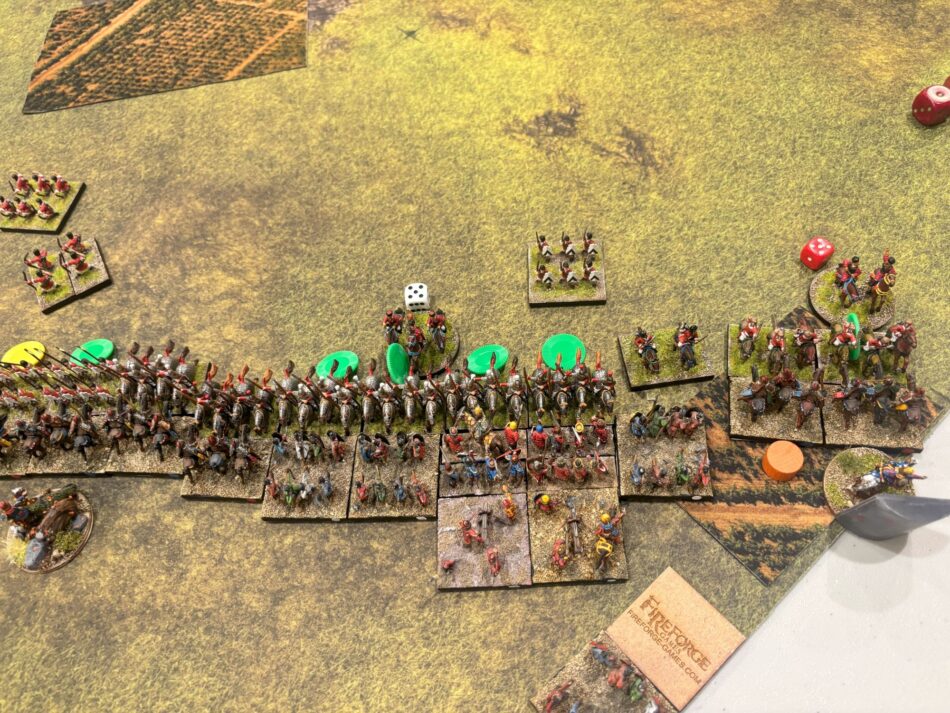
The final clash between Chinese infantry and cavalry Vs the Cataphracts. They are better armoured and armed, but suffered some disappointing hits that even the combat
Here comes the final charge. Michael’s cataphracts slam into my heavy and medium infantry, and also into my cavalry line. To protect his flank, though, he’s forced to commit some mediocre infantry. As expected, my medium foot crumble—but not before dealing some rightful damage to the cataphracts, which already had hits before even reaching combat.
My cavalry tear apart the mediocre infantry and begin rolling up the line—same thing on the right where my medium foot in the field manage to rout the LH in front of them, then flank one of the cataphracts. The match is very close, and we’re both on the edge of breaking. But before the decisive turn can be played, time is called. We stop at 50–46 (if I read the score sheet right), in my favor. Another exciting, balanced match!
Game 3: vs. Jay Stone and his Ming
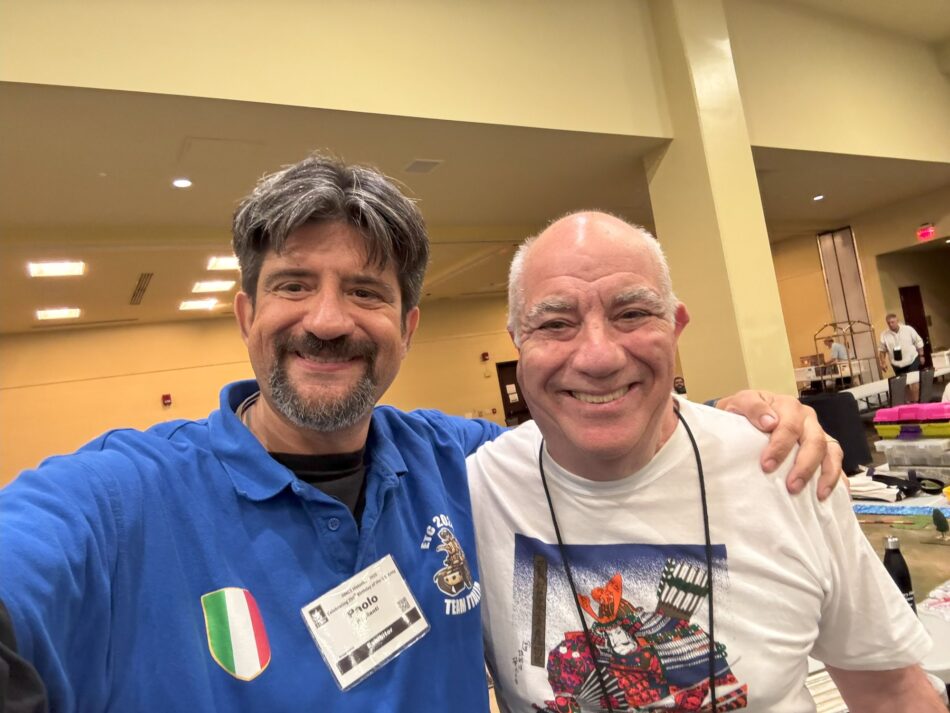
Civil War! The last match is a mirror match—Jay is also playing Ming Chinese. This time, I win initiative and of course choose to attack, since I always prefer to deploy facing the enemy directly. Here’s the deployment:
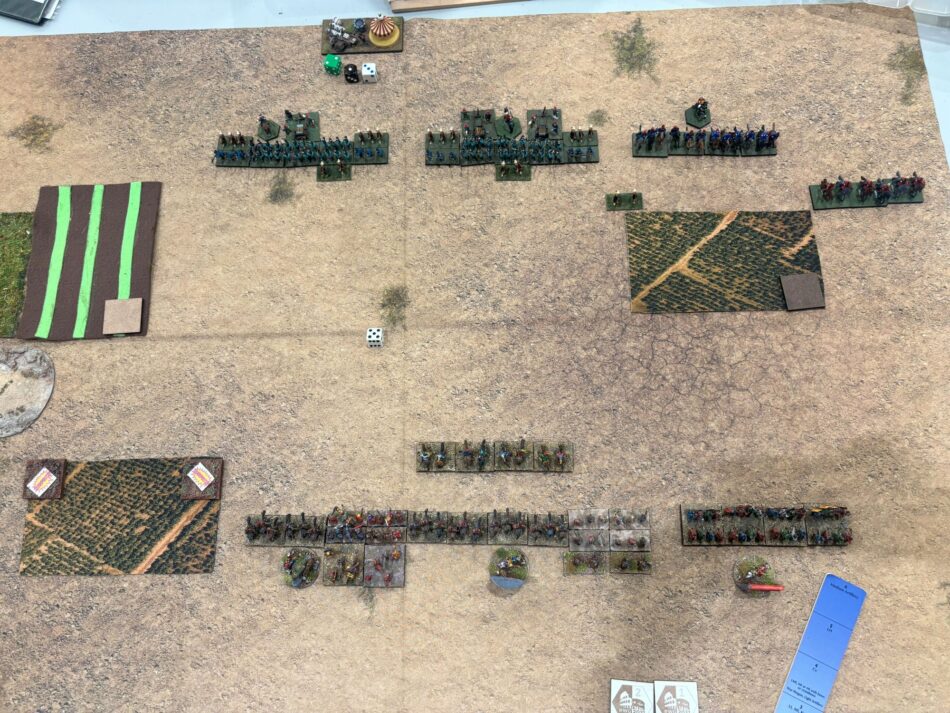
Jay’s list is slightly different from mine—he has two heavy infantry blocks and three integrated artillery units, plus a cavalry wing similar to mine. Having learned in the previous match that my medium foot have very short lifespans in open ground, I deploy them in front of the Field on the right, with the heavy foot on the left. In the center, the cavalry wing.
Since I have little chance against Jay’s heavy infantry (also polearm like mine), I decide to avoid central combat and swing around the right side, aiming to fight along the short edge of the table, near the Field in the right half. As soon as Jay sees my cavalry swinging wide, he refuses that flank.
Here’s the situation one hour into the game. My medium foot control the Field and are harassing his medium foot and cavalry, while my other units are trying to form a new line along the short edge.
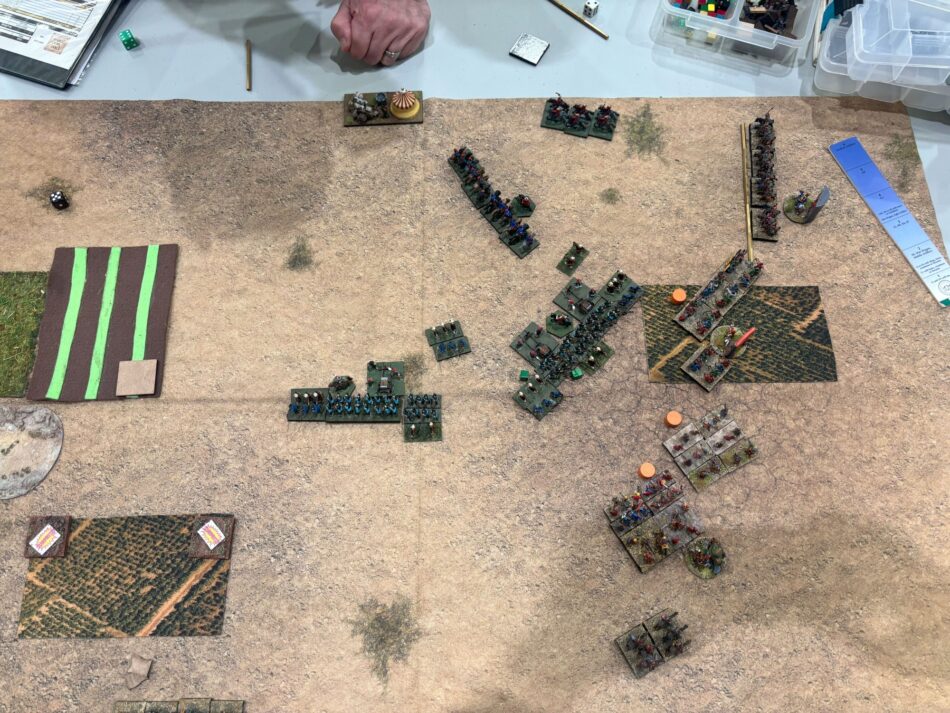
Unfortunately, things aren’t going so well: first, I make the mistake of leaving the cavalry bases exposed and not aligned with the mixed Medium Infantry, and Jay charges them with his elite troops, gaining overlap bonuses. Then he breaks my medium foot just as they exit the Field, neutralizing my attack on that flank. However, I manage to rout his Light Horse and pursue them into his camp—those four morale points will prove vital!
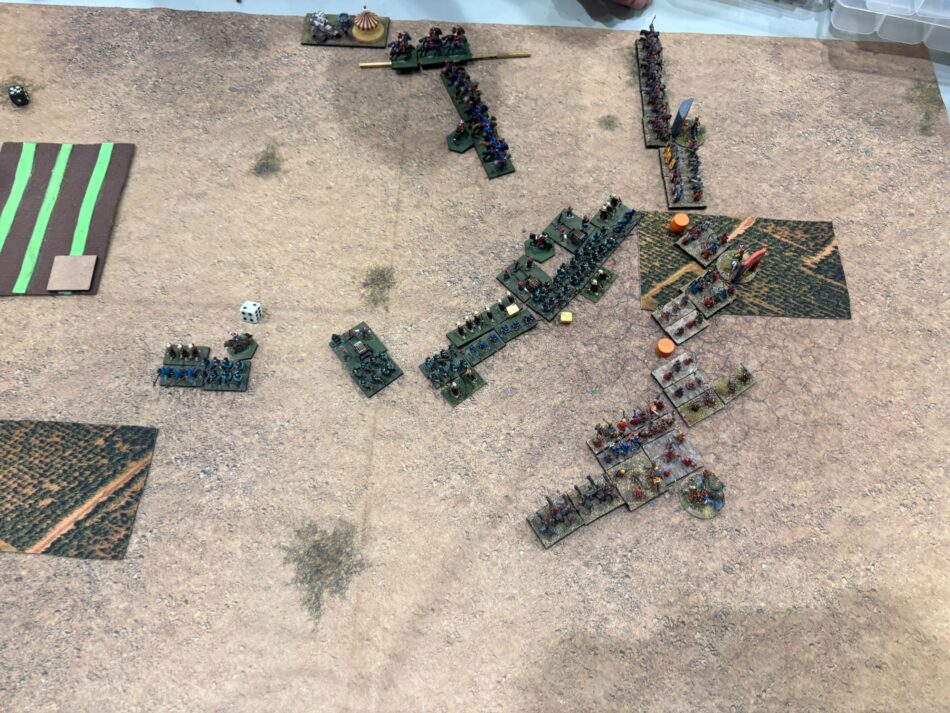
On the Field and near the edge facing my baggage, things go much better. Tempted by an initial success (and some lucky dice), Jay dares to push his heavy infantry into the Field. I counter it with my Medium Foot Swordsmen and Light Foot. A couple of lucky turns allow me to punch massive holes in Jay’s line—and when I destroy his front-line heavy infantry, it also causes cohesion loss to the integrated artillery right behind them.
We get the call for the final turn, and it’s Jay’s. Since we’re both close to breaking, he makes a couple of attacks, knowing I won’t get another turn to respond. But this time, luck is on my side—and when we count losses, I’m at 17 out of 21, while Jay is at 22 out of 22! A game played right to the final moment, with a surprise win at the end!
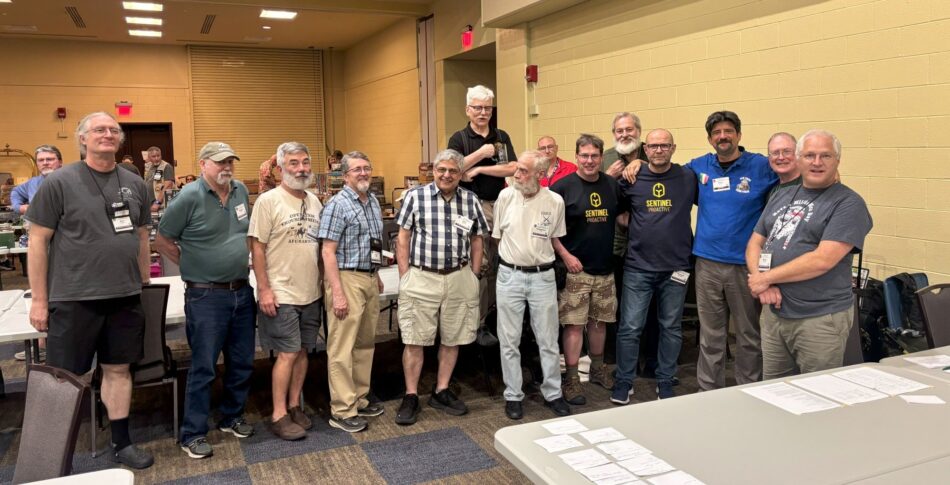
To my great surprise, I discover I’ve finished second on the podium, with two wins and one winning draw. First place goes to David Boor with Sui and T’ang, well deserved with his three victories. Here is the final classment.
| List | Units | ||||
| David | Boor | 260 | 171 | Sui and Tang Chinese | 21 |
| Paolo | Paglianti | 229 | 281 | Ming Chinese | 22 |
| Dennis | Shorthouse | 216 | 229 | Mongol Empire | 20 |
| Bill | McCampbell | 201 | 171 | Sui and Tang Chinese | 22 |
| Duncan | Richards | 201 | 171 | Sui and Tang Chinese | 21 |
| Kurt | Holmes | 200 | 175 | Tang and Five Dynasties Chinese | 22 |
| Derek | Hannan | 198 | 227 | Jurchen-Jin | 19 |
| Harvey | Denison | 191 | 279 | Yuan Chinese | 24 |
| Phil | Gardocki | 190 | 282 | Yi Korean | 25 |
| Jim | Tobin | 185 | 279 | Yuan Chinese | 23 |
| Mike | Kennedy | 178 | 119 | Chinese Northern and Southern Dynasties | 21 |
| Marc | Crotteau | 171 | 116 | Han Chinese | 21 |
| Jeff | Wiltrout | 169 | 227 | Jurchen-Jin | 20 |
| David | Ray | 167 | 171 | Sui and Tang Chinese | 23 |
| Dan | Bigelow | 158 | 121 | Three Kingdoms Korean | 23 |
| Jay | Stone | 157 | 281 | Ming Chinese | 22 |
| Brian | Cantwell | 135 | 223 | Goryeo Korean | 23 |
| Kornel | Burnacz | 131 | 171 | Sui and Tang Chinese | 23 |
| Steve | Roper | 129 | 80 | Warring States | 24 |
| Joseph | Dicamello | 125 | 227 | Jurchen-Jin | 23 |
| Brian | Caskey | 119 | 116 | Han Chinese | 21 |
| Jeff | Herzog | 108 | 223 | Goryeo Korean | 24 |
| Carl | Stefanelli | 107 | 282 | Yi Korean | 24 |
| Tom | Welch | 90 | 172 | Tibetan | 23 |
| Alan | Wright | 67 | 116 | Han Chinese | 21 |
| Tom | Hazlett | 64 | 118 | Three Kingdoms Chinese | 23 |
I really enjoyed this return to ADG: even if it’s not as deep and intricate as DBMM, it allows for much faster games (two and a half hours versus DBMM’s three and a half to four), and uses far fewer figures. I definitely plan to play in more tournaments in the coming months! The players were all nice and competent
x