
The Hungarian Sub-Optimals!
By: Phil Gurtler
I have been super excited about Konflikt 47 since I saw it on the discount shelf at my local store six years ago after first edition floundered. Now with the rerelease and the new plastic kits, I get to live the best parts of German tanks and multilegged battlemechs in one! To create my dream K47 army, I took a little bit of liberty to head cannon my own reasons for why I will be playing my favorite models. Notice I didn’t say the best units…a dozen or so games in, and I have only actually won a single game.
I may or may not also have also been inspired by the Hungarian Konflikt 47 army Warlord posted recently and the previews of the new Festung Europa Book and its lore implications. The previews showing a conquered Hungary with the exception of the area around Budapest.
News from other fronts is rare for the Hungarian people and even more rare when it’s about a defeat as colossal as the atomic bombing of Dresden. An eerie hush swept over the airways in the immediate aftermath… even the red menace seemed to wait, unsure of its next move…
But then the airways were alive once again! Reports of stunning success and new wünderwaffes turning the tide in the Ardennes filled the beleaguered Hungarian peoples with hope! Maybe these new wonder weapons would turn the tide in the east as well as the west. Less publicized to its allies, however, was the mostly silent but dramatic coup that saw the old regime in Germany replaced by the mysterious Green Vault… With the front stabilized, life returned to a discomforting quiet. But that pseudo peace was soon to be shattered by new horrors… even worse than those already seen on the eastern front.
This isn’t war. This is the end.
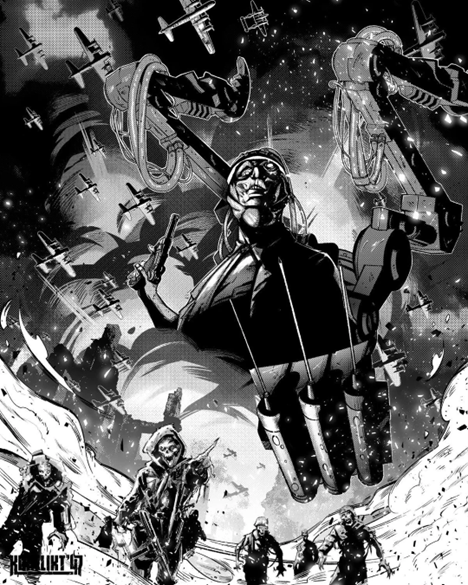
Soon enough, reports of the dreaded totenkorps, terrifying schreckwülfen, and abhorrent nachtjager were slowing making their way back to the Hungarian people. Tales of the undead devouring hapless soviet soldiers as enemy tanks were crushed into scrap by the weight of a thousand moons shocked and horrified a people who had already tried to exit the war in 1944. Even worse, the Soviets soon had their own horrors, copied from captured German examples and unleashed in Hungarian sections of the front line.
Fighting bravely, the outdated Hungarian equipment was no match for these new weapons of war, and a desperate plea was sent to German high command for assistance. Remembering the attempted coup of 1944, the Green Vault was leery of sending its most advanced designs to what many viewed as a “potentially unreliable” ally. But understanding the dangers of a weakened southern flank, the Green Vault decided to follow in the footsteps of the previous regime and make available limited supplies of their early and crude attempts at harnessing the powers of the rift. Initial attempts at mechanization involving outdated tank chassis with legs bolted on to them proved the concept was viable, and soon enough, dedicated axis walkers, built from the ground up as to better incorporate the benefits of walker warfare, were doing battle on the fields of Poland.
These modified Panzer IIIs and IVs, with their outdated chassis and limited armaments, were soon delivered to Hungarian forces in an attempt to bolster their beleaguered allies. These ersatz walkers were delivered without the new Schwerefeld Projektor weapons, for fear that the Hungarian military units might defect and take this carefully guarded secret technology with them to the soviets.
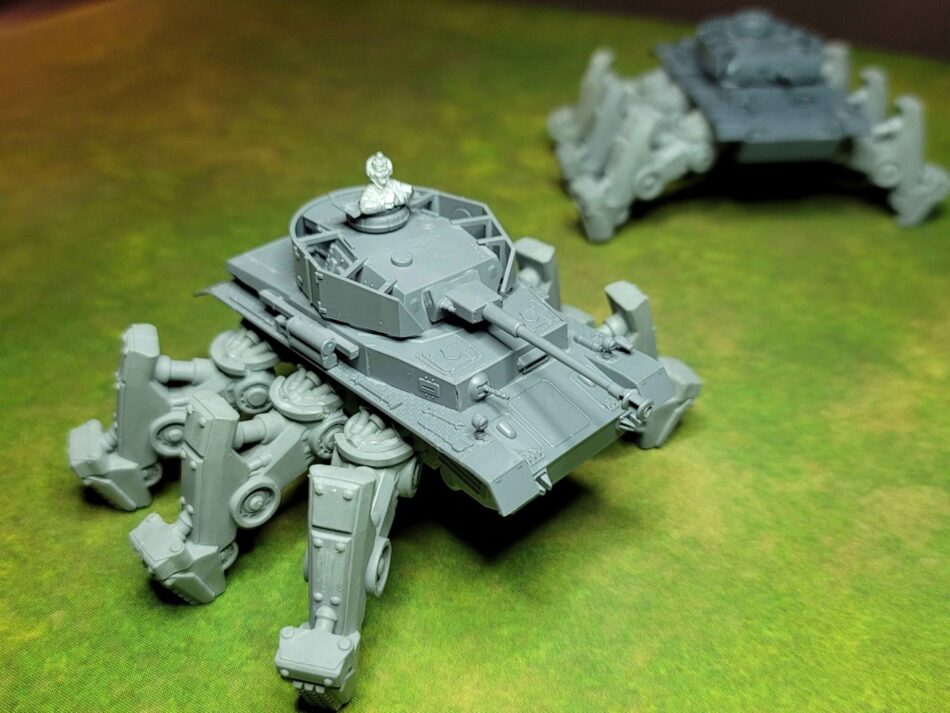
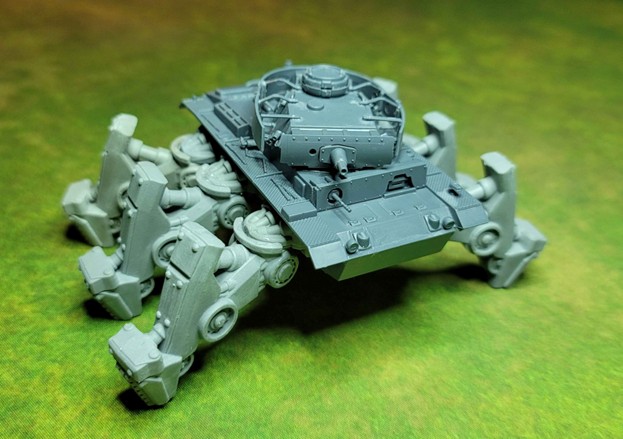
To represent this, my force is primarily equipped with two models of Panzer IV ausf. X Panzerläufer. One is the standard Panzer IV H with the 7.5cm L48, and the other is a Panzer III N with the short 7.5cm infantry support cannon. These reflect both what tanks were historically issued to the Honvéd in WW2 by the Germans, and the two non-rift options for the Panzer IV walker found in the starter set. The Panzer IV H was delivered in late 1944 and 10 Panzer III N were delivered in 1942. The Panzer III N Panzerläufer was easy to convert once I acquired some extra walker legs from the Panzer IV kit. The other reason I chose to use a Panzer IIIN is that by this late in the war, it wouldn’t make sense for the German army to be using Panzer IV F1s.
Even one of the first prototypes of the Wotan Heavy Walker was delivered and was highly valuable in the retaking of Budapest from Soviet forces. These early prototypes were just Tiger IIs modified with legs and used as a testbed for if German walker technology could support the heavy weight needed to further develop the super heavy walkers.
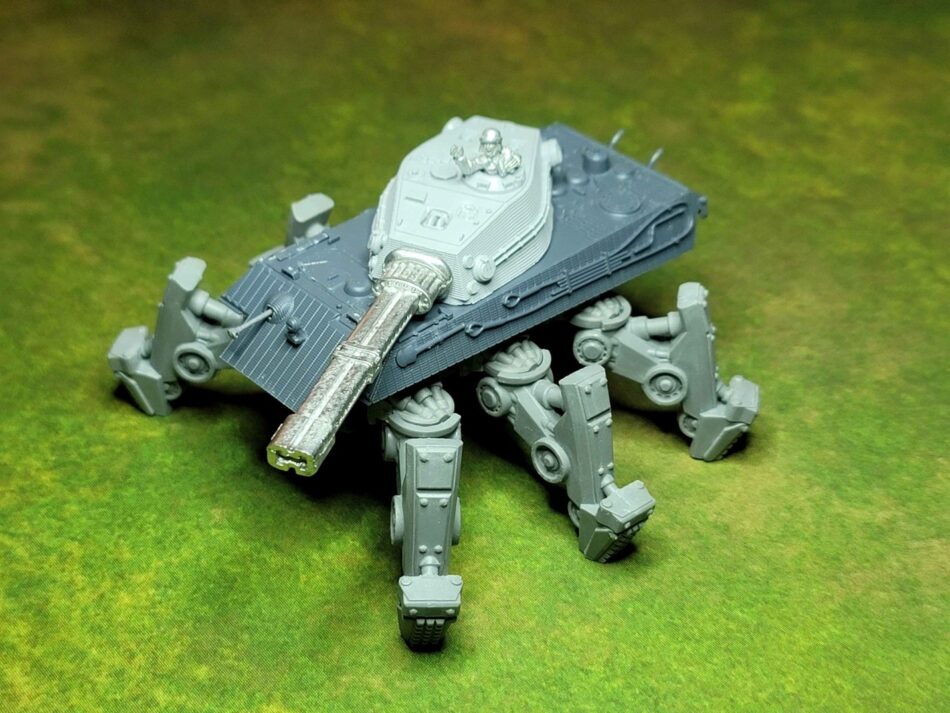
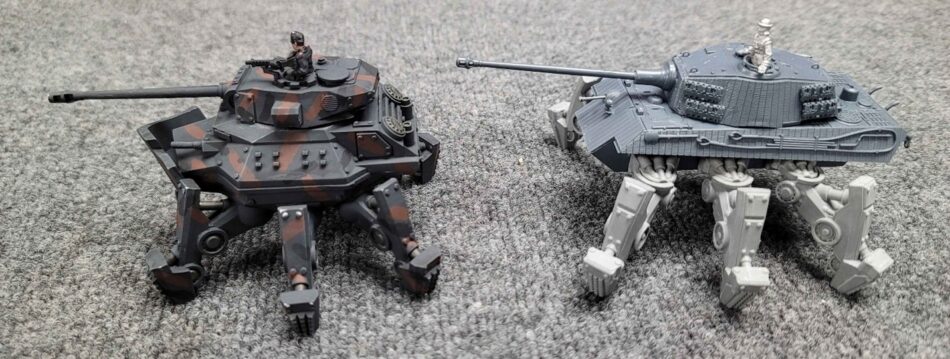
Hungary was never given Tiger IIs in real life, only 10 Tiger I Es shortly before Operation Bagration. However, at least two Tiger IIs did partake in the defense of Budapest and are deeply involved in the mythos of the siege. My paint job will attempt to recreate Tiger II 234 of the 503rd Heavy Panzer Battalion in Budapest. From a model standpoint, the Tiger II rail gun kit was an easy way to represent a DV11 Wotan with either the super-heavy AT or the railgun as it comes with both turrets. The only additional modification was to swap the ball mount machinegun with a 2.8cm barrel from the stahltruppen kit. Rules wise, this is a standard Wotan, I’m just not a huge fan of the official model and want to pay homage to the well documented use of Tiger IIs in the siege of Budapest.
But Hungarian industry did not sit idle! During the lull in the fighting, Hungarian factories were rebuilt and domestic arms production was renewed. With the rebuilding of the Manfréd Weiss factory, which was responsible for domestic production of a modified German Kwk40 7.5cm gun, the original plans for the Zrinyi I were dusted off and they were soon seeing service with Hungarian assault gun divisions.
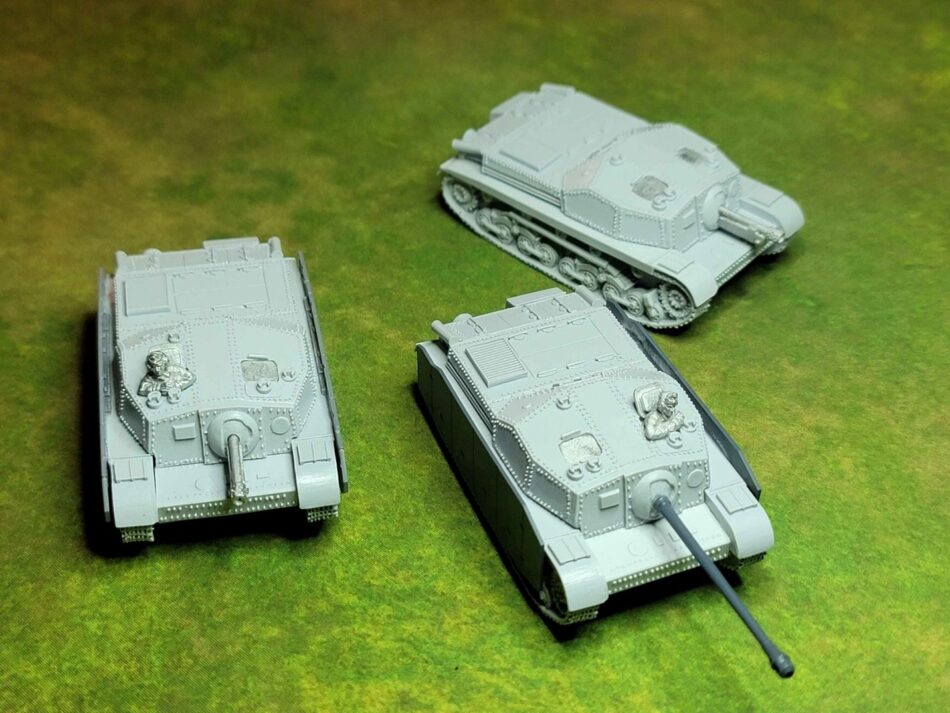
I ADORE the Zrinyi, so having an excuse to build a Zrinyi I was too good to ignore. Simple conversion, just swapping the 105mm howitzer with the extra 8.8cm barrel from the Tiger II kit previously mentioned. The Zrinyi I is played as a late model StuG and the Zrinyi II is played as a StuH. Both options come from the Armies of Germany Book.
Lastly, in an attempt to emulate the success of the German Vogelspine, Hungarian industry began to build their own panzer walkers. Starting small, they used the hopelessly outdated Toldi IIa as a basis for their own light walkers. While largely successful as a first effort from an economy with limited heavy infrastructure, the “Toldispinne” was still limited by its armament and the fact that it was larger and less conspicuous than the Vogelspinne it was trying to copy.
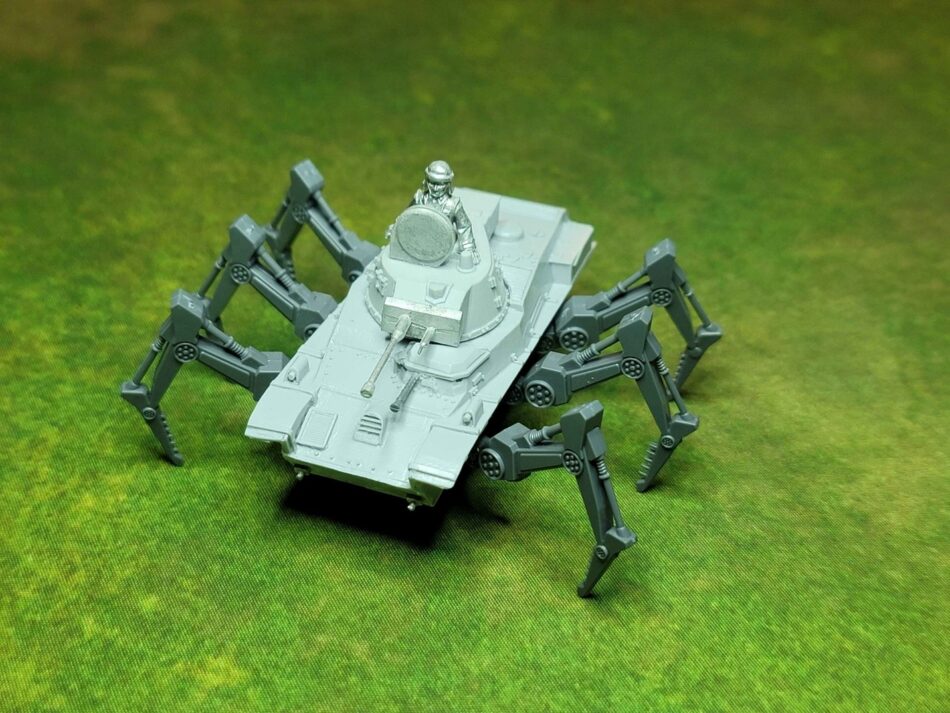
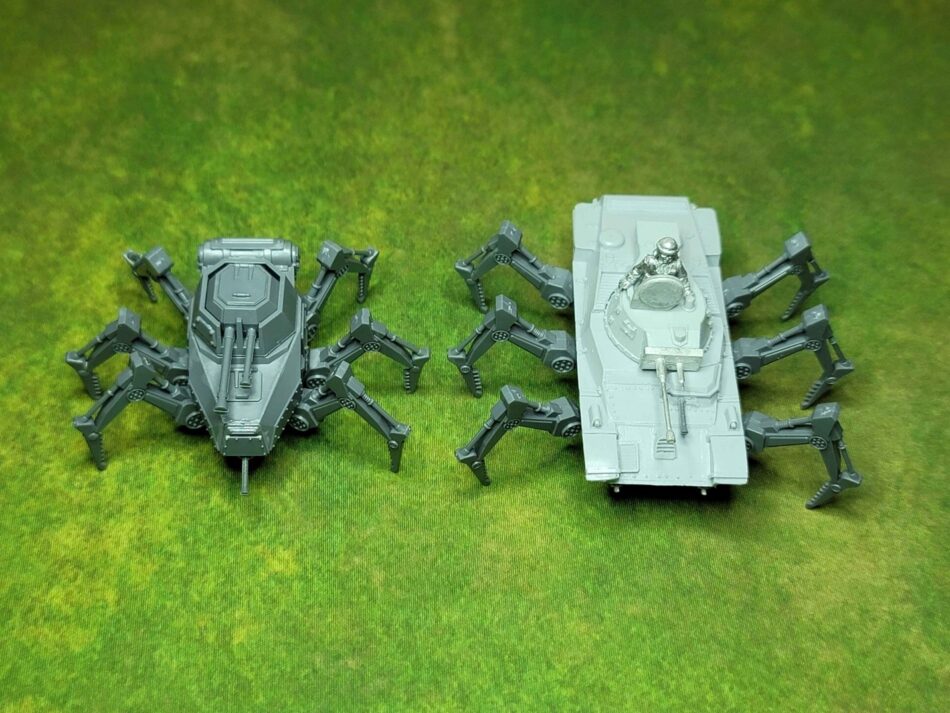
Hungarian Armor during WWII was often seen as impressive given the limitations of its industrial base, but it just simply wasn’t able to mass produce on the Soviet scale, or specialize on quality like the German economy was and I wanted to represent that with a light walker based on the Toldi as a reasonable first effort at domestic walker production.
This was a fun little conversion, nothing too crazy, just drilling out the hull so that the ball mounts on the Vogel legs would rest neatly and glue easily. The basic loadout for the Vogel is a light AT and Light Autocannon, which the Toldi IIa kit closely resembles and the only other change was to drill out an MG port on the side of the driver’s position to give it the hull MG from the actual Vogelspinne. Like the Tiger II from earlier, this is a situation where I am modeling for disadvantage as the Toldi is a good inch or two longer than what it is proxying.
In addition to armored vehicles, the Green Vault delivered limited amounts of Grade II power armor, which were issued to the elite assault troops meant to follow closely behind and support the Zrinyi IIs.
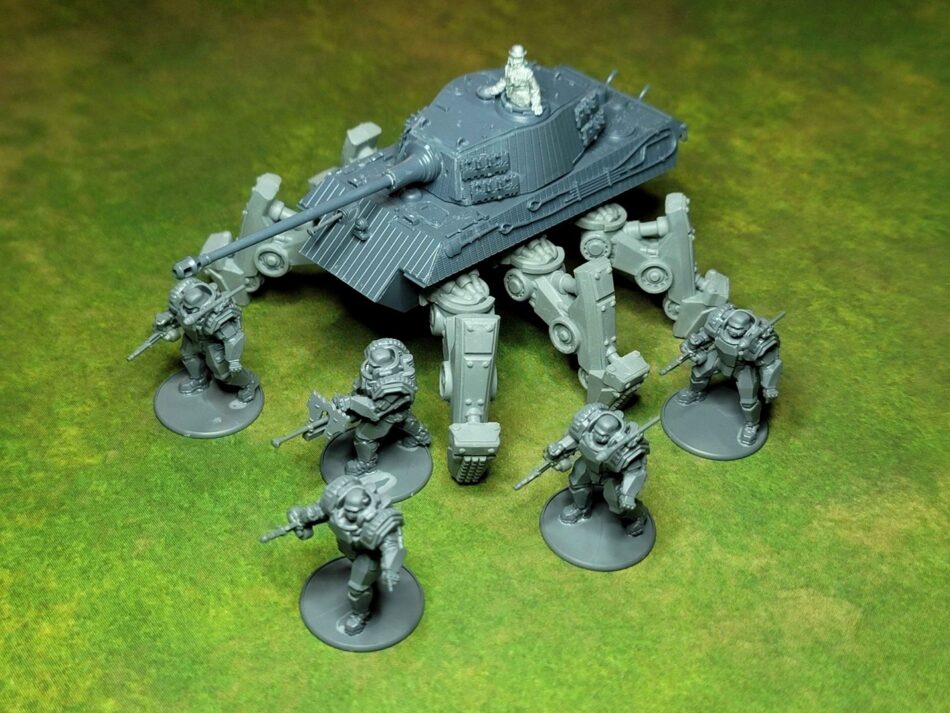
The starter sets all come with stahltruppen… so I have a lot of them. I am also an unabashed fan of superheavy, terminator type, infantry, so I am not too mad about that. But these are supplies that I would consider as too important for the Green Vault to give the Honvéd enough to equip all of their troops. As such, I limited it to one unit of them. I did give them all MG42s as the Honvéd never adopted the sturmgewher or 7.92x33kurtz but did have production capability for 8mm Mauser and was using the MG42 extensively by the end of the war.
The 1st Parachute Battalion also saw the fruits of Axis rift technology, being equipped with German kontragravitation harnesses. This elite unit was rebuilt after suffering a nearly 50% casualty rate during the siege of Budapest. Their maneuverability and skill in close assaults and urban clearing were instrumental in the retaking of their capital city a few years later.
I wanted to limit my usage of stahltruppen and I always found the history of the various paratrooper forces that never actually jumped into combat interesting. I chose to use the Italian Falco models verses the fallschirmjägers for much the same reason I didn’t give thesStahltruppen the STG. Also the Beretta Model 38 is a much closer visual match to the Hungarian 43M, which is what Hungarian paratroopers were actually issued.
Unlike the drastic changes the Green Vault imposed upon the German Heer, turning it into the Volksarmee and relabeling Panzergrenadiers as Volksgrenadiers, the Honvéd changed little in its organization. They were too busy with the near complete rebuilding of the 2nd Army and bringing both the 1st and 3rd armies to the same standard as the 2nd. That said, the poor bloody infantry, issued with the same small arms that they started the war with in late 1940, still make up most of the fighting forces of the Honvéd.
The Szent László Division is a very interesting unit. Formed late in the war, it was a division made from whatever scraps could be pulled from other units from the army and airforce. It was often viewed as one of the most elite Hungarian units due to its absorption of the 1st Para Battalion mentioned above. Because of its status as a more elite unit, created from mostly veterans of previous battles, I used the Hungarian Parachute Assault Section as my “volksgrenadiers.” This also lets me represent the transition from early war rifles to late war SMGs, MG42s, and panzerfausts as the kit from Warlord contains a healthy mix of all 4 weapons.
Seeing a potential for a future manpower shortage, the Green Vault also offered Hungarian high command 9 battalions of Totenkorps. But the Hungarians, always a superstitious people, viewed them as an affront to their religious beliefs and politely declined. Even going so far as demanding they never are deployed on Hungarian soil.
I’m a mech and superheavy infantry guy, the zombies and mutants are cool but just don’t do anything for me, even with the new release. I am waiting for a proper Romanian Vampire army using the Count though.
With these new weapons and backed by the dark powers of the Green Vault, Hungarian high command hopes to save their nation and people from the red horde descending upon them and just maybe survive the end.”