
Liberation of Italy: British and Commonwealth Forces
By Richard Steer
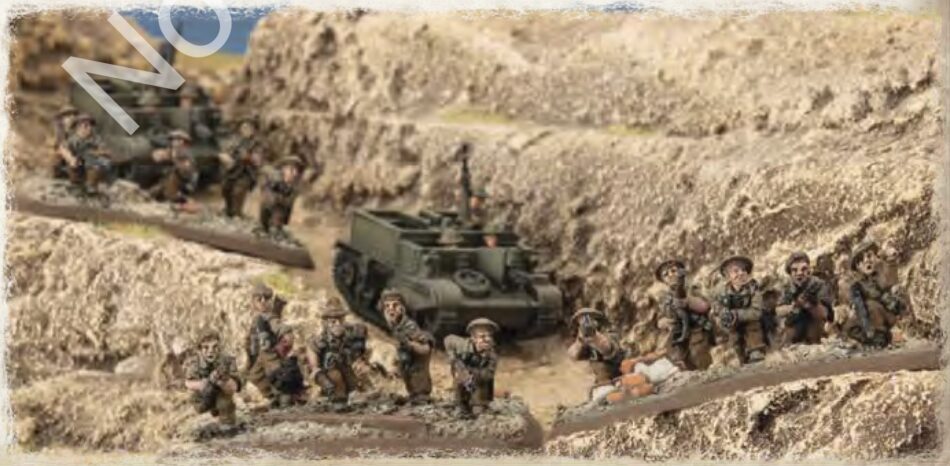
The Italian Campaign has finally arrived in the 4th Edition of Flames of War with Battlefront’s announcement of Liberation of Italy. Paolo has given us an overview of the book and its historical context, and in this article, I will dive a bit deeper into the book’s British lists.
The Italian campaign ran from 1943 to 1945, which spans FOW’s Mid-War and Late-War periods. The first 4th Edition Late-War book, Fortress Europe (2019), provided an early bridge between the two eras by giving a rough approximation of the units in the theatre in early 1944. Liberation of Italy completes the story by expanding those lists out to cover the period through to the end of the war.
The Core Formations
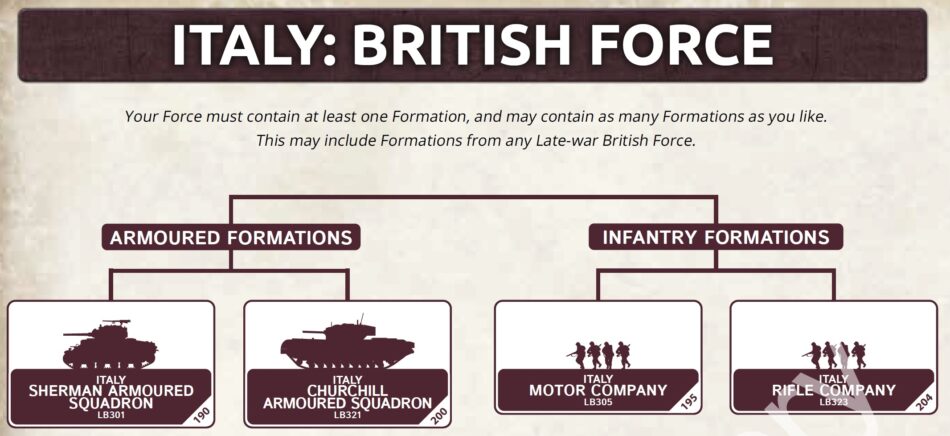
The core formations are relatively basic, with Sherman and Churchill squadrons, and Motor and Rifle infantry companies being the same options as in Fortress Europe (2019). Any formations from any Late-War British books can also be used, with the book specifically suggesting the Parachute Company and Commando Troop from D-Day as historical options.
Italy Sherman Armoured Squadron
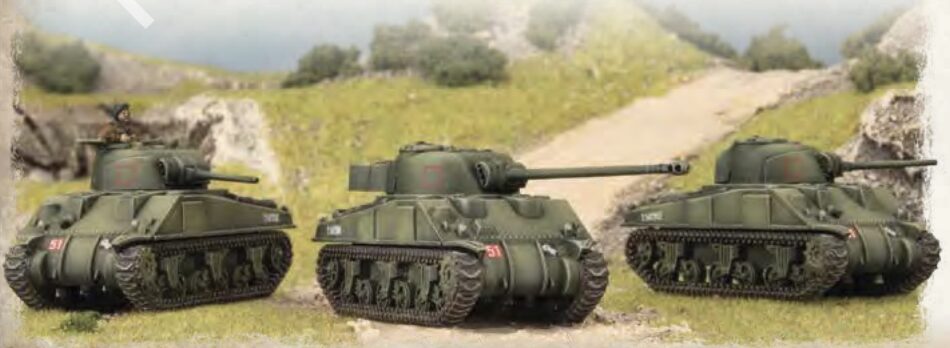
The Sherman Squadron has the standard British structure of Squadron HQ, two to four Sherman Troops with a mix and match of 75mm, 76mm, and Firefly Troops, and an optional Stuart troop. The Squadron HQ can replace up to two tanks with Sherman 105s.
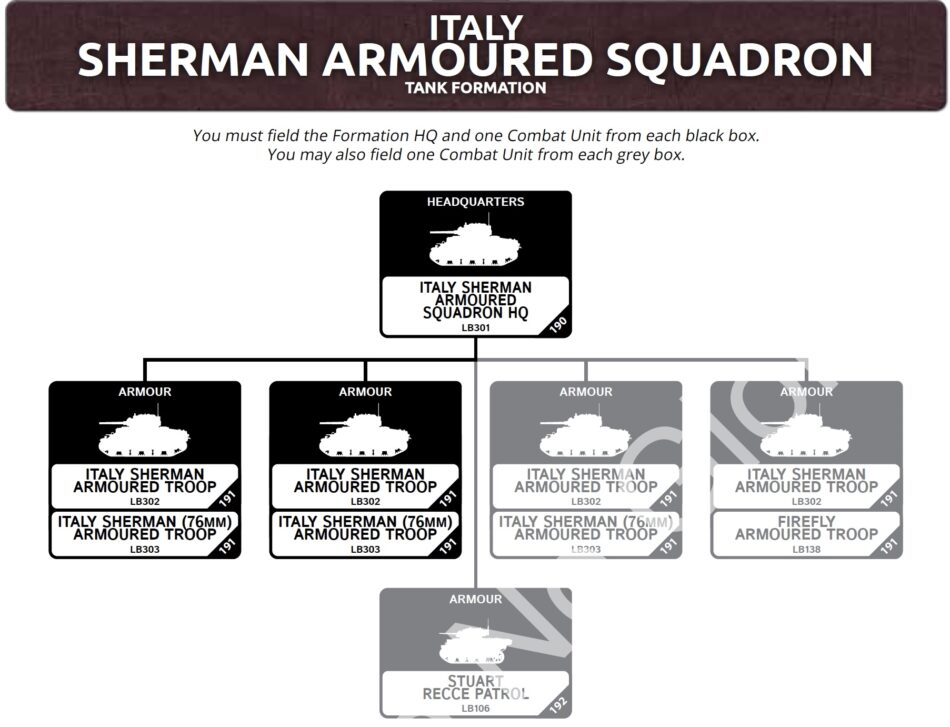
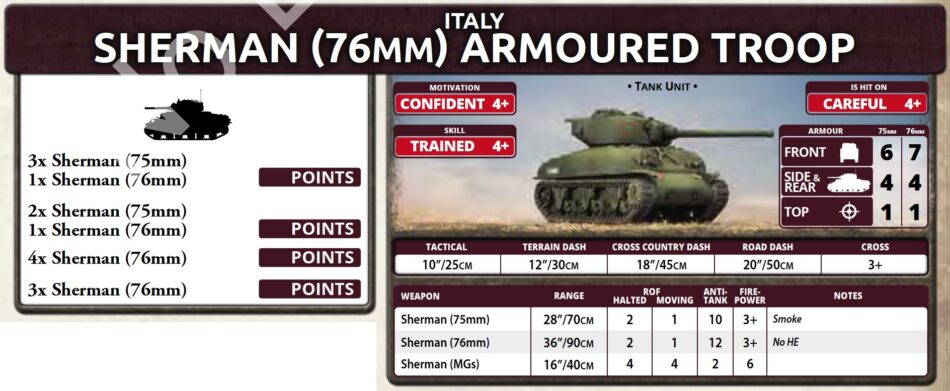
The Sherman 76mm is a welcome addition, previously only being available through the Polish armoured squadron command card in Bulge: British. Now it is a black box unit with Front 7 and Anti-tank 12 at a cost of 1-point per tank more than the Sherman 75mm.
The unit structure can either mimic the standard troop with a 76mm in place of the usual Firefly, or as a pure 76mm troop with three or four tanks. Given the amount of Front 7 in the Late-War era, having access to Anti-tank 12 is useful. The downside is that the 76mm has the No HE rule, meaning that the Sherman 75mm, much like in real life, is likely to still have a role.
Italy Churchill Armoured Squadron
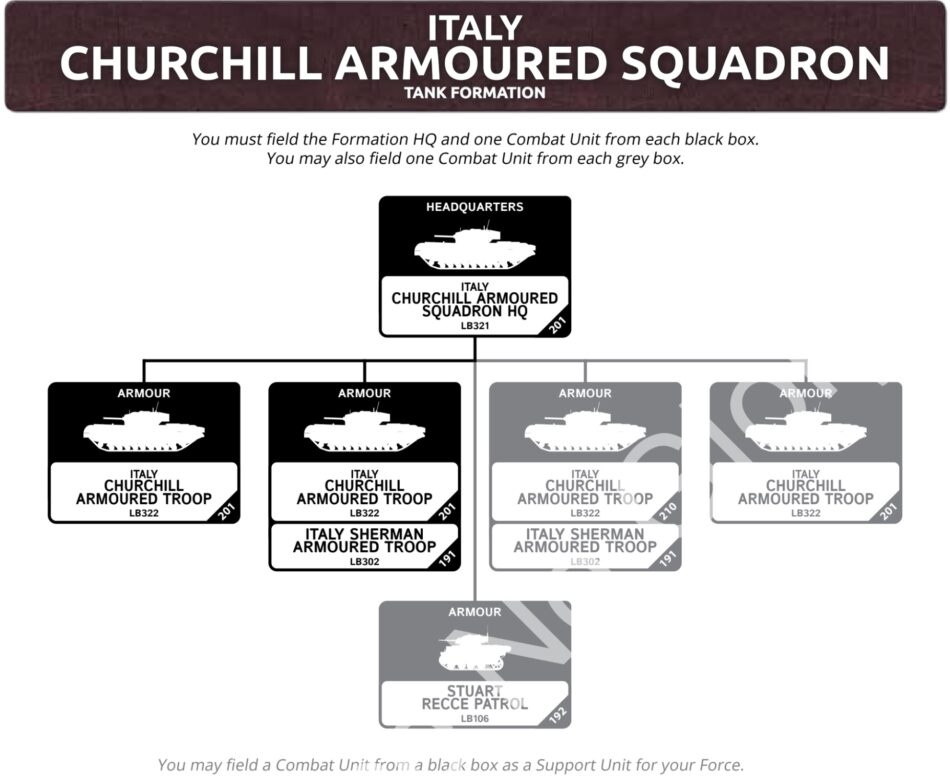
The Churchill Squadron now has more options than it did in Fortress Europe. While the overall structure is the same, the Company HQ can have either up to three 6pdr tanks, or a mix of 75mm and 95mm tanks. Similarly, the Churchill troops themselves offer a mix of 6pdr tanks with armour 8/7/2, or the 75mm version with armour 9/8/2.
The Churchill 6pdr is the same price it was in Fortress Europe, which feels underpointed, and I wouldn’t be surprised if this gets adjusted in the next round of Dynamic Points.
The Infantry: Rifle and Motor Companies
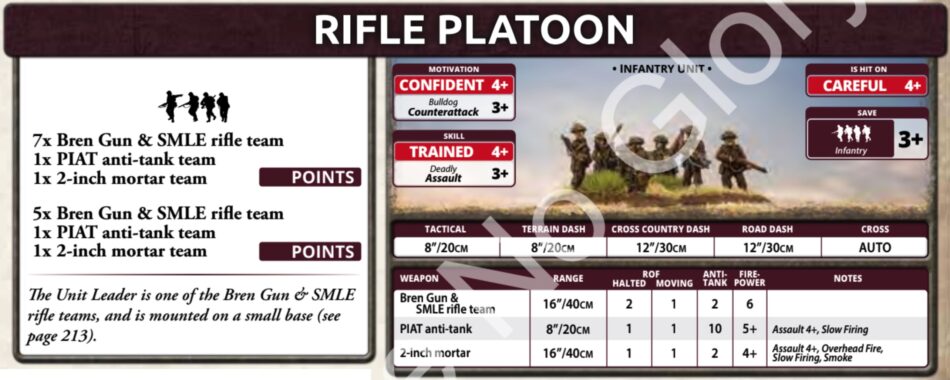
Both the Rifle Company and Motor Company are identical to those we have seen in Fortress Europe. The infantry units are Confident Trained Careful with improved assault and counterattack stats, and do not have the Rally 5+ that the infantry from D-Day and Bulge have. The formations don’t have the option of including Wasps or MMG carriers. This gives you an interesting choice when building a force: take the Italy infantry for their slightly better morale, or the D-Day/Bulge infantry for the additional equipment.
Support
Most of the options in the support tree are units that we have seen before. One interesting note is the Allied Support box. As well as the usual text that says that you can include one black box unit and one formation from US, French, and CIL Italian forces, there is a second sentence that effectively allows you to take a second Allied black box unit from this book.
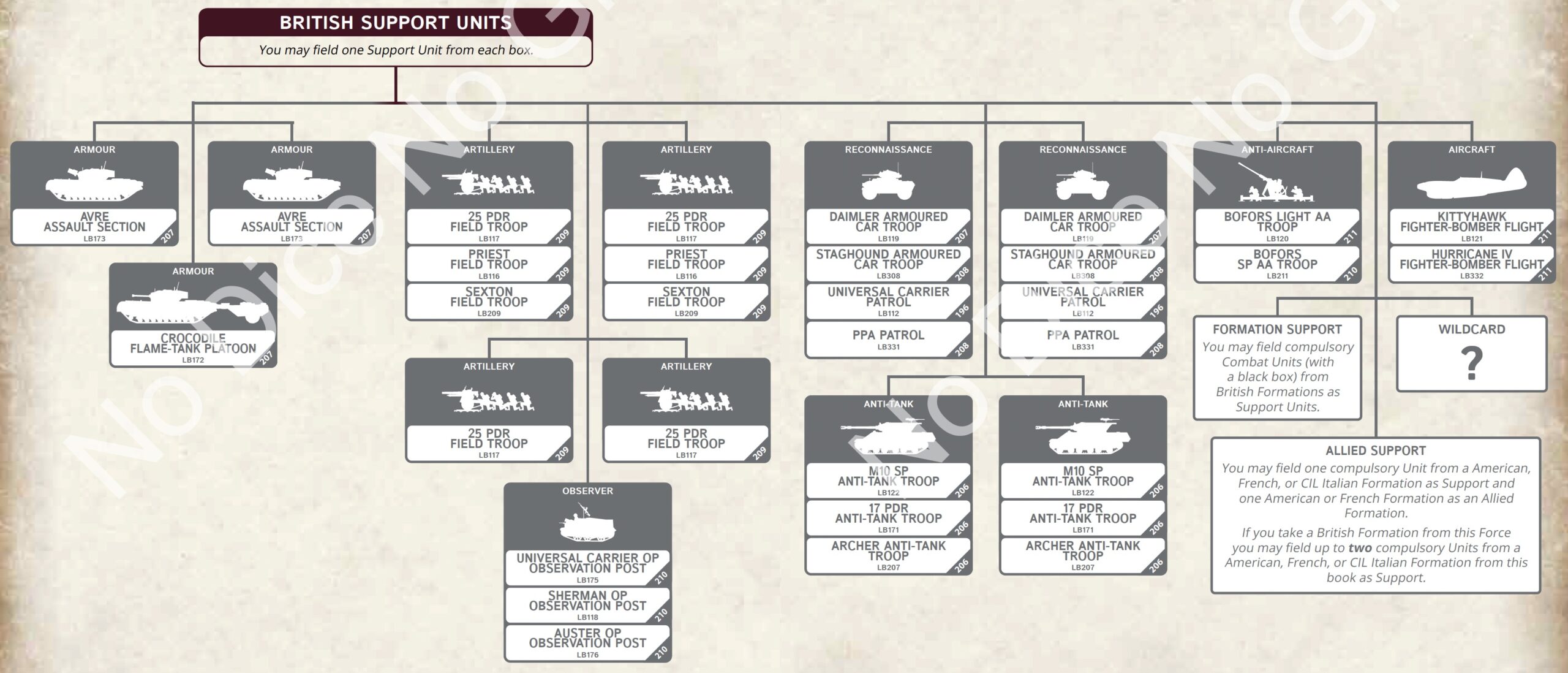
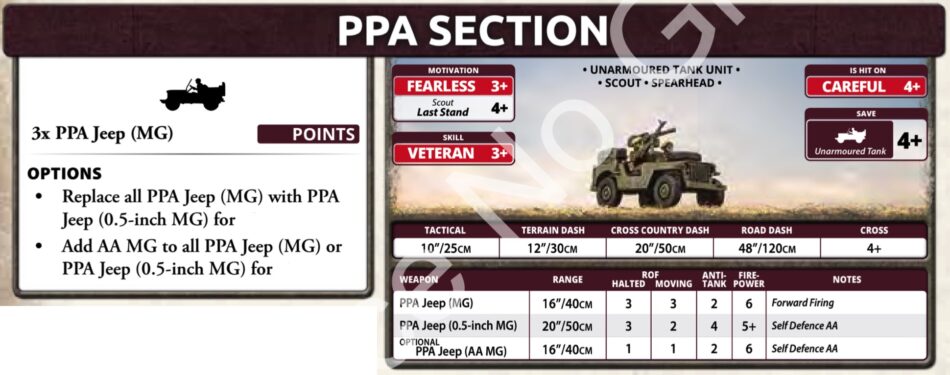
The new units are the Staghound armoured car (previously only a Command Card in Bulge: British), the recce jeeps of the PPA Patrols, and the Hurricane IV fighter-bomber with rockets.
The Command Cards
I consider the Command Cards to be essential for getting the most value out of the book. They take the basic core formations from the book and expand them to represent the variety of units that fought in Italy.
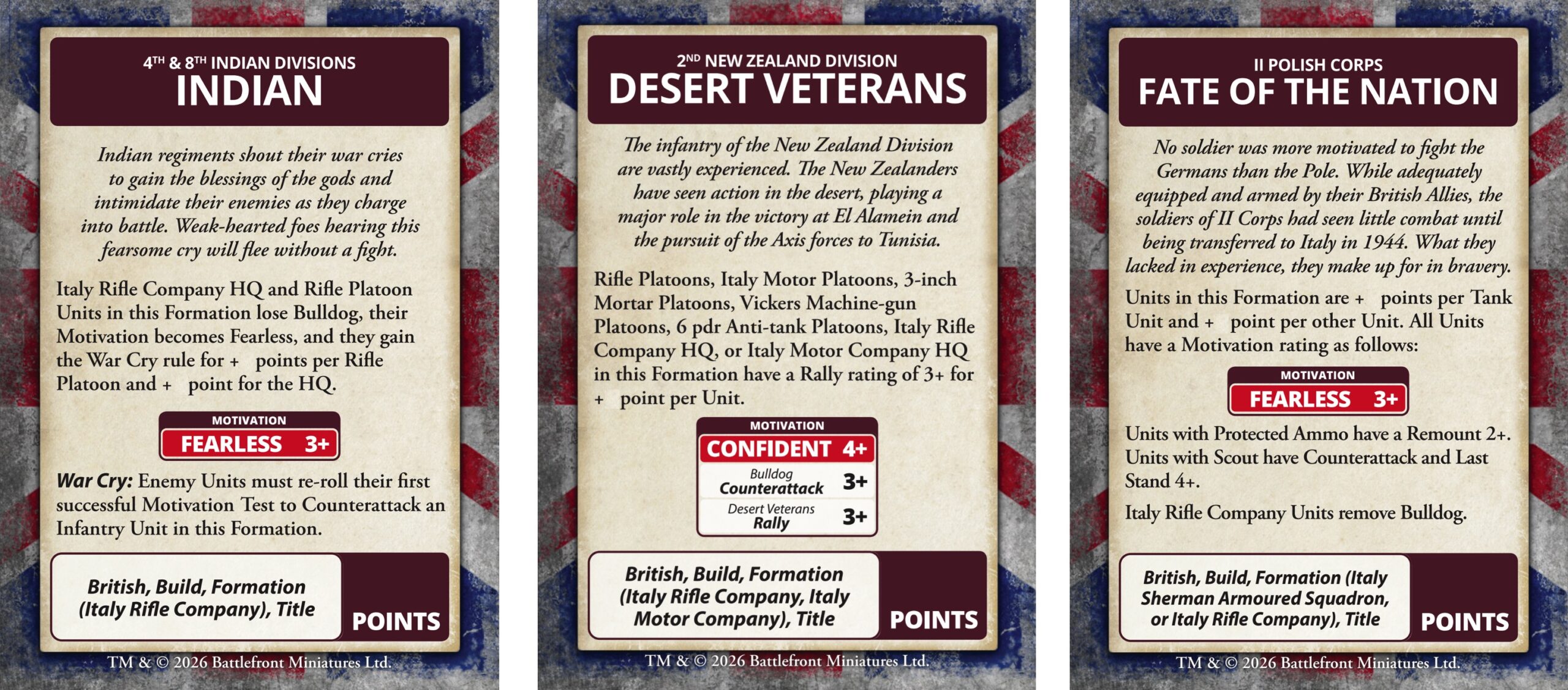
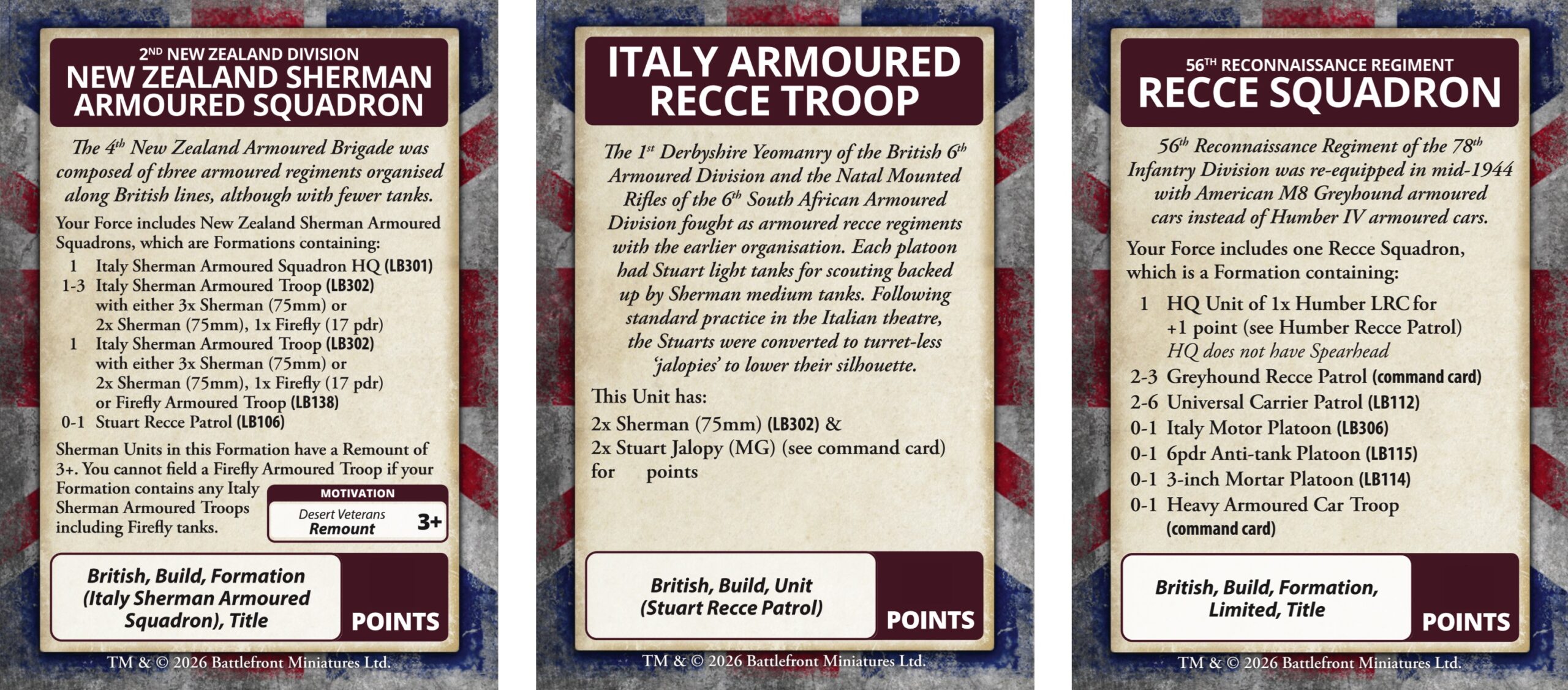
Italy was a thoroughly multinational campaign. National command cards cover Scottish, Irish, South African, New Zealand, Indian, Canadian, Polish, and Greek units, each with tweaks to the unit stats, and some unique formations and units that should make each nation feel distinct.
Additional unit options include British and Canadian Recce Patrols with Humber, Greyhound, or Fox armored cars, and armored transport options like Kangaroos and C15TA trucks.
Reflections
The British lists in Liberation of Italy cover a lot of historical options. I’ve been scratching my head trying to think of real forces that are unable to be represented, and the biggest things I’ve been able to come up with so far have been caused by the restriction on mixing Title cards, such as the Greek Brigade being supported by NZ armor at Rimini. On the downside, as far as we know, the release doesn’t include a few specific models associated with the theatre, such as the Sherman III and Churchill NA75.
From a competitive standpoint, there don’t appear to be any game breakers. Rally 4+ Late-War British infantry has existed ever since Fortress Europe, and the various command cards that upgrade morale are more for flavor than doing anything particularly different from the cards in previous British releases. There are no sneaky downgrade cards of that type that we’ve previously seen stack discounts to produce cheap but powerful lists. The big addition really seems to be the Sherman 76mm Troop, and it will be interesting to see how popular it becomes.
As a British player, I’m overall very happy with what I’ve seen so far of Liberation of Italy. It has stuck close to the history, given me some new options to explore, and looks like it should be just as competitive as previous Late-War British books.
Are there full formations for , the British 1st Derbyshire Yeomanry and the South African Natal Mounted Rifles , Polish Pulk ulanow karpackich (Carpathian Lancer Regiment) and Indian Recce Squadron ?
1DY and NMR get a single Sherman/Jalopy unit, not a formation, which is the same as how they were in Road to Rome. No card for Carpathian Lancers, but if you were desperate to do them then I’d suggest starting with the 56th Recce card and use Staghound models instead of Greyhounds. No Indian Recce Platoon – you’d have to bring the Armoured Car Troop of 4 x Daimlers across from Bulge and model it with Humber IVs instead.
There hasn’t been lists for 1DY and NMR , since the 1st Fortress Europe book . The Carpathian Lancers were in the Poles in Italy PDF and got dropped in Road to Rome , they were closer to an armoured car unit , than an infantry recce unit . As for the Indian Recce its not just the Humbers , some also got M8 Greyhounds and the UCs were in 4s , 2 of which usually had a PIAT. They also had the jeeps used in a recce role , with 6 per plt Then there was the assault platoon which was a lot larger than a motor plt .
I’ve just dug out those old PDFs. The Carpathian Lancers are simple, then: they can be directly represented by the Staghound Armoured Car Squadron card. You’re out of luck with the Indian Recce Squadrons as nothing comes anywhere near close enough to representing them. Again, they weren’t in Road to Rome which I suspect is why they didn’t come across to the new book. Hopefully BF will release a new PDF for them at some point.
There is an Indian recce squadron for Italy list in V3 forces
Here’s the link to the V3 Indian Recce list https://www.flamesofwar.com/hobby.aspx?art_id=4396. There have been a lot of PDF lists released recently, so hopefully once the Italy book is out we’ll see a few extras like this get added to V4.