O Bella Ciao! Liberation of Italy – Flames of War Late War Book
By Paolo Paglianti
It’s time to liberate the peninsula from the Germans! We have been waiting for it for a very long time, but it has finally arrived. The virtual bridge between Mid and Late War in Flames of War, Liberation of Italy is set roughly between Fortress Europe and the D-Day operations, although the war in Italy continued well beyond the liberation of France.
The book includes both sides of the conflict: on one hand the Axis forces, on the other the Allies who landed in Sicily and then fought their way up the Italian peninsula. Most readers probably already know the broad outline of what happened, but a brief historical summary is useful to understand why Italy became such a painful and unique battlefield. You will find it at the end of the article if you are interested in the historical background.
As usual, over the coming weeks on NoDiceNoGlory we will publish several in-depth articles covering the different armies in detail. In this article, we will take a general overview.
One important note before we begin. In Flames of War there are currently two point systems: the Book points and the Dynamic points system used in almost all tournaments. At the time of writing, the Dynamic points for Liberation of Italy are not yet available, so we will only refer to the Book points.
German Army
Let’s start with the Germans, former allies and now occupiers of the peninsula. We find the classic formations already present in other Late War Flames of War books, such as Tiger, Panther and Panzer IV formations. There are, however, a few small but interesting differences. For example, the Tiger formation can take an Elefant Tank Hunter platoon as a Black Box option, while the Panther formation cannot select Tigers, only Panzer IVs. Another example is the Panzer IV formation, which can include a FlammPanzer III platoon in formation.
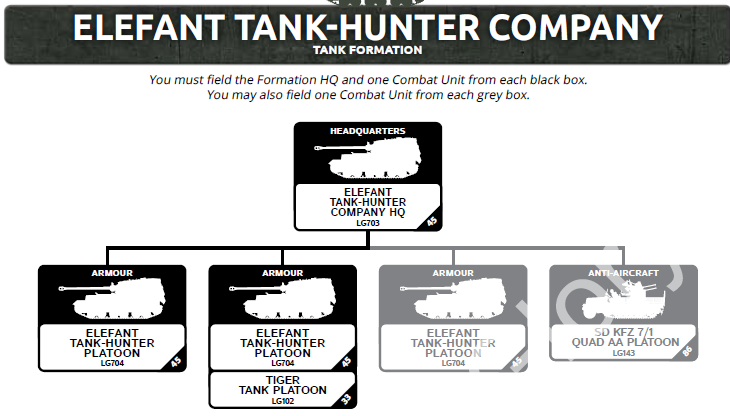
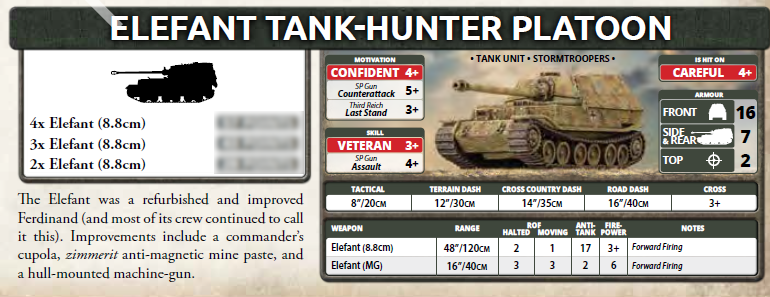
A notable addition is the Elefant Tank Hunter Company, consisting of HQ, 2–3 platoons of Elefants (upgraded Ferdinands with MGs, Front Armour 16 and AT17), plus a Sd Kfz AA unit. Each platoon can include up to four tanks. A formation like this had not been seen since Mid War Eastern Front days, and even there, it existed only as a card.
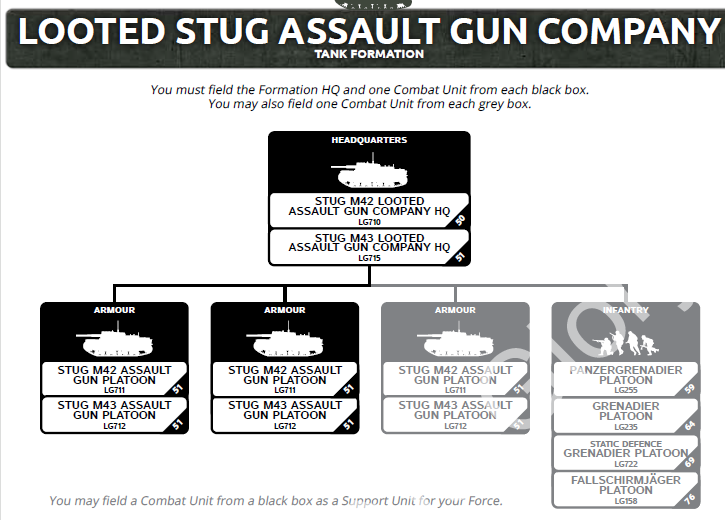
We also find a StuG Formation, very similar to the one from Bagration. But the brand-new Looted StuG Assault Gun Formation is particularly interesting, allowing players to field Italian M42 assault guns as German vehicles.
Don’t be fooled by the name. The M42 has light tank armour by Late War standards, only 4-2-1, but it carries a more than respectable gun with AT10 and FP3+. A single vehicle costs 3 points and four StuG M42s cost 13 points, although they will probably receive a discount once Dynamic points are released. Since they are in German service, they benefit from Motivation 3+, Skill 3+ and the Stormtrooper rule, so we would not be surprised to see them appear soon in both friendly games and competitive play.
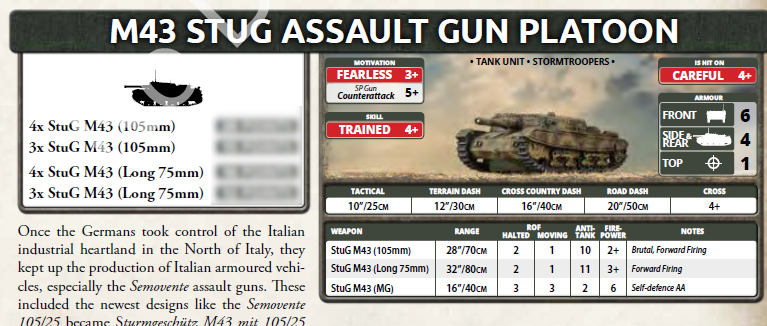
The M43 is even better, with improved hull armour (6/4/1) and stronger guns: either AT11/FP3+ or AT10/FP2+ Brutal. However, the price rises to 16 or 20 points for four tanks.
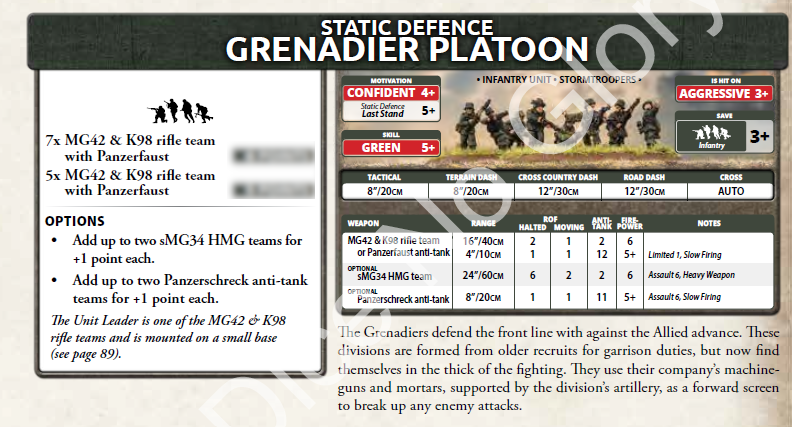
There is little to note regarding the Panzergrenadier formations, which are almost identical to those found in D-Day and Bagration — for example, they lose the SD KFZ flamethrower platoon. The Static Defence formation is essentially the same as the D-Day Beach Defence formation, and the Fallschirmjäger receive very few changes.
One important detail is that the German Italy army may include support from another German or SS formation from a different Late War book, but only a single Italian RSI platoon rather than a full formation.
The cards are mostly what one would expect from a German formation: 21cm Nebelwerfers, elite Fallschirmpanzer divisions with Last Stand 2+, the option to turn guns into Pakfront nests, and a couple of formation scout cards.
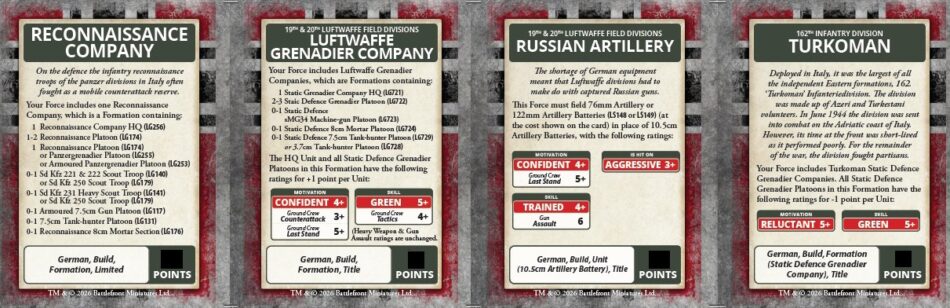
There are also several discounted divisions. The Luftwaffe Grenadier Company reduces Last Stand and Skill to 5+ (while keeping Tactics 4+) in exchange for lowering the cost of Static Defence units by one point each. The Reichsgrenadier card lowers Skill to 5+ (again retaining Tactics 4+) for a one-point discount per unit. The Turkmen Division further reduces Static Defence Motivation and Skill to 5+, again for a one-point discount, making it ideal for defensive armies.
RSI Forces

Let’s move on to the RSI units. Their formations are infantry-only, with no armoured formations available (except for the Leoncello Card formation, more on this later). The random die roll to determine whether units are elite, present in the Mid War book, is also gone.
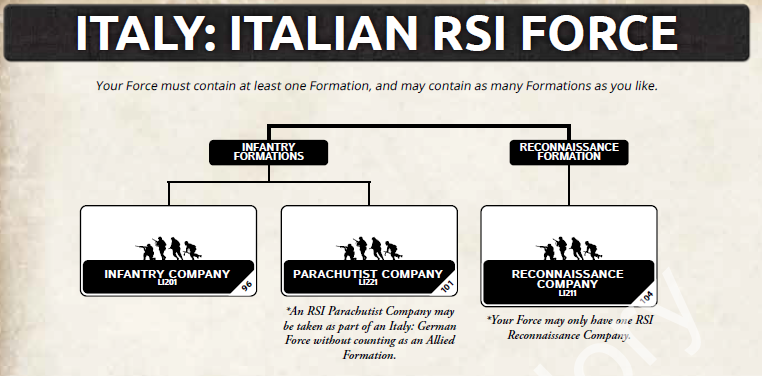
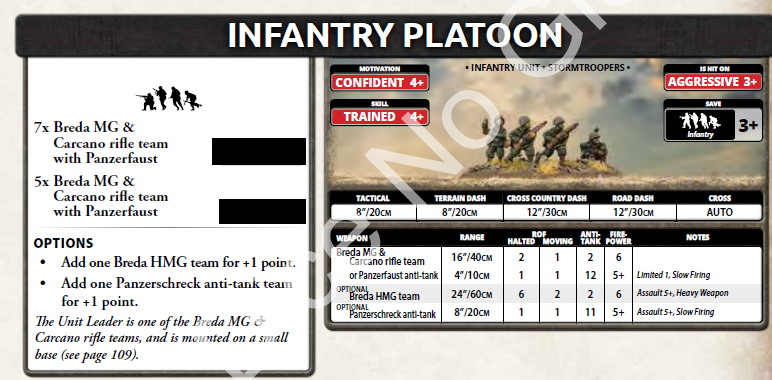
The infantry company includes three infantry platoons, 8cm mortars, and either 75mm anti-tank guns or captured British 6-pdrs. The troops are Motivation 4+, Skill 4+, and Aggressive. They are essentially cheaper and less effective versions of German units, from whom they inherit equipment and special rules: they carry Limited 1 Panzerfausts and have the Stormtrooper special rule, although with Skill 4+ it is less reliable.
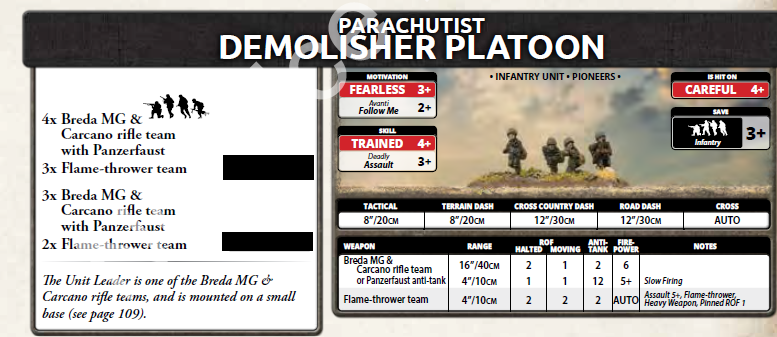
The Paratroopers are elite troops: Fearless 3+, Follow Me 2+ like their Mid War counterparts, Trained but with Assault 3+, and Careful, but they do not have Stormtrooper. They also carry Limited 1 Panzerfausts. A platoon costs 10 points, The Demolisher platoon is also interesting, with four Panzerfaust teams and three flamethrower teams for 11 points.
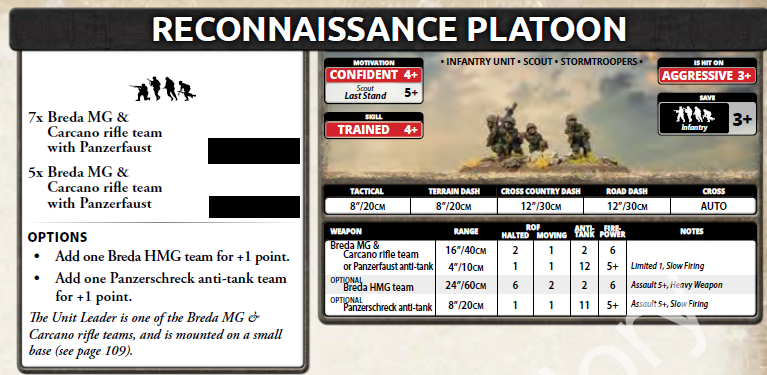
The Reconnaissance Formation is particularly unusual, including four infantry platoons plus HQ, all with Scout, and even the return of the AB41 armoured car.
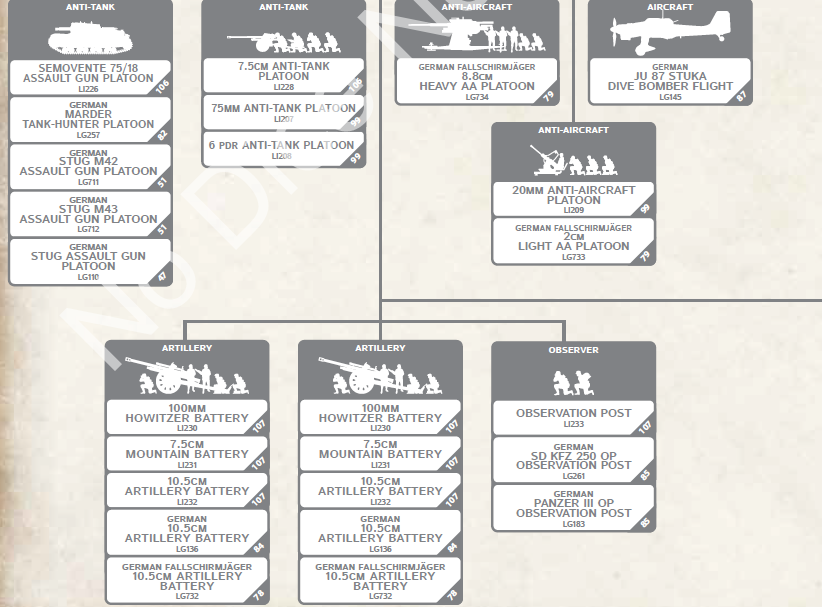
Support options are fairly limited: the Germans did not entrust many of their vehicles to the Italians. Available support includes 75/18 assault guns, 100mm, 10.5cm and 7.5cm artillery batteries, plus a single slot that can be filled by German StuGs, Marders, or StuG M42/M43s — but only one of these choices may be fielded. There is also access to Stuka air support and the formidable 88 AA gun.
The cards add a lot of flavor. There is the option to field Motociclisti Troops (Bike Raiders) and Tank Hunters loaded with Panzerfausts and Panzerschrecks. The Monterosa Alpini improve Counterattack to 3+ and gain the Mountaineer ability. Littorio Grenadiers gain Assault 3+, while the San Marco Marines receive Motivation 3+. Bersaglieri gain Follow Me 3+ and Terrain Dash 10”.
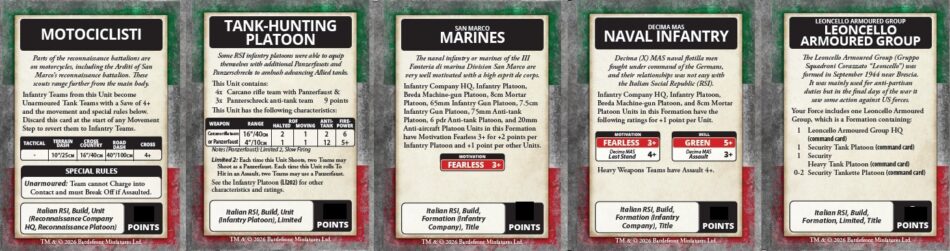
The infamous Decima MAS is also included, with Motivation 3+ (but Last Stand 4+) and Skill 5+ (Assault 3+), either as an upgraded infantry company or as a full formation, in which case they improve to Skill 3+.
Speaking of infamous units, the Leoncello unit is also represented, armed with obsolete M14/41 and P26 tanks, available only through cards. These are the only armoured support options available to an RSI army, if you don’t want to field a German allied Formation.
The Allies in Italy

Let’s start with the Americans, who historically advanced along the Tyrrhenian side of the peninsula — Naples, Rome and Florence.
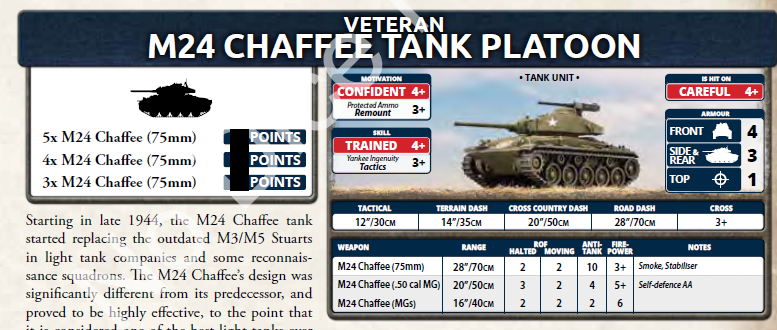
The formations are a mix of D-Day and Bulge. We find Shermans, Chaffees, Stuarts, and the classic Armoured and Rifle Companies. Almost all of them are Veteran, except the Rifle Company, which can also be fielded as Aggressive. The Ranger Company/FSSF is Aggressive as well, but improved stats.
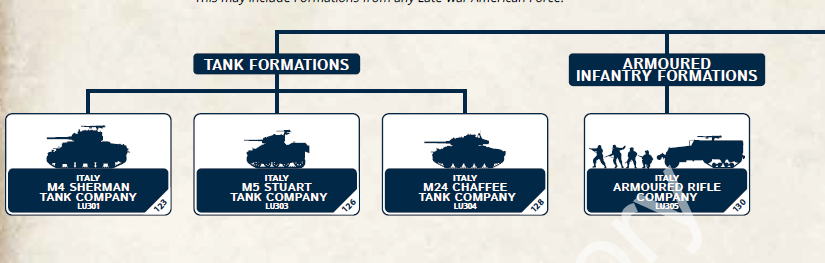
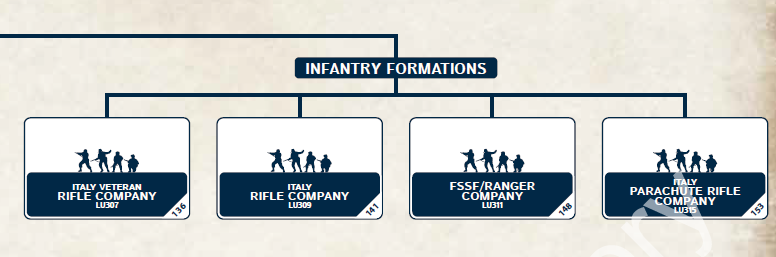
The Shermans are still “old style”, meaning no Jumbo Shermans but can upgrade to 76mm guns. Support options also bring few surprises, apart from Bofors AA guns.
The cards help differentiate your Italian-theatre US forces. There is the 100th Infantry Battalion with Japanese-American troops, who are not only Fearless with Last Stand and Rally 2+, but also have a special rule similar to Banzai — if they are stopped by Defensive Fire during an assault, they may immediately launch a second assault with a successful Motivation test. Of course, they cost a hefty +4 points per platoon. These cards are available both for Veteran and Aggressive Infantry.
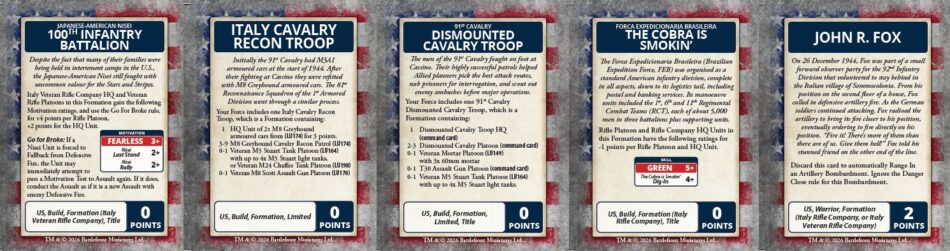
The Reconnaissance card is also interesting, granting Spearhead to a Stuart or Chaffee unit for +2 points. The Brazilian Expeditionary Force (FEB) Formation Card reduces the cost of Rifle units by one point, while worsening Skill to 5+ (though Dig In remains 4+).
Notable character cards include John R. Fox, who can automatically range in artillery for just 2 points — even without Danger Close! — making him particularly deadly in combination with Priests, and Thomas Wigle, who forces enemy units to re-roll successful Counterattack tests against his unit for 4 points.
Unfortunately, AT12 is the maximum anti-tank value available to American forces in Italy: there are no Hypervelocity cards. It is difficult to see a reason to play Italian US tank army in place of Bulge or D-Day, other than campaign games limited to Italian front. However, I think could be worthwhile to try the US-Japanese infantry in combination of some Bulge Sherman Veteran formation with full AT12 and Jumbo tanks.
France
The French also return, although with a limited selection consisting mainly of Tirailleurs infantry formations and Colonial Goum formations. This is the only way to play French free army in Late War, other than the D-Day card for the US Tank Division.
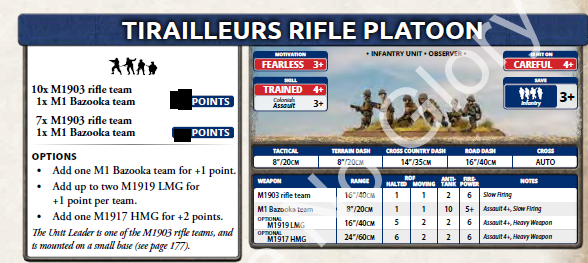
Late War French infantry is actually quite strong: Fearless, Trained (but Assault 3+) and Careful. A platoon with ten infantry teams and a bazooka costs 14 points, only 3 points more than a Veteran US Rifle platoon, while also retaining the Observer ability typical of American units. The formation additionally includes two mortar platoons. Essentially, they are “elite” US troops.
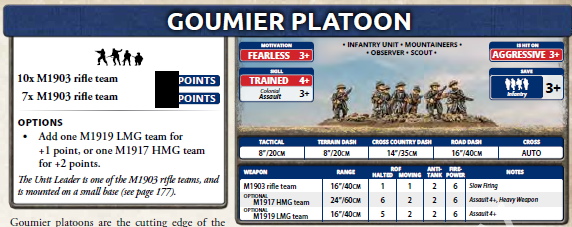
The Colonial Goum formations are Aggressive, but still Fearless with Assault 3+, although they lack platoon variety. They gain both Scout and Mountaineer but have no bazookas.
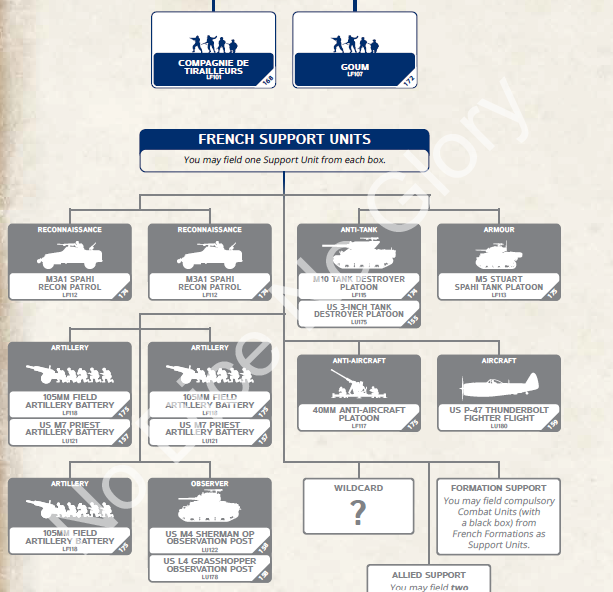
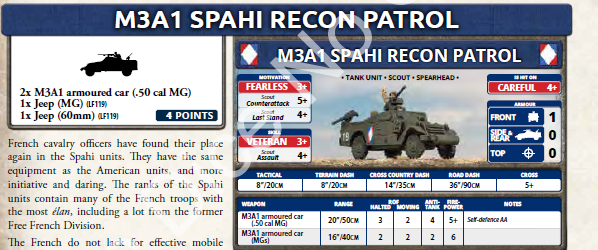
Support options include allied American units, M10 platoons (up to five tanks for 21 points), elite Spahi M3A1 scout cars with Fearless Veteran crews, and elite Spahi Stuarts, again up to five tanks per platoon.
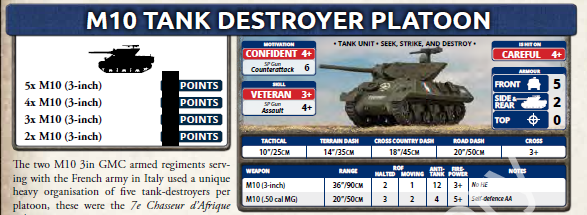
Allied support may include two platoons chosen from US, British, or Italian CIL forces.
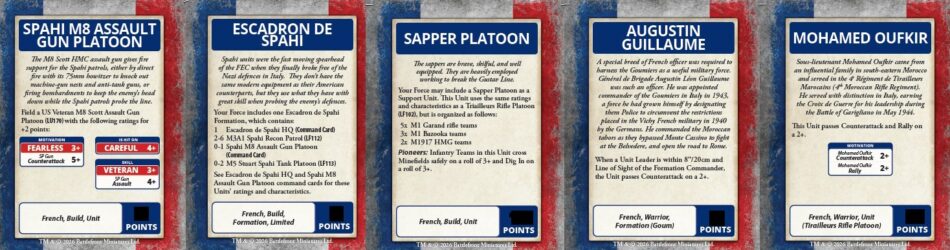
Among the cards, particularly notable are the ones allowing M3A1 Scout formations — possibly the only Allied elite morale 3+ scout formation in the game! — and the card enabling an M10 formation. Overall, French Free Army is an interesting (but costly) US-like elite troops, with some nice features as the 5-tanks M10 platoons.
British Forces
The British section of the Italy book also combines formations and support from both D-Day and Bulge. The Sherman formation is the classic mixed platoon version with 75mm Shermans and Fireflies, but it also includes interesting platoons made entirely of Sherman 76mm tanks or only Fireflies.
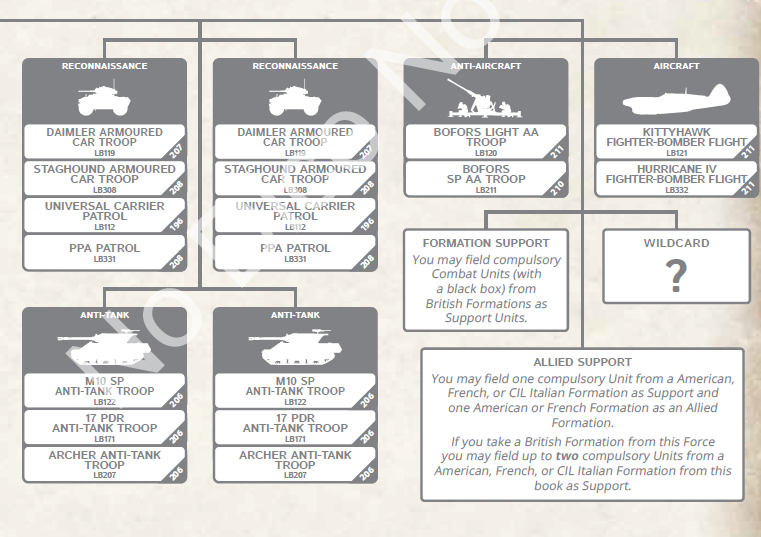
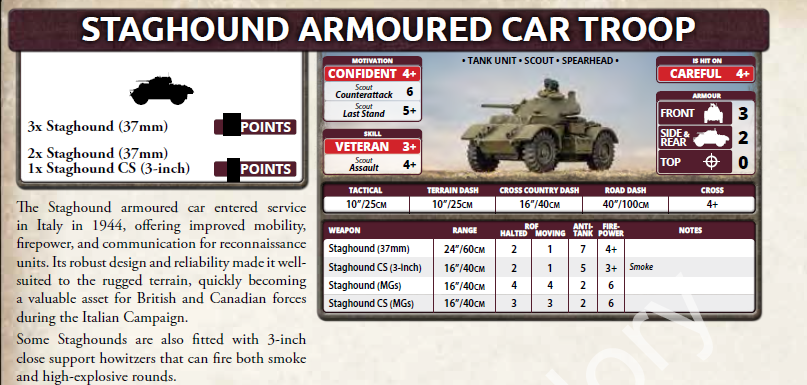
Among the support choices we find Archer tank destroyers with AT15, plus the ever-present Crocodiles and AVREs, alongside Sextons and Priests — unfortunately still in platoon sizes of two or four guns. There are also some new options for scout cars as supports.
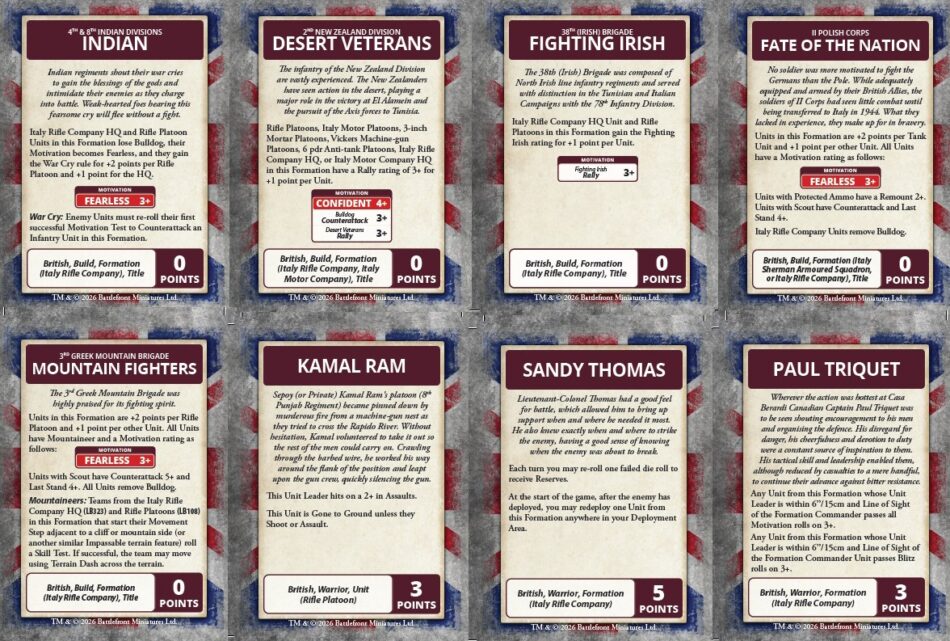
The cards are much more interesting, luckily. Rifle Companies may be fielded as Indian Divisions, gaining Motivation 3+ and War Cry, which forces the enemy to automatically fail its first Counterattack attempt, just like in Mid War, for +2 points per unit. The same applies to Maori formations.
Naturally, the Canadians are included too, with their characteristic Rally 3+. New Zealand units cost +1 point per unit and gain Rally 3+, for both Rifle and Motor formations. Similarly, the Northern Irish 38th Brigade also gains Rally 3+. Among the Formation Cards, the New Zealand Staghound formation with CS support is particularly noteworthy.
Polish divisions are also present, with Fearless 3+ and Remount 2+ for tanks thanks to Protected Ammo, as well as Greek formations with Fearless 3+ and Mountaineer.
The Kamal Ram card is particularly fun: it allows a Rifle infantry unit to remain Gone to Ground at all times, even in the open, unless it shoots or assaults. Will we see many in future games?
Italian Co-Belligerent Forces (CIL)
Finally, we come to the Italians of the CIL — the Corpo Italiano di Liberazione, fighting alongside the Allies. There are actually three different ways to field Late War Italians.
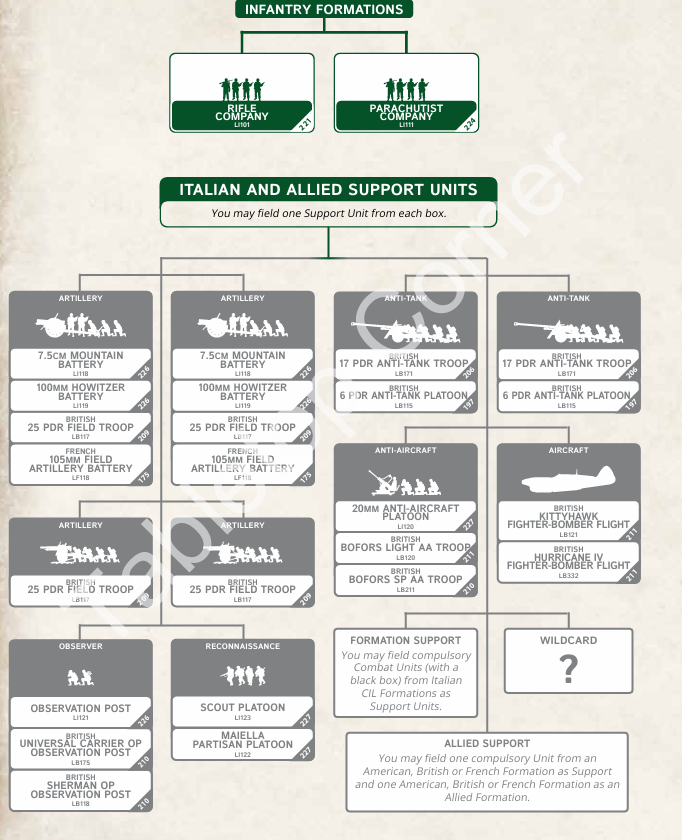
The first is as a standard formation. As with the RSI, the choices are limited: only Rifle and Paratrooper formations, plus rather sparse support options — practically no tanks, although plenty of artillery. Most likely, a pure CIL force can only work defensively, or alongside a British or American allied tank formation to provide some mobile anti-tank power.
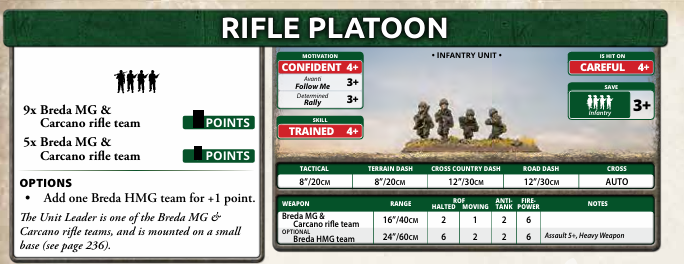
The standard Rifle infantry is Confident, Trained and Careful, although it benefits from improved Follow Me and Rally at 3+ for 8 points. Bazookas and PIATs are absent, but alongside the weak 47mm AT guns with only AT6, the force can field two essential platoons of 6-pdr guns with AT11, crucial if you want to survive mechanised assaults. Things improve considerably with the Paratroopers: Fearless, Trained but with Assault 3+, and Careful, making them far more interesting. They can field double mortar platoons — 5 points for three teams — and again have access to double 6-pdr platoons.
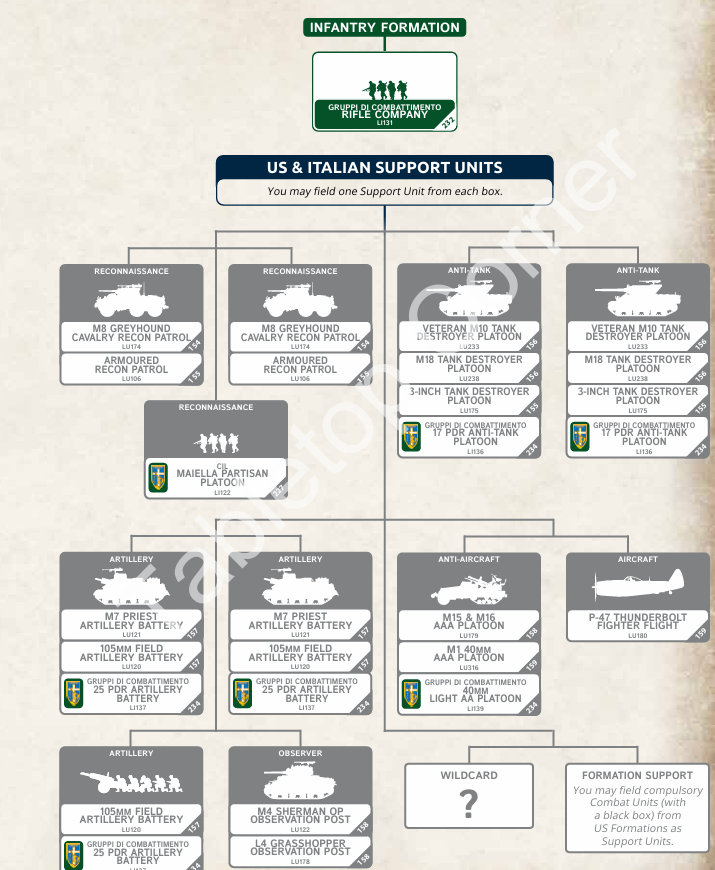
The most interesting alternatives, however, are the Gruppi di Combattimento formations, which combine an Italian Rifle formation with Allied formations and support. This is the American-style organization. Remember that you may also include US formations, and neither counts as Allied Support for formation morale purposes — meaning that if one formation breaks, the other still maintains morale. The support choices are essentially the same as the US list discussed earlier.
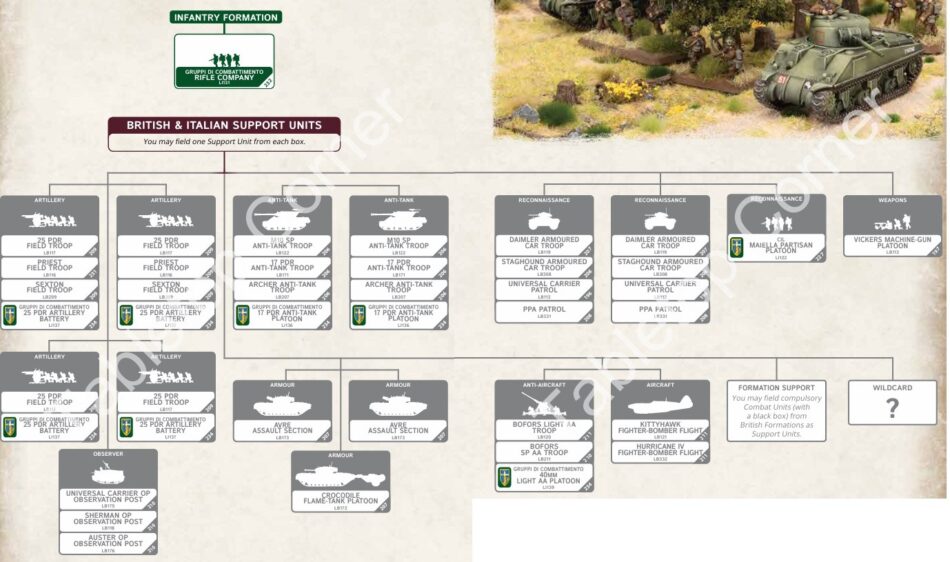
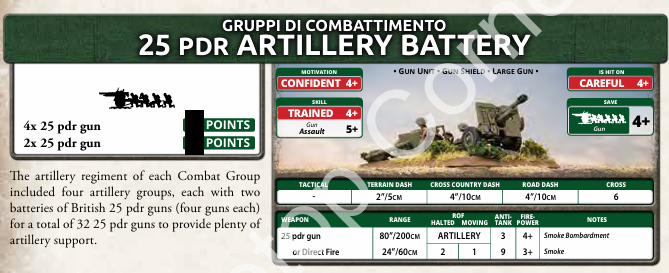
The same applies to the British-style organization. Italian Rifle units are combined with British support and formations, for a different flavor of game style. This is the most interesting formation of the Italy book, if you like to play Allied in Late War. It has very good AT punch (AT14, even AT15 if you use those Archers), the Crocodiles and AVREs to take out enemy infantry, and the only British-like infantry formation with two cheap (6 points), effective mortars for two smoke barrages.
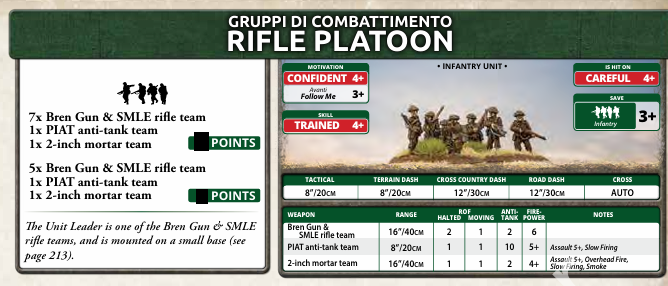
Another interesting feature is that Rifle platoons in the Gruppi di Combattimento follow a British-style structure: every platoon includes a PIAT and a 2-inch mortar, costing 8 points. They lose Counterattack and Assault 3+, settling for standard 4+ values, but retain improved Follow Me 3+.
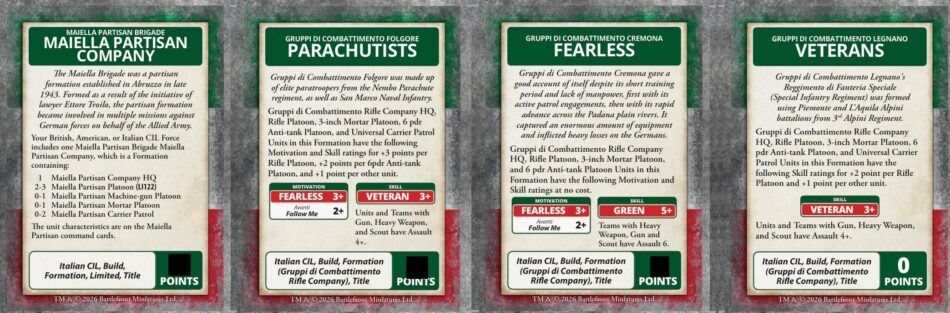
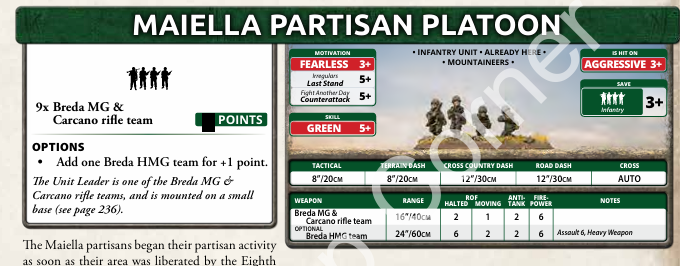
The Italian CIL cards are very similar to the RSI ones. We find Alpini with Mountaineer and Fearless 3+, Motorcycle Troops, the Legnano card improving Skill to 3+ for +2 points per platoon, and the Friuli card worsening Motivation to 5+ for -1 point per platoon. The Folgore card upgrades Paratroopers to elite status with Fearless and Veteran for +3 points per Rifle platoon. Finally, there is also a Formation Card for the Maiella Partisan Company, usable in CIL, US and British forces alike — an excellent option for players who want to defend without worrying too much about Reserves.
Historical Background – The Italian Campaign
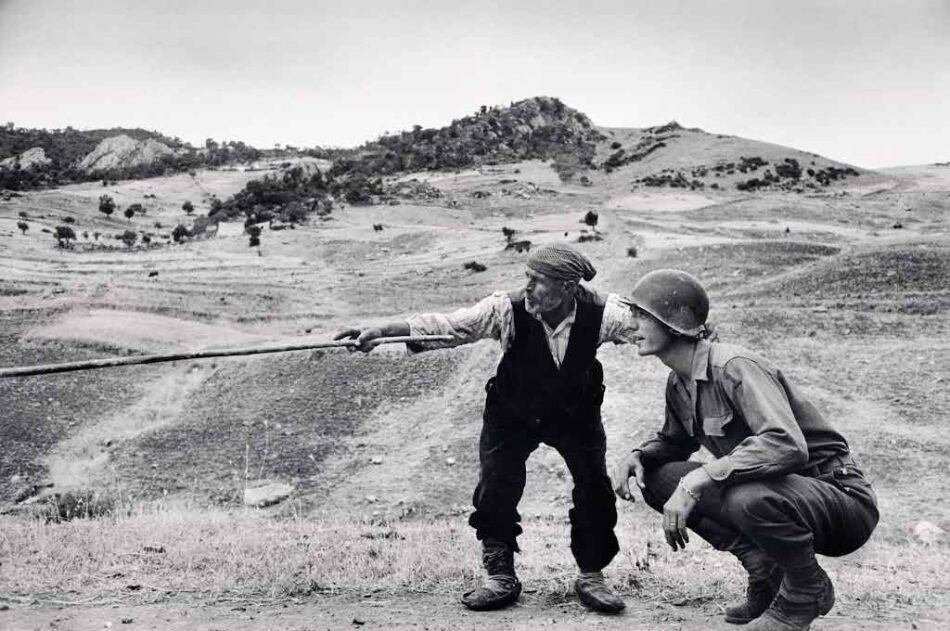
The Allies landed in Italy on July 10th, 1943. Axis resistance failed to stop them in Sicily, and the American and British armies liberated the island in a relatively short time.
Less than fifteen days later, between July 24th and 25th, the Fascist Grand Council — effectively the only political body within the dictatorship — voted against Mussolini, holding him responsible for the disastrous situation. King Vittorio Emanuele III, who had hardly distinguished himself through acts of courage since the March on Rome in 1922, decided to have Mussolini arrested and appointed Marshal Badoglio as head of government.
The King and Badoglio secretly negotiated an armistice with the Allies (they were not exactly brave men), after prudently relocating to southern Italy under Allied protection. On September 8th, 1943, while the Allies were still in Sicily, Italy officially surrendered.
Unfortunately, Badoglio failed to issue clear orders. He did not explicitly state that Italy was now at war against Nazi Germany, and many Italian soldiers did not immediately understand what was happening. For many of them, the war simply seemed over.
For the Germans, however, the situation was very different. They intended to continue — and win — the war, and they considered the Italians as traitors. Hitler immediately sent eighteen German divisions into Italy to effectively occupy the country and continue fighting the Allies. The result was chaos. Huge numbers of Italian soldiers were disarmed and deported to labor camps in Germany. In many cases, German troops brutally attacked Italian units that attempted to resist. The most infamous example was the massacre of the Acqui Division on the Greek island of Cephalonia, where former allies executed thousands of Italian soldiers who refused to surrender their weapons. More than 5,000 Italians were killed. It is estimated that around 600,000 Italian soldiers were deported to Germany because they refused to fight alongside the Nazis.
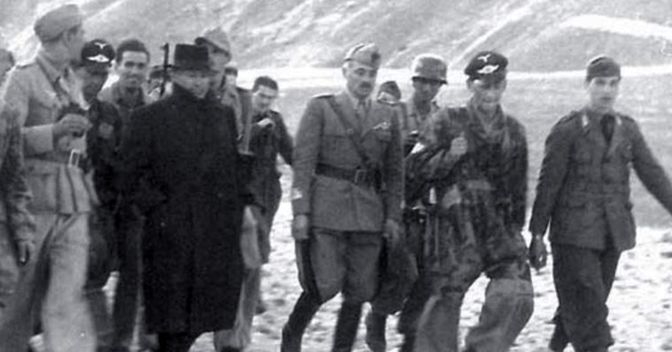
The situation remained chaotic for months. A German commando unit led by the infamous Otto Skorzeny — yes, the same one featured in the Bulge cards — carried out a daring raid to free Mussolini from his mountain prison on Gran Sasso. The Germans then used Mussolini to establish the Italian Social Republic (RSI), a puppet state in northern Italy controlled by Nazi Germany. Italian units still loyal to Mussolini gathered there and fought alongside the Germans, mainly in anti-partisan and internal security operations. Among the most notorious were the Black Brigades and the Decima MAS, which absorbed elements of the original elite commando unit. Meanwhile, the Allies reorganized the Italian units loyal to the King into new “Combat Groups” such as Legnano, Folgore, and Friuli. These units fought alongside the Allies during the liberation of Italy, often cooperating with partisan formations.
Both the Nazis and their Fascist allies committed numerous crimes against civilians throughout the campaign, including massacres and reprisals against the population.
The End of the Campaign
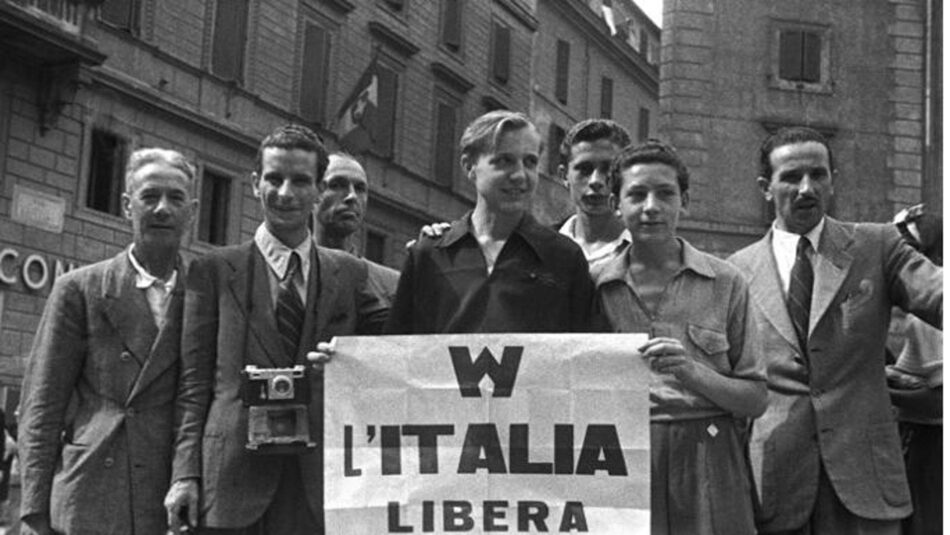
Once the Allies broke through the Gothic Line — the massive defensive line stretching across northern Italy above Rome — Allied and Italian forces advanced into the Po Valley in April 1945. April 25th marks the end of the war in Italy and is still celebrated today as Liberation Day. Mussolini was captured by Italian partisans near Lake Como while attempting to flee to Germany and was executed the following day, effectively ending the Repubblica di Salo’ and fascism in Italy.
Only 11 Elephants were sent to Italy as part of the 1st Coy schwere Panzerjäger-Abteilung 653 from Feb 1944 , the other 37 of the BHQ ,2nd and 3rd Coys went to the Eastern Front , along with 3 Bergepanzer Elefants and some odd convertions .
Are South Africans an option in the British lists?
Are the Churchill I CS , Fox armoured car and Otter LRC in the book/cards ?
The Fox and Otter are available as a Canadian Recce Patrol command card. No Churchill I CS, but you get the standard LW 95mm Churchill CS in the book. I will have an article looking at the British forces coming out soon.
So does the September landings on “the boot” fit in? MW or LW? A lot of bitter fighting preceded the 1944 demarcation line for LW.