First Look: Reading a Stat Card for the Starcraft Tabletop Miniatures Game
By Aaron Kamakawiwoole
Hey Reader!
The Starcraft Tabletop Miniatures Game is out in the world now, and that means we can finally show an example of a stat card, because it’s probably the final version! With open beta behind us and being firmly in First Edition, as you consider ordering your minis, we thought it would be useful to look at an example stat card to show you how to read it, and what to look for in units that you prize.
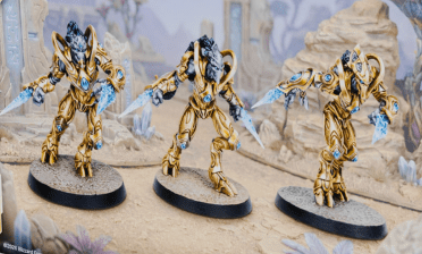
For our example today, we’re going to take a look at the proud and powerful zealots of the Protoss.
I. Stats and Supply Chart
Each stat card is printed on both sides, and you can download all of them for free on the Starcraft website. The front shows you the base abilities of the models in the unit, and the back shows the upgrades you can purchase:
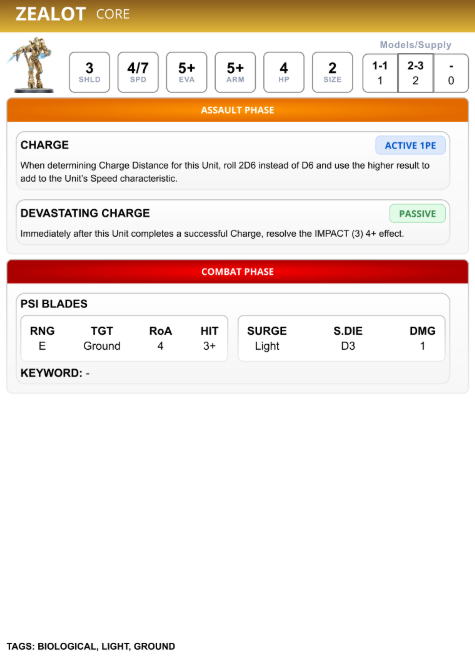
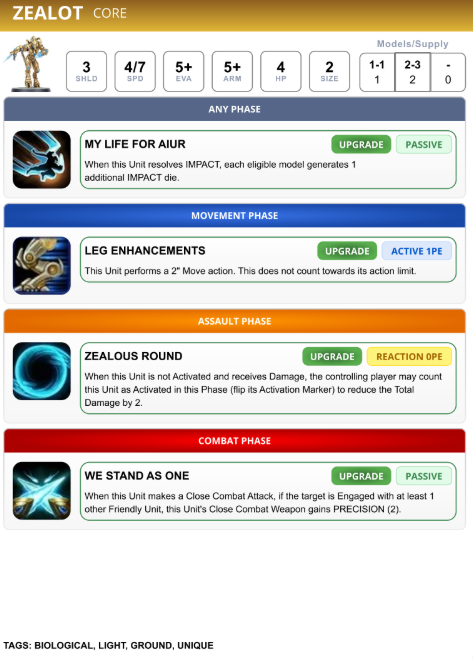
The unit’s stat line is at the top, giving you your base attributes in the game. As a quick walkthrough:
- Shields (Shld) are only available to Protoss units: these are Hit Points (HP) that the unit (not each model) can suffer before suffering them on any of their models. So this squad of Zealots has three Shields: they can suffer three Wounds before suffering Wounds on a model.
- Speed (Spd) is how many inches the Lead Model moves when they move. The other models are then placed within 3″ (usually) of that Lead Model (which can be any model – it’s not a “unit leader” like in Star Wars Legion, for example: it’s just one of the models that you choose to start with, typically the one furthest in the direction you want to go). So this squad of Zealots can move 4″ with the Lead Model, and the rest of the unit is placed within 3″ of the Lead Model. Should the squad be reduced to one model, it gets to use the second higher number, which is equal to the normal move distance plus that coherency distance.
- Evade Saves (Eva) are rare saves that allow you to cancel wounds that slipped past your Armor Save (which is next). Generally speaking the best saves are a 4+, and there are some units who don’t have an Evade value at all: they are too large and cumbersome to evade attacks. This Zealot unit gets to perform an Evade Save on a 5+ roll.
- Armor Saves (Arm) are the basic defense of units in this game. Lightly armored targets tend to have a 5+ or 6+ save, while armored targets tend to have a 3+ or 4+ save. When this unit is hit, they prevent wounds on a 5+ roll.
- Hit Points (HP) are the number of wounds that each model in the unit has. These could be as low as one for Zerglings, though most models so far are between two and four, with some in double digits. So it takes four Wounds (after removing the Shields) to remove a Zealot.
- Size is used when interacting with terrain and some tokens: if a model’s Size is higher than a terrain piece, it can see over it. If it is the same or lower, line of sight is blocked unless the attacker is within 1″ of that terrain piece, in which case they can peak over it and attack. So tall units can see more targets, but they are also easier to shoot and charge.
Models also have a Supply Chart, showing how much Supply they take up based on how many models still remain in the unit. This could be as high as two so far, and if they get depleted enough, it could drop down to zero.
Supply determines both how effective the unit is at controlling objectives (so you’re counting Supply, not models, which is really nice!), as well as how many units you can have out on the table at once, so there are benefits and tradeoffs to units having a lot of Supply. Our Zealots start with three models and a Supply of two, and go down to one Supply when reduced to one model.
And finally, Stalkers are a crowd favorite from Starcraft 2, sporting a powerful ranged attack, much-needed fire support against armored targets, and a short-range teleport to help you claim objectives faster, or evade an ill-fated close combat engagement. They are relatively affordable for how durable they are, and if you like the tactical options of Adepts, you’re going to love Stalkers. Built for shenanigans (and one of the few Protoss units that can reliably heal if you play your Tactical Cards correctly), Stalkers offer a good baseline for holding objectives through strong damage and reasonable resilience.
II. Phase Abilities
Below the Stats and Supply Chart you’ll find the phase-specific abilities for the unit. In the case of Zealots, they don’t have any innate abilities in the Movement Phase (more on this in a bit), but they have two in the Assault Phase.
Charge allows them, if you spend one Psionic Energy (which is generated by your tactical card choices – more on that in a future post!), to roll 2D6 and add the highest to your charge distance. Charge distances are typically your Move + 1D6, so rolling two and taking the higher value makes them more reliable.
Devastating Charge is a passive ability (so it doesn’t cost you any resources to activate, which is nice) that simply says that when you successfully charge you get to perform three Impact Hits against the target for each model in your unit. So if you have three Zealots, they get to roll 3×3 = 9 Hits (on a 4+, as noted in the entry) against the unit: the unit would then perform their Armor Save, possibly an Evade Save, and then wounds are dealt to the defending unit.
Impact Hits are nice because you still get to attack in the Combat Phase: it’s just a chance to get in some damage before you start swinging for real, which is a nice tradeoff for not being able to attack until you get into melee.
And then in the Combat Phase we have your primary attack with the Zealots: your Psi Blades have a Rate of Attack (RoA) of four, hitting (Hit) on a 3+. So if you have three models, you’d roll 3×4 = 12 dice, trying to hit on a 3+. The entry then tells you that the attack Surges (more on that below) on a D3 against Light targets, and deals one Damage (Dmg) for each successful hit that is not saved.
Surge allows units that in the game are strong against a specific type of unit to be strong against those units specifically. In this case, Zealots surge against Light targets (as distinguished from Armored targets), and depending on the D3 roll, if you’re fighting a Light target, 1-3 of your hits will bypass armor saves. They won’t bypass Evade Saves, but your opponent won’t get a chance to Armor Save against those hits.
III. Upgrade Abilities
Most units also have additional upgrades (and sometimes additional attacks) that they can take: these upgrades are on the back of the card. They list the number of points you spend to purchase them, and what those abilities do. In the case of the Zealots, you can get in a second move action every turn (at the cost of a Psionic Energy, and admittedly on a 2″ Move + 3″ Coherency, not your full 4″ Move + 3″ Coherency), an additional Impact Hit per model (which is nice), the ability to give up activating to prevent damage, and potentially add Precision (which converts X misses to hits, which is really nice) to your Psi Blades attack.
Different playstyles will encourage different upgrades; make sure, though, that you still have enough units on the table, because as great as any upgrade is, if you invest too much into upgrades at the expense of bodies on the table, much like in Starcraft, it could cost you the game.
IV. Tactical Cards
There are other ways to get abilities for your troops: those come from tactical cards, which we will discuss in our next post. But suffice it to say for now, if you want to power up abilities on your card, prevent damage to your zealots, make their attacks more reliable, or teleport them across the map (yay for powerful alien tech!), tactical cards are how you do that.
Until next time,
Centaur
YT: @CentaurGaming (Starcraft and more)
YT: @ZurnCentral (Bolt Action)