Deployment in the Starcraft Tabletop Miniatures Game
By Aaron Kamakawiwoole
Hey Reader!
Our intro series to the game is almost complete – we’re going to walk through how deployment works in Starcraft, as it’s a clever improvement on some game systems while still borrowing principles from games you’ve likely played. You’ll find more info in the core rulebook PDF that’s free to download, but below is the short synopsis of Archon’s unique (yet familiar) take on deployment works.
I. Select a Unit
To deploy a unit, choose one of the units from your army list. Note that the total Supply value of your units on the table cannot exceed the Maximum Supply for the Round, so you will typically only have a portion of your army on the table at a time. So as you start selecting units to deploy on Round 1 (where you’ll have around 3-4 Supply to start the game at 1000pts, or 6-8 Supply to start the game at 2000pts), plan ahead for how much Supply those units will use.
Once you’ve selected your unit, you’ll need to decide where to bring that unit in, which can take one of four forms.
II. Place the First Model
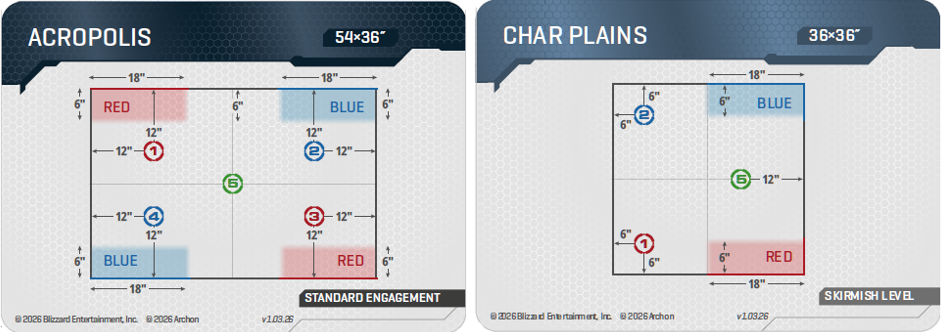
No models start on the board at the start of the game: all units will move onto the board. The most common way that models will move on is from the player’s Entry Edge.
Sometimes this is a long edge of the table, a set number of inches from a corner, or multiple split portions of the board. Simply place one of the models in the unit (which we call the “lead model“) in base contact with a point on your Entry Edge, and then execute a Move Action (move that model up to its Speed Value, and place all of the other models in the unit, if any, in coherency, which is typically fully within 3″ of the lead model).
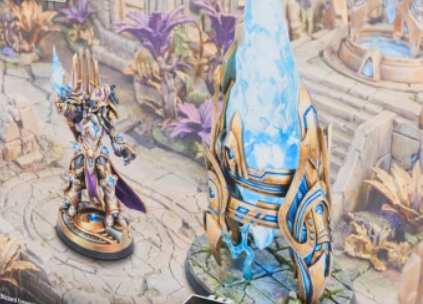
The second way to deploy is via a Structure. Some factions have the ability to place structures (like pylons for the Protoss, Nydus Worms, etc.) that function as an additional friendly Entry Edge, so on turns following the summoning of one of these structures, the Lead Model in a new unit may be deployed in base contact with the structure and then perform its Move Action.
This gives you some flexibility to reach far-flung objectives, quarters of the map, etc., so long as you can protect the structure from damage.
The third way to deploy is from a non-Player Entry Edge via a Tactical Card. Proxying a production building in a different part of the map from your main base is commonly done in Starcraft, and you can do this in the tabletop game as well! Your first unit produced on a turn can be deployed (if you’re willing to field and exhaust a specific tactical card like a Proxy Barracks, Warp Gate, or Zerg Six Pool) from any of the Entry Edges on the board that are not marked as an Entry Edge for either player, and then perform their Move Action.
This can give you immense opportunities for maneuver, though these tactical cards are also expensive, so you’re generally fielding less resources and options for your force in other areas.
And finally units can be deployed in base contact with a token. To represent units being dropped in via an aerial transport, when another unit activates in the Movement Phase, they can tap that tactical card and place a token anywhere beyond 10″ of an enemy unit: at the end of the turn, place the Lead Model in base contact with the token, and then deploy the rest of the unit in coherency.
III. Unique Forms of Deployment
There are some units that can deploy in more unique ways; many Zerg ground units gain the Burrow Ambush ability that allows the Lead Model to be placed in base contact with a friendly Entry Edge, and then be placed 18″ away from that spot, and then deploy the rest of the models in coherency (but cannot perform any actions after that deployment), representing the Zerg popping out of their burrowed positions underground – they were hiding on the map all along!
Unique deployment forms will cost Minerals (so army points), so you’re paying upfront for versatility in your deployment options. But they can be very useful for an aggressive form of play.
IV. What Is Best?
With the knowledge that this advice comes from someone who was one of the beta testers, but has yet to participate in an event (I’ll be going to the Nova Open Tournament in September, so more on that in the coming months!), I have three recommendations for you in terms of how to think through deployment.
First, simple is good: spending resources, points in your army, etc., can give you an edge in some cases, but in many cases it’s wasted resources that could have gone into improving the resilience, firepower, and/or speed of your troops. In all these cases, a simpler approach of deploying from your own Entry Edge (which is always free) may be better. So only invest in other options if you need it for your play style and expected mission objectives.
Second, save your specialists for later in the round. If you have a unit that is good at fighting armored targets (like Terran Marauders), don’t deploy them until you see where the enemy Protoss Stalkers, Terran Goliaths, or Zerg Roaches are deployed. This way you won’t need to spend a critical turn marching across the board to get to a useful place.
And finally, plan around next Round’s Supply. Each new round will add 1-2 Supply to both sides, so when deploying, think ahead about which units you want to deploy next Round, and make sure you save enough Supply to get those units out on time. This will keep you from not having adequate support on the table when you need it (this is called being “supply blocked” in Starcraft, and it’s a whole thing in the RTS game), and that could be the difference between victory and defeat.
Conclusion
For those who have played Star Wars Legion, Bolt Action (with Meeting Engagement deployment rules), and many other games, all of this feels familiar. But one thing I’ve loved about this setup is how different it is, without having to rely on random rolls or scenarios dictating deployment options. If you want unique ways to deploy, you can take them – but they’re going to cut into what you can spend to upgrade your troops in other ways.
And that’s a good thing for any game: it encourages interesting choices that make for different play experiences in the future, which I love!
Until next time,
Aaron Kamakawiwoole
YT (Starcraft): @CentaurGaming
YT (Bolt Action): @ZurnCentral