Converting a Romanian 75mm Artillery Piece

By Kreighton Long

While window shopping for light artillery models for my WW2 Romanian army I found limited options to choose from. While Great Escape Games makes a fine looking Romanian light artillery piece (one will make its way into my arsenal eventually) I wanted to challenge myself with a bit of conversion work to add variety to my three-light artillery Romanian list for Bolt Action.

For my conversion attempt I began with the wooden spoked wheel variant of the WWI French style 75mm gun as found in the Warlord Games . The crew themselves needed a little customization to make them more Romanian which is where the conversion work was done for this piece. I did attempt to find a way to modify German, Soviet, and American helmets to the point where they would pass as Romanian but the solution alluded me.
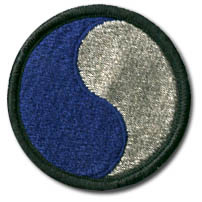
Painting the Blue and Gray Unit Patch on WWII US Army Uniforms

By Kreighton Long

29th (US) Infantry Division history – Battle of Normandy – D-Day Overlord

In honor of my new home in Virginia, and for a less commonly seen WWII US Army theme, I decided to design my US Army on the 29th Infantry Division.

The 29th was a National Guard division recruited from northern Virginia, Maryland, and southern Pennsylvania.  The division deployed to the European Theater of Operations and took part in the amphibious landing at Omaha Beach, bocage fighting in Normandy, siege warfare at Brest in Brittany, then urban fighting and battles of maneuver in Germany.

Painting World War Two Romanians

By Kreighton Long

The backbone of the World War Two Romanian army was the humble riflemen. Romania lacked the quality and quantity in armor of their German or Soviet peers and the heavy artillery that rained destruction on their victims on the Eastern Front was sorely lacking in Romanian arsenals. Without powerful armor formations or heavy guns the Romanian military was forced to rely on manpower rather than firepower.

The average Romanian rifleman was equipped in fairly simple, but functional, gear. Color photographs of Romanians from the war are hard to come by but illustrations from Osprey Publishing and photographs of contemporary reenactors helped to guide my color choices. The Romanian soldier wore a cotton tunic during the summer which bleached in the sun. During the winter the Romanian soldier wore woolen tunics which retained their darker khaki color. Woolen trousers were worn year round and maintained their color like the woolen tunic.

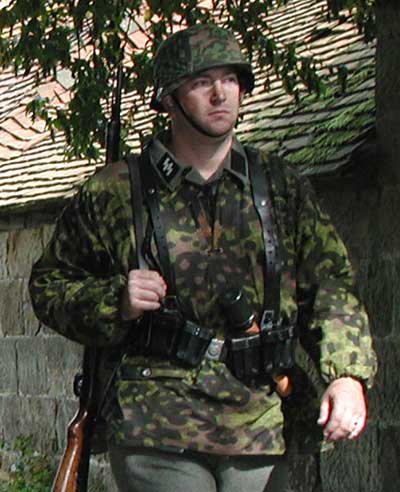
Painting Waffen SS Erbsenmuster Camouflage

Related imageBy Kreighton Long

No World War Two military incorporated camouflage as extensively as Germany. Most rivet-counters/armchair historians can eyeball camouflaged German infantry and reliably tell you what branch of the German armed forces the camo-clad trooper served.

This is especially true for the Waffen SS. From their first actions in Poland in 1939 through the fall of Berlin in 1945, the SS was equipped with camouflage uniforms that visually set them apart from the Heer and Luftwaffe ground troops.

Unfortunately for tabletop wargamers, painting the different camouflage patterns of the Waffen SS can be an intimidating challenge. Personally, I held off painting my first SS infantry for years after entering the hobby due to a lack of self-confidence.

Since working up the courage to attempt painting SS camouflage, I completed numerous iterations, each time learning how to suck less next time.

Painting Waffen SS Platanenmuster Camouflage

By Kreighton Long

No World War Two military incorporated camouflage as extensively as Germany. Most rivet-counters/armchair historians can eyeball camouflaged German infantry and reliably tell you what branch of the German armed forces the camo-clad trooper served.

This is especially true for the Waffen SS. From their first actions in Poland in 1939 through the fall of Berlin in 1945, the SS was equipped with camouflage uniforms that visually set them apart from the Heer and Luftwaffe ground troops.

Unfortunately for tabletop wargamers, painting the different camouflage patterns of the Waffen SS can be an intimidating challenge. Personally, I held off painting my first SS infantry for years after entering the hobby due to a lack of self-confidence.

Building Bolt Action Pin Markers

By Kreighton Long

Gamers have a variety of means of marking progress and mechanics in their games. The means of doing so range as wildly as the reasons we need to track them. Whether the game calls it stress, fatigue, or pins, we can use tokens, dice, or counters.

Players of Bolt Action deal with pins, a game concept that functions against a unit’s morale.

Marking pins on the table can be as simple or fancy as the player wants it to be. For my games, I decided that I wanted to create a way of tracking pins that would blend into the table and compliment the aesthetic as much as possible.

After some digging around I came across appropriate casualty markers from .

For this project specifically, I used a . The core idea here was to create a scenic looking marker combining a casualty model with a slot where a 9mm D6 can be turned to represent the number of pins on a unit. After completing the test piece shown below I’m committing to working on a set for personal use with my WWII German armies.

Painting Heer and Luftwaffe Splinter Camouflage

By Kreighton LongGerman WWII Tent Quarter & Poncho Zeltbahn Splinter Pattern Camouflage – International Military Antiques

While the Waffen SS made extensive use of camouflage uniforms, the German Heer incorporated its own pattern, albeit not to the thoroughness of their SS peers.

In this article, I would like to share my process for painting Splinter Camouflage. This pattern is applicable for both Heer as well as Luftwaffe Fallschirmjager who sported similar patterns during the mid and late-war periods.

I recommend finding examples of splinter camouflage in history books or Google Images and leaning on them to help form the shapes of the different parts of this pattern. We will be using the following Vallejo paints in this tutorial:  German Cam. Beige (821), Leather Brown (871), German Cam. Medium brown (826), Black (950), and Luftwaffe Cam. Green (823). We will also use Citadel’s Seraphim Sepia as a wash.

Mass for the Masses: building cheap Spanish church terrain

By Tyler Stone

The crew over at just unveiled their ‘Ports of Plunder’ range of scenery. These affordable MDF kits are the result of a collaboration with , and have all of the quality the community has come to expect from 4Ground’s scenery. As I type this, my fellow TotS podcaster Glenn van Meter is working on assembling and reviewing a few of these excellent kits.

Marder III Ausf. H, Sd.Kfz. 138 – A Plastic Soldier Company Review

By Tom Burgess

One of my major projects that I completed in 2019 was building an all-plastic German Mid-War East Front Panzer Grenadier force. And of course, what Mid-War German force can you have without Marders backing it up?

Unfortunately, Battlefront (BF) only offers the Marder III  in one version and in metal resin. Luckily the Plastic Soldier Company Panzer 38(t) kit has the option to build two Marder variants. So I ordered a box from my local game store, Hard Knox Games, to add to my force.

Putting the New American Options to work

By Chris Jackson

The new US book has been sent to the gaming stores and I was able to look at a copy, so after a long, anxious wait we can finally play with the American Army we have seen in news reports and grown to know and love.

Tanks that can swat anything in front of them like flies with near impunity, armored transport that can kill tanks and armored vehicles with the same ease they move across the battlefield.

Aircraft that kill from beyond the reach of most air defense systems, and other technology that allows the Americans to come and to dominate the battlefield like no one else can.

The downside to all of this high tech and nigh-invulnerable equipment is that it comes at a steep price. Even with the elevated points of the 2020 tournament season, a single platoon of M1A1 HC tanks could make up 60% of your points.