
In Search of the Perfect Pak 40
by Jesse Marcelo
This April, Warlord Games announced the introduction of their first all-plastic field gun and support weapon kits, marking a departure from their previous metal and Siocast offerings. According to Warlord, the primary driver behind this shift has been the increased demand for artillery pieces following the release of the 3rd Edition of Bolt Action. The new platoon structure allows players to field multiple artillery pieces more easily, creating a greater need for support weapons on the tabletop.
Leading this new range are the German Pak 40, MG34/42, and 8cm mortar.
This announcement happened to coincide with me starting my first German Bolt Action army. COINCIDENCE?! Probably. But since I was already in the market for some anti-tank support, I figured this would be the perfect opportunity to take a closer look at the new plastic Pak 40 and compare it against the other options currently available.
For this comparison, I acquired four Pak 40 kits from three manufacturers: the new plastic kit from Warlord Games , Warlord’s older metal kit, a plastic kit from Rubicon Models, and a metal-and-resin kit from 1st Corps Miniatures. I’ll be evaluating each kit based on the ease of construction along with the quality of its major sub-assemblies: the barrel, gun shield, and gun carriage.
Before we dive into the review, I want to briefly go over the scale differences between the models. The Warlord Plastic Kit, Metal Kit, and Rubicon kit are all approximately 1:56 scale or 28mm. The outlier here is the 1st Corps Miniatures kit, which is a 1:48 scale miniature. This scale is often used for vehicles and does look at scale next to Warlord Heroic scale miniatures, but it is important to keep this size difference in mind as we move into the review.
Ease of Construction
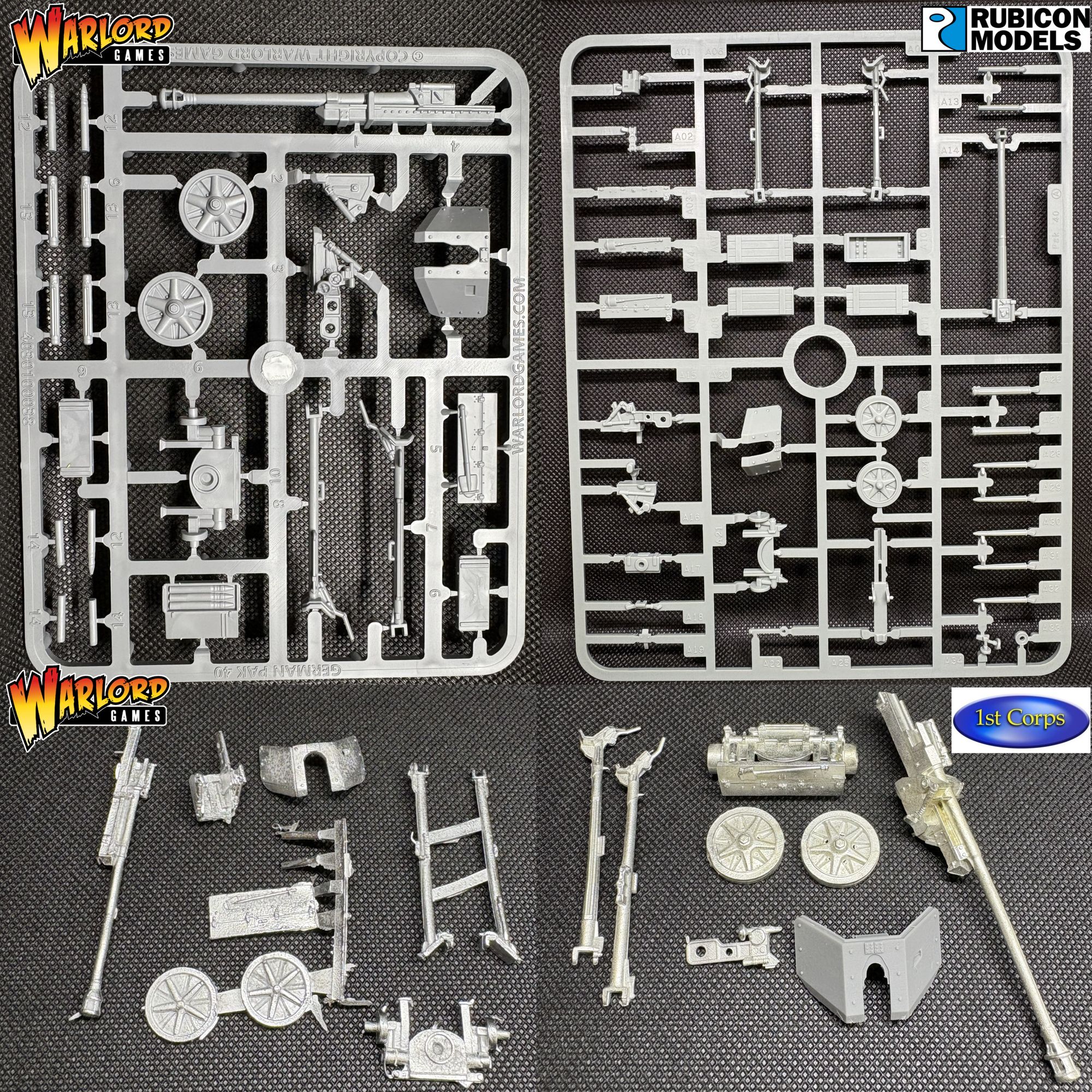
Jumping right in I can say with confidence that the new plastic Warlord kit is an excellent entry point for new modelers or those looking for an easy build. It consisting of just 10 parts with no especially small or fiddly components. Everything fits together cleanly, making it an easy kit to build in a single sitting.
Its predecessor, Warlord’s older metal kit, actually has one fewer part at 9 pieces, but don’t let that fool you. Many of the metal castings require straightening before assembly, and the mating surfaces often leave you fighting the model more than building it.
While Warlord is trying to keep its parts count low, Rubicon has decidedly gone the other way with double the parts at 19-20 total depending on what configuration you build the kit in. Many of these parts are quite small, including the traverse and elevation cranks and various towing hooks whose purpose we will cover in the gun carriage section.
Finally we have 1st Corps who have shrunk their part down to a mere 6 parts. It was by far the quickest and easiest build of the entire pack, pun intended, with minimal clean up required, solid connection points between the parts, and large parts that made assembly a breeze. Just remember to wash your metal and resin kits off with soapy warm water before assembly as I did find a fair bit of mold release present on the kit I received.
Barrel & Cradle
The barrel, breech, and cradle define much of a gun’s silhouette, and nothing ruins an anti-tank gun’s intimidation factor quite like a drooping barrel.
So how does the new plastic Warlord kit compare to its metal predecessor?
Actually, quite well.
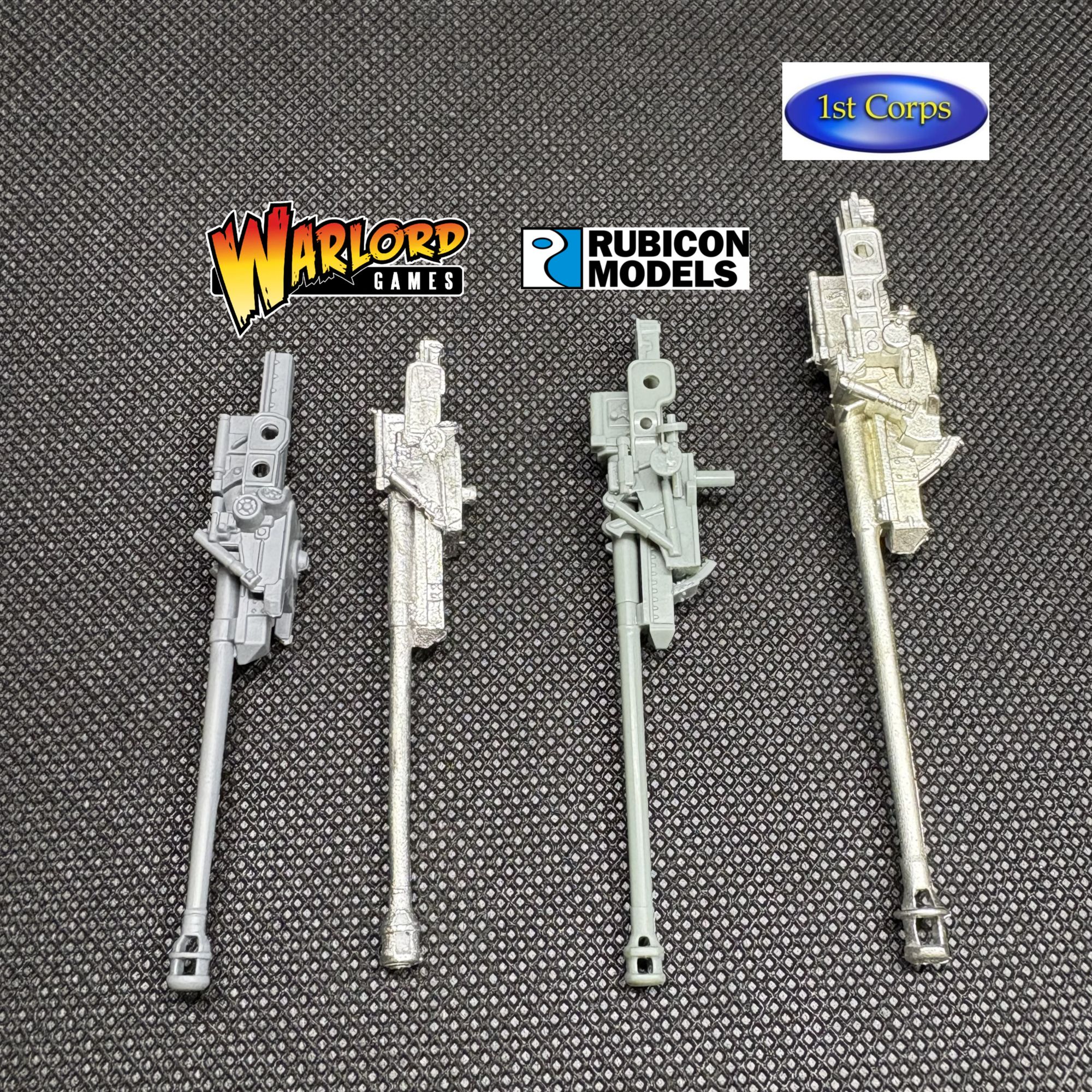
The barrel, breech, and cradle are molded as a single plastic piece featuring a well-defined muzzle brake. The cradle and saddle strike an excellent balance between detail and ease of assembly, requiring only two additional parts to complete. With minimal sanding and a few minutes of work, the result is what I consider the strongest barrel assembly of the four kits.
By contrast, Warlord’s older metal offering suffers from comically oversized proportions and a tendency to arrive bent or sagging—an indication of the projectile dysfunction common in older metal models. Overall, it’s a less-than-stellar representation of the Pak 40.
Moving beyond Warlord, Rubicon’s kit offers excellent detail throughout the breech and muzzle areas. However, that detail comes at the cost of complexity, requiring eight parts to complete the assembly. Where the design falls short is the barrel itself, which features a noticeable recessed ring at the forward cradle mounting point. On the real Pak 40, this collar should protrude rather than recess. I haven’t been able to find any Pak 40 variant with this feature, and once you notice it, it looks a bit odd. That said, Rubicon deserves credit for being the only manufacturer to engineer a functional mount that can be elevated and depressed after assembly.
The final contender, 1st Corps Miniatures, is by far the simplest to assemble, requiring only two parts. Taking advantage of its slightly larger scale, 1st Corps has packed an impressive amount of detail into the barrel assembly, rivaling or surpassing every other kit in this comparison. My sample also arrived perfectly straight, I even checked it with a ruler, so no concerns about barrel droop here.
Gun Shield
Next up is the iconic German wedge-shaped gun shield, a hallmark of German anti-tank guns from the mini Pak 36 to the gargant Pak 43.
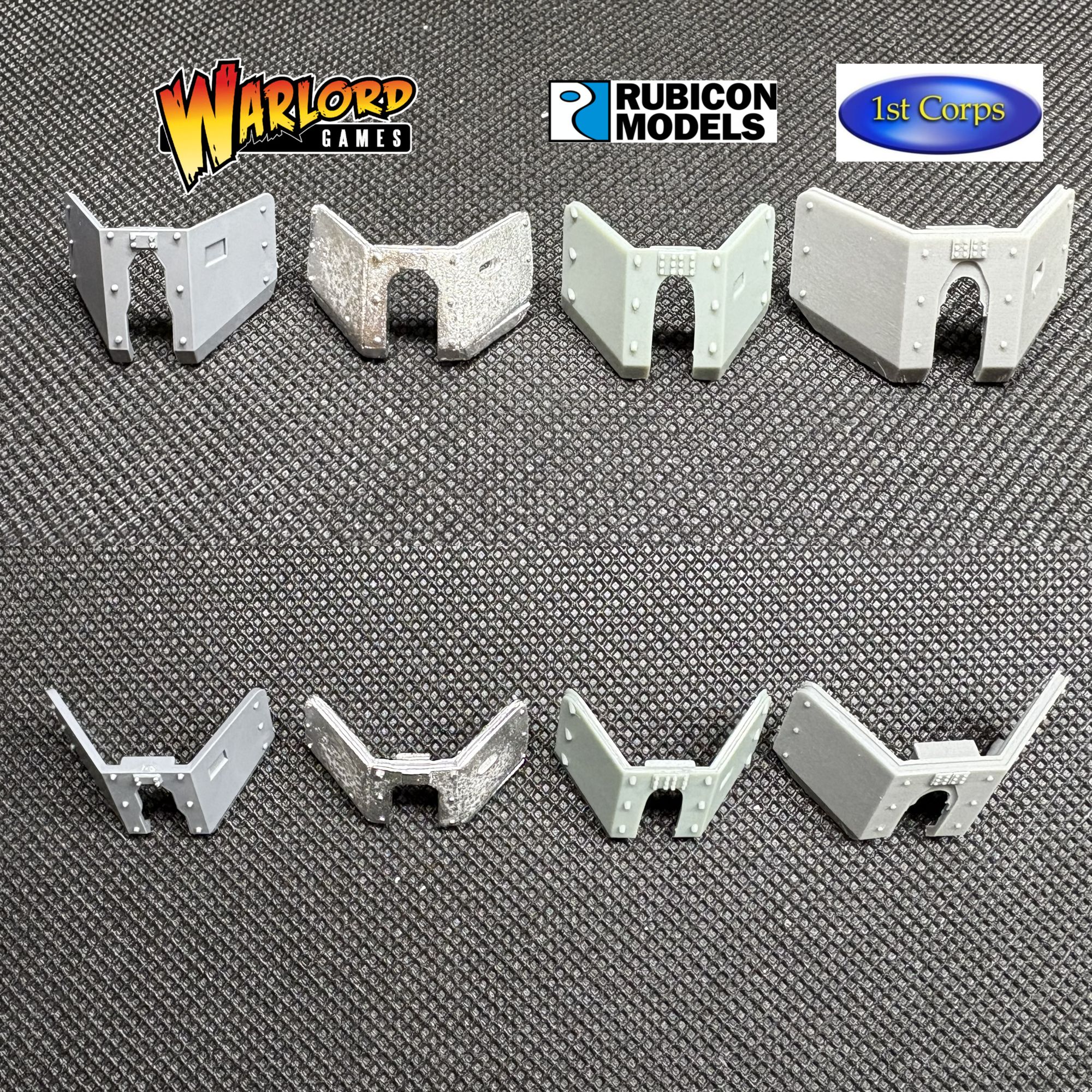
This was probably my least favorite component of Warlord’s original metal kit. The shield was often cast at too wide an angle, giving the gun an overly broad appearance, and bending it back into shape was never particularly enjoyable. Yet despite those shortcomings, the metal kit did have one major strength: a clear representation of the Pak 40’s distinctive double-layered gun shield.
Which makes it all the more frustrating that this feature is absent from the new plastic release.
The new plastic shield improves on the metal version in nearly every other respect, with sharper detail, cleaner molding, and a more accurate silhouette. However, it’s disappointing that Warlord chose not to replicate such a defining feature of the Pak 40, especially considering that the double-layered shield was standard on all German anti-tank guns after the Pak 38.
Some may argue that this was a necessary compromise when moving to plastic. My counterargument is simple: Rubicon managed it.
Rubicon’s plastic gun shield includes a convincing representation of the layered armor plates while maintaining comparable detail and proportions. Given the otherwise similar quality of the two kits, I would give Rubicon the edge in this category based on that feature alone.
Once again, 1st Corps enters the conversation and immediately raises the bar. Their shield features crisp rivet detail, the most convincing double-layered armor effect of the group, and several details absent from the other kits, including stowage items mounted to the rear of the shield.
The only concern I have is durability. Because the shield is cast in resin while the remainder of the kit is largely metal, I worry that a hard drop could potentially crack or break the shield. These are gaming pieces, after all, not display models.
Gun Carriage
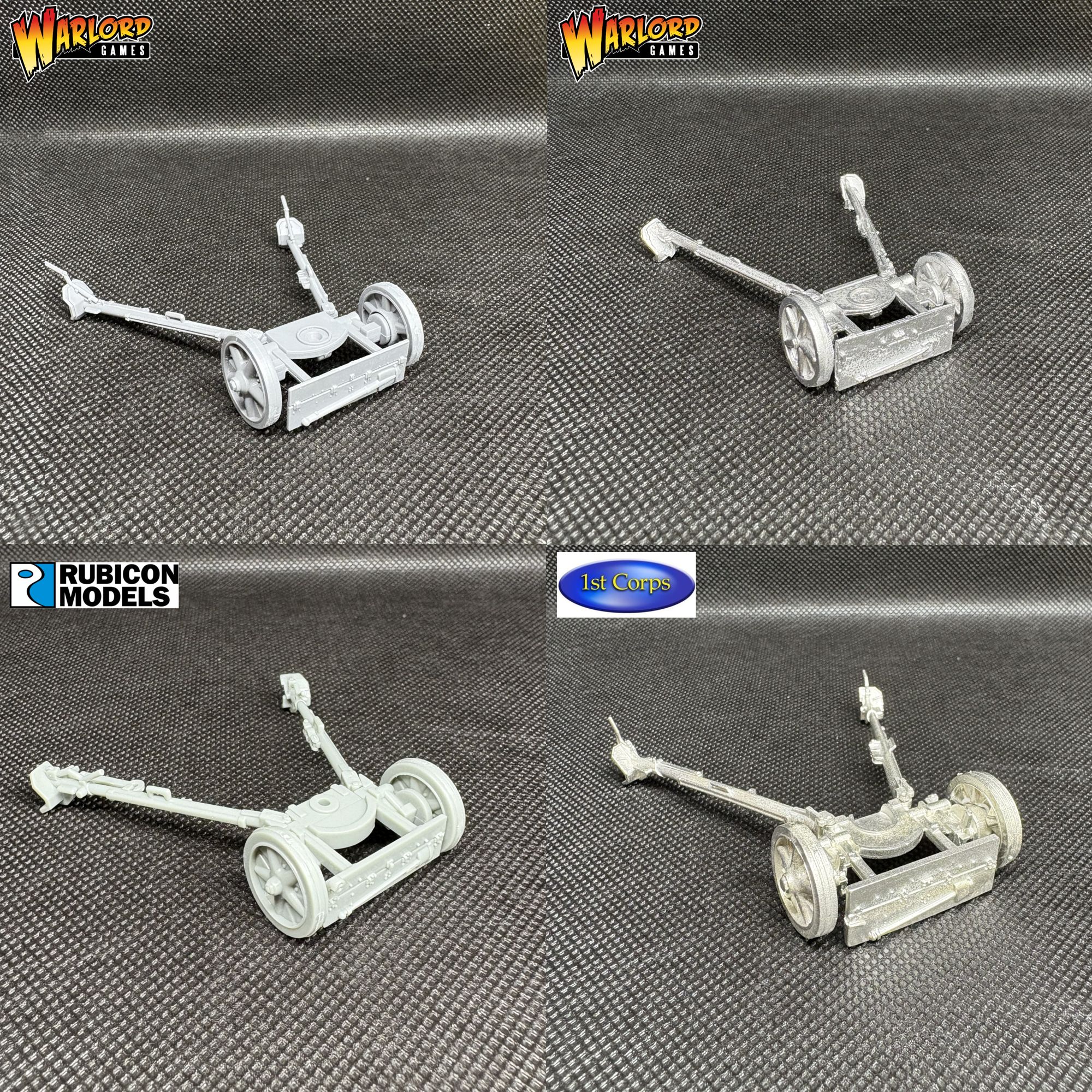
The final major assembly is the gun carriage. If I’m being honest, it’s also the least exciting and least noticeable part of the model.
There’s not much to distinguish the two Warlord kits here. Both use relatively simple six-part assemblies and feature towing hooks and connecting hardware molded directly onto the trail arms, meaning the guns can only be built in the deployed configuration.
As with the other components, the plastic Warlord kit represents a substantial improvement over the older metal version. Details are sharper throughout, particularly on the front shield, wheels, and the addition of the ground-spade operating levers at the rear of the trail arms.
Rubicon stands out by being the only kit that can be built in either the deployed or towing configuration. This provides a great deal of flexibility but once again comes at the cost of increased complexity, requiring ten or eleven parts depending on how the front shield is assembled.
With careful assembly and painting, it’s even possible to preserve both the gun’s traverse and elevation functions, which is a feature I find genuinely impressive.
Finally, we arrive at the 1st Corps kit. Like the Warlord offerings, it uses a relatively straightforward six-part assembly. Detail remains excellent throughout, but the carriage does suffer from some of the same limitations as the Warlord kits, with towing hooks and connectors molded directly onto larger components. Compared to the exceptional quality of its barrel and gun shield, this is probably the weakest part of the 1st Corps kit but only because it is good and not outstanding.
Conclusions
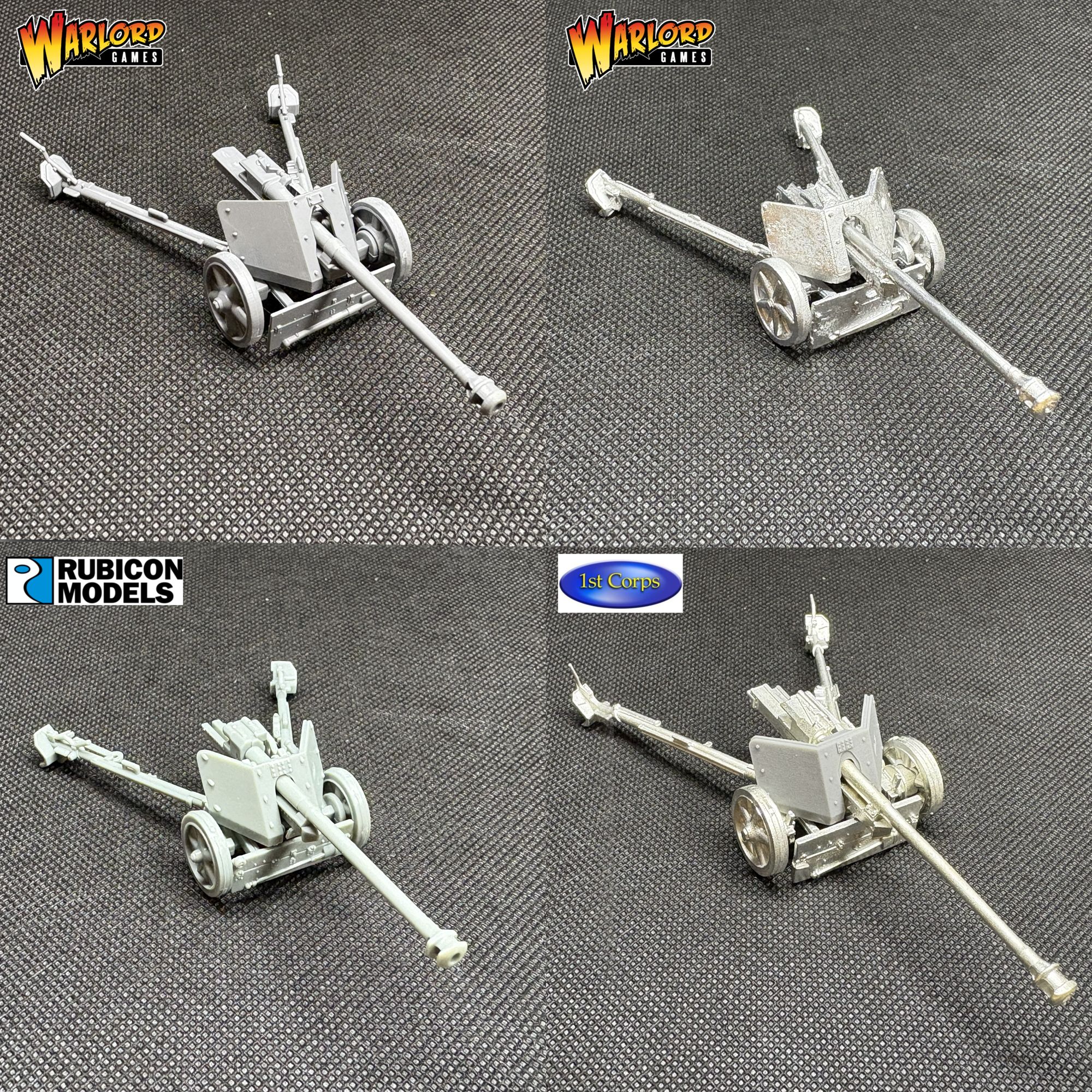
So, what’s the best Pak 40 kit currently on the market?
Well… it depends on what you’re looking for.
If you already own Warlord’s metal Pak 40 and simply need additional guns to fill out an artillery platoon, are new to the hobby and just starting a German army, or just want something easy to build that still looks great on the tabletop, I would strongly recommend the new plastic Warlord kit.
If you’re looking for maximum flexibility, perhaps a dedicated towing display, movable gun elevation, or traverse, or simply enjoy the assembly side of the hobby, Rubicon’s offering is probably the best fit.
If detail is your highest priority and you don’t mind working with metal, resin, or a slightly larger scale, or if you’ve already drank the 1:48 scale vehicle koolaid, then 1st Corps Miniatures deserves serious consideration. The amount of detail they’ve managed to pack into this kit is genuinely impressive.
Personally, I plan to use the new Warlord plastic Pak 40 gun carriage and gun assembly mated with the Rubicon gun shield to get the best of both worlds for my German army. The perks of getting to review all of them!
That’s a lot of ground to cover for a single anti-tank gun, but I hope this comparison helps you decide which Pak 40 is the right fit for your army.
Thanks for reading, and may the dice gods roll in your favor.
Oh, and I suppose the old Warlord metal kit could be the right fit for you if you’re a masochist.