No Dice No Glory Episode 79: Black Powder ACW Epic Battles
Today we have a special podcast for you. We sit down with Jon Russell from Warlord Games and we ask him all about the new Epic Battles for Black Powder.
By Kreighton Long

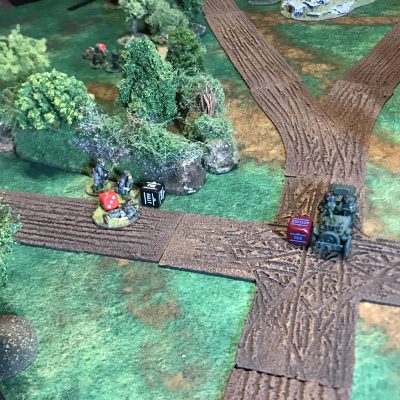
Gamers have a variety of means of marking progress and mechanics in their games. The means of doing so range as wildly as the reasons we need to track them. Whether the game calls it stress, fatigue, or pins, we can use tokens, dice, or counters.
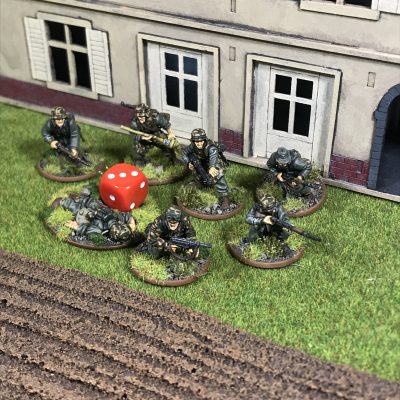
Players of Bolt Action deal with pins, a game concept that functions against a unit’s morale.
Marking pins on the table can be as simple or fancy as the player wants it to be. For my games, I decided that I wanted to create a way of tracking pins that would blend into the table and compliment the aesthetic as much as possible.
After some digging around I came across appropriate casualty markers from .
For this project specifically, I used a . The core idea here was to create a scenic looking marker combining a casualty model with a slot where a 9mm D6 can be turned to represent the number of pins on a unit. After completing the test piece shown below I’m committing to working on a set for personal use with my WWII German armies.
By Kreighton Long
While the Waffen SS made extensive use of camouflage uniforms, the German Heer incorporated its own pattern, albeit not to the thoroughness of their SS peers.
In this article, I would like to share my process for painting Splinter Camouflage. This pattern is applicable for both Heer as well as Luftwaffe Fallschirmjager who sported similar patterns during the mid and late-war periods.
I recommend finding examples of splinter camouflage in history books or Google Images and leaning on them to help form the shapes of the different parts of this pattern. We will be using the following Vallejo paints in this tutorial: German Cam. Beige (821), Leather Brown (871), German Cam. Medium brown (826), Black (950), and Luftwaffe Cam. Green (823). We will also use Citadel’s Seraphim Sepia as a wash.
By Tom Gall
There are a good number of quality WWII rulesets in existence, let’s explore some of these rules, point out what their strong/weak points are and compare what might draw you to one over the other.
The rulesets considered in this article are : by Battlefront, by Too Fat Lardies, by Warlord, by Plastic Soldier Company.
Each of these rules is generally company level actions with support, for the most part, feature individual models, and focus on the WWII era. All are D6 based. All have extra material that offer campaign experiences, lists, and flavor to feel like you’re been given command with a battle to win. All are either point costed and/or have a list building system which makes it easier to put together a game.
This week, we’ll look at two of the four: FOW and Battlegroup. The other two systems will follow in a later article.
By Tom Burgess
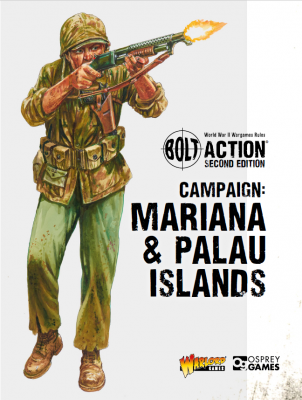
When Warlord expanded their Bolt Action campaigns in the Pacific to include Campaign: Mariana & Palau Islands I was ecstatic to see that they included coverage of the US Army in this campaign.
Though US Army Divisions serving in the Pacific far outnumbered the US Marine Divisions, addressing the US Army is always a second thought in Pacific wargaming if it gets any attention at all.
Kudos to Warlord for not leaving the US Army out on this book. One unit that I have always wanted to model, 2nd Platoon, Able Company, 1st Battalion, 322nd Infantry Regiment in the Battle, fought its first battle on Angular Island.
By Kreighton Long
Last week Warlord Games made the new book available for pre-order. This latest addition to their inventory of Bolt Action supplemental materials provides just over 150 pages of new content for fans of the 28mm World War Two skirmish game.
Focused on two campaigns in the South Pacific, this book attempts to provide engaging scenarios and unique unit and theater options for players representing the Japanese and United States combatants of the war.
The battles for the Marianas and Palau Islands all occurred during the summer and autumn of 1944, half a world away from the violent crescendos of the Normandy landings and Operation Market Garden in western Europe and Operation Bagration in eastern Europe.

By Kreighton Long
This past weekend the hosted CYBËR WÅRS 2020 giving attendees a virtual convention experience that will hopefully help alleviate some of the pent up pressure to geek out after months of closed shops and social distancing.
Throughout the CYBËR WÅRS weekend over a dozen panels took place over Zoom with interviews of movers and shakers in the wargaming community. During one such panel representatives from came together for a 2-hour conversation including some sneak peeks at upcoming releases and works-in-progress over at Warlord HQ.
By Kreighton Long
As the pandemic continues to dominate our news feeds and our minds I’ve been trying to focus on the future and how exciting it will be to attend club days and tournaments.
Warlord Games is doing its part to ramp up my excitement with the planned publication of their second D-Day Campaign Book with nearly two hundred pages focusing on the Anglo-Canadian Sectors from Gold, Sword, and Juno Beaches to the capture of Caen and the German defeat at the Falaise Pocket.
As you can expect from Warlord, this book contains new historical scenarios, units, and theater selectors.
Look for Bolt Action: Campaign: D-Day: British and Canadian Sectors to be released this coming Autumn. With the disruptions from the pandemic, Warlord has not put an official release date on it yet but indicate they hope to have it out potentially in October.
by Troy A. Hill
The Covid-19 pandemic is having both deleterious and beneficial effects on the Table Top Miniatures hobby. From missed conventions and abrupt halts, then sputtering starts to in-person gaming at Friendly Local Gaming Stores (FLGSs), the pandemic has really rocked the table-top gaming industry back on its heels.
But, I’m seeing a trend on many of the social media platforms: either new gamers are entering the hobby, or existing gamers are picking up new armies, or new games to try. One area is in the Napoleonic gaming world. I’ve seen several “New to the hobby, where do I begin?” posts just in the forums and pages with Warlord Games.
I’m in that same boat, and I’m happy to share my trials and tribulations, so any gamers jumping into the great unknown of Napoleonics can learn from my mistakes.
In this piece, I’ll share what I learned about researching, and the models I’ve begun with. I’ll also include images of the Warlord British Line Infantry models, and the process I went through assembling and painting them. You might want to read the image captions separately from the text of the main piece.
by Dennis ‘Matt Varnish’ Campbell
Everyone has that model or unit that is just… well… it’s not your best work. For my Napoleonic French army in 28mm, that unit is my battalion of Old Guard. Here is the story of how they are my worst unit and how I fixed the situation
First of all, in preparation for a big game of a while back, I had decided that I needed an Elite unit to back up my glorious Line infantry, and so painted all 24 figures in one day. Naturally, the plan was to come back later and re-work them.. so its very basic.. main colours then a wash over the whole model with GW Nuln oil. My pot of Nuln Oil was bad so that it left pools of white residue everywhere and a super gloss finish.
I still used them for the game. On my way back, I had to slam on my brakes for some lady in a white SUV who cut me off, and I could HEAR my boxes of miniatures in my trunk tipping over. I could only imagine the carnage. Almost every single model that had rifles facing forwards were broken, and I had to re-glue so many bayonets, that I only used them in one other game after that,