Podcast: No Dice No Glory Episode 78: Battle Vault EP13 Bagration German Deep Dive
NDNG BattleVault Episode 13 Bagration German Deep Dive.
By Tom Gall
The Flames of War Late War series continues with the latest book Bagration German. This is force is the mirror to the . Battlefront has slated the book, command cards, unit cards are more for a January release. Already if you look at the Battlefront site, you’ll see a .
Will this book make up for the Russian advances contained in the Bagration Soviet book? Is there a new meta ahead? Will Hetzers Hetz? What surprises await? Let’s dive and see what Bagration German offers for you!
By Mitch Reed
Recently sent me some of their brand-new and I got around to finishing them just in time to make sure that they land on your holiday wish list. I usually do not collect too much terrain in 15mm however after recently getting a mat that looks like a torn-up battlefield, I decided to take this project on. Past buildings from Battlefront were usually one to three-story affairs made of resin and came pre-painted, these plastic kits are huge and very well done with five floors to expand your table upwards.
by Tom Gall
In this article we’re going to focus on infantry for Battlegroup NorthAG by the Plastic Soldier Company. How should we paint and base them?
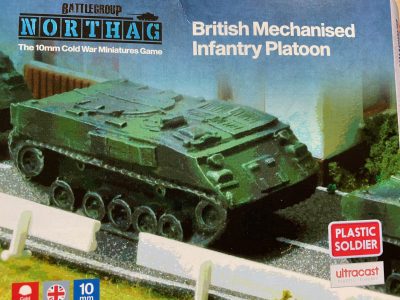
Let’s start out with British infantry, as their camo pattern uniform is a bit more complicated. For the models, I’m using the Plastic Soldier Company 10mm Ultracast, mechanized infantry box.
Starting with a base coat, I primed my British black. Starting with Helmets 888 as the initial coat of Vallejo, followed by a dry brush of 886 Green Grey Vallejo.
Glenn, Tyler and Tom talk about what they’ve been up to since the kickstarter for “Raise the Black” Ended. Tom and Glenn plan their next bet to motivate each other to keep painting. And Tyler and Glenn help walk us through the next two scenarios in their strategy tutorial series (Control the Field and Take and Hold).
By Tyler Stone
Well, the is a wrap and the pledge manager is on the horizon (possibly even available, by the time you’re reading this) and it’s time to start thinking about what boxes you’d like to add to that Admiral pledge. But what if you’re done deciding, and that decision was Soldiers? Well, you’re in luck, because I’ve got a battle report with the French Army list that Mike sent out us to preview. So charge your muskets and fix bayonets, let’s dive into some new material.
By Kreighton Long
Following a successful campaign, is due to release additions to their in the coming months. These additions include a variety of US and Russian miniatures including nine-man fire teams for both nations.
The metal models come in a healthy variety of poses as they shoot, move, and communicate around the battlefield. This month we’ll take a look at the Russian miniatures.
By Kreighton Long

Gamers have a variety of means of marking progress and mechanics in their games. The means of doing so range as wildly as the reasons we need to track them. Whether the game calls it stress, fatigue, or pins, we can use tokens, dice, or counters.
Players of Bolt Action deal with pins, a game concept that functions against a unit’s morale.
Marking pins on the table can be as simple or fancy as the player wants it to be. For my games, I decided that I wanted to create a way of tracking pins that would blend into the table and compliment the aesthetic as much as possible.
After some digging around I came across appropriate casualty markers from .
For this project specifically, I used a . The core idea here was to create a scenic looking marker combining a casualty model with a slot where a 9mm D6 can be turned to represent the number of pins on a unit. After completing the test piece shown below I’m committing to working on a set for personal use with my WWII German armies.
I am joined by Liz Davidson (Beyond Solitaire) and we talk about the Zenobia Awards, which looks to add diversity in the historical gaming community.
By Robert Kelly
I had been to the in Aarhus, Denmark on a previous visit, but when I found out that they had spent about $1.5 million dollars on a refurbishment, I figured it was time to check it out again. The most striking thing about the museum is that it is housed in the former Gestapo Headquarters. The Germans invaded Denmark on 9 April, 1940 and by the end of the day, Denmark had capitulated. You first had to reserve a spot in the museum (its very small) and then pay just under $12 USD on entry.