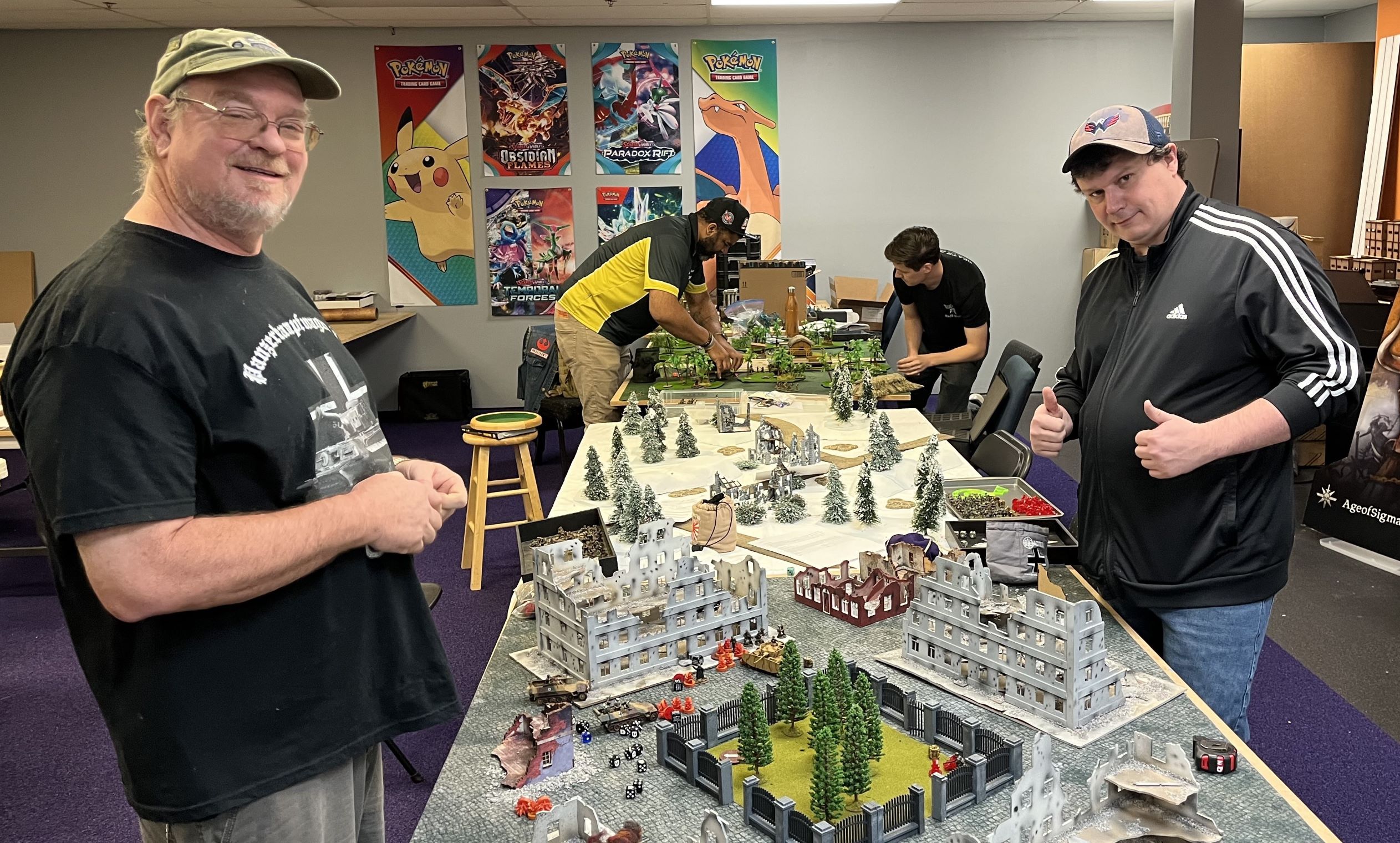
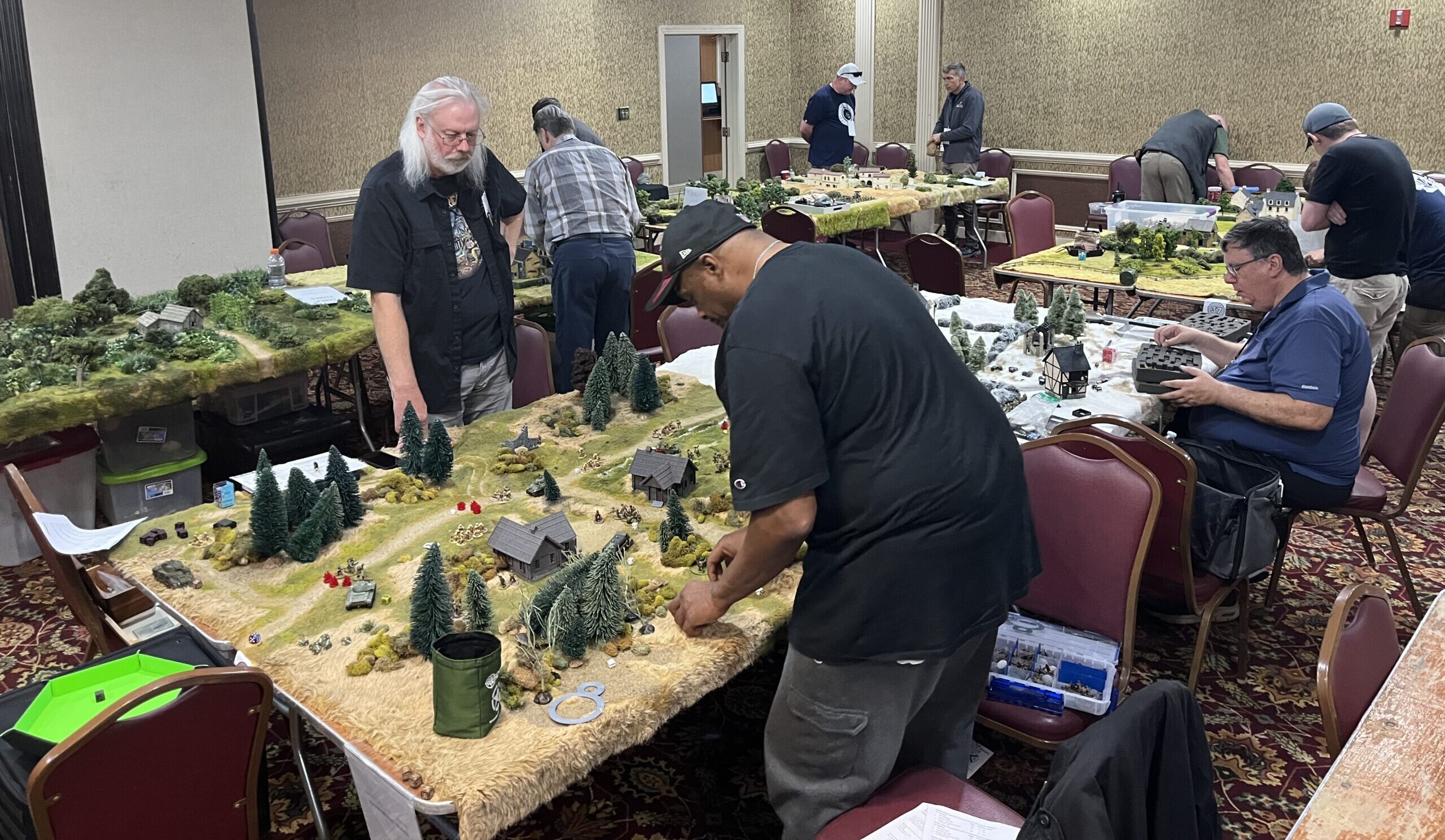
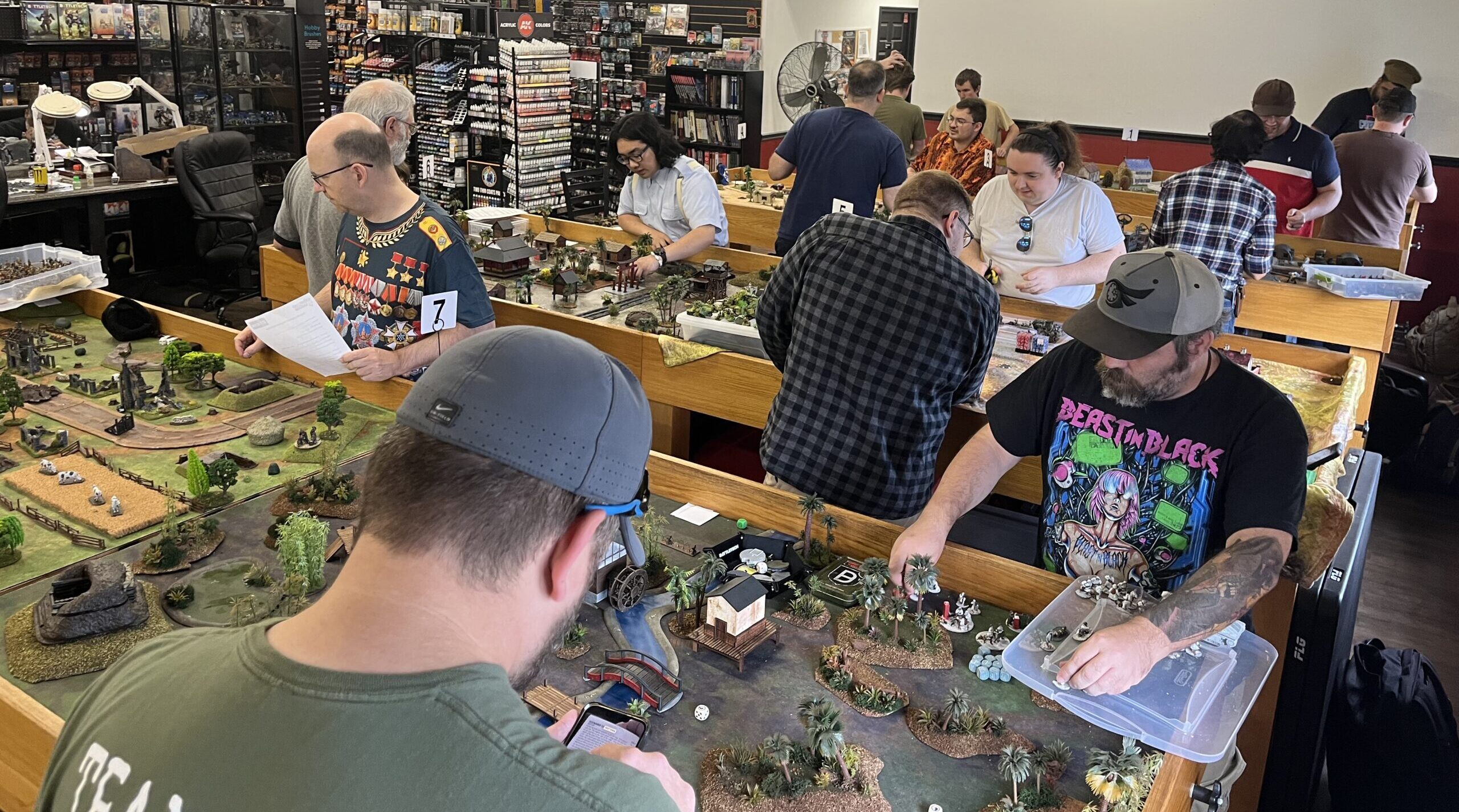
I recently had the pleasure of attending a 1000 point Bolt Action tournament at Your Hobby Place in Fredericksburg, VA. The tournament was hosted by Josiah Nehrke and we began the day with six players. The participants played through three rounds: Key Positions, Seek and Destroy, and Breakthrough. The lower than expected turnout was likely due to the tournament falling on Mothers Day weekend and that the previous weekend was another local tournament at the Richmond Open. The event progressed smoothly with all parties respecting the prescribed schedule and the whole event had a friendly atmosphere with players joking and helping each other with rules throughout the day.
Josiah’s highlight of the tournament was the high standard for how the players’ armies were painted. He considers it rare to have such effort and care put into every players’ armies at events and the paint jobs, paired with the tables, made the event a special one. Special shout out to Wayne W. for his excellent terrain. Wayne provided nearly 100% of everything on the tables and multiple players took the time to praise the tables we had the opportunity to play on.
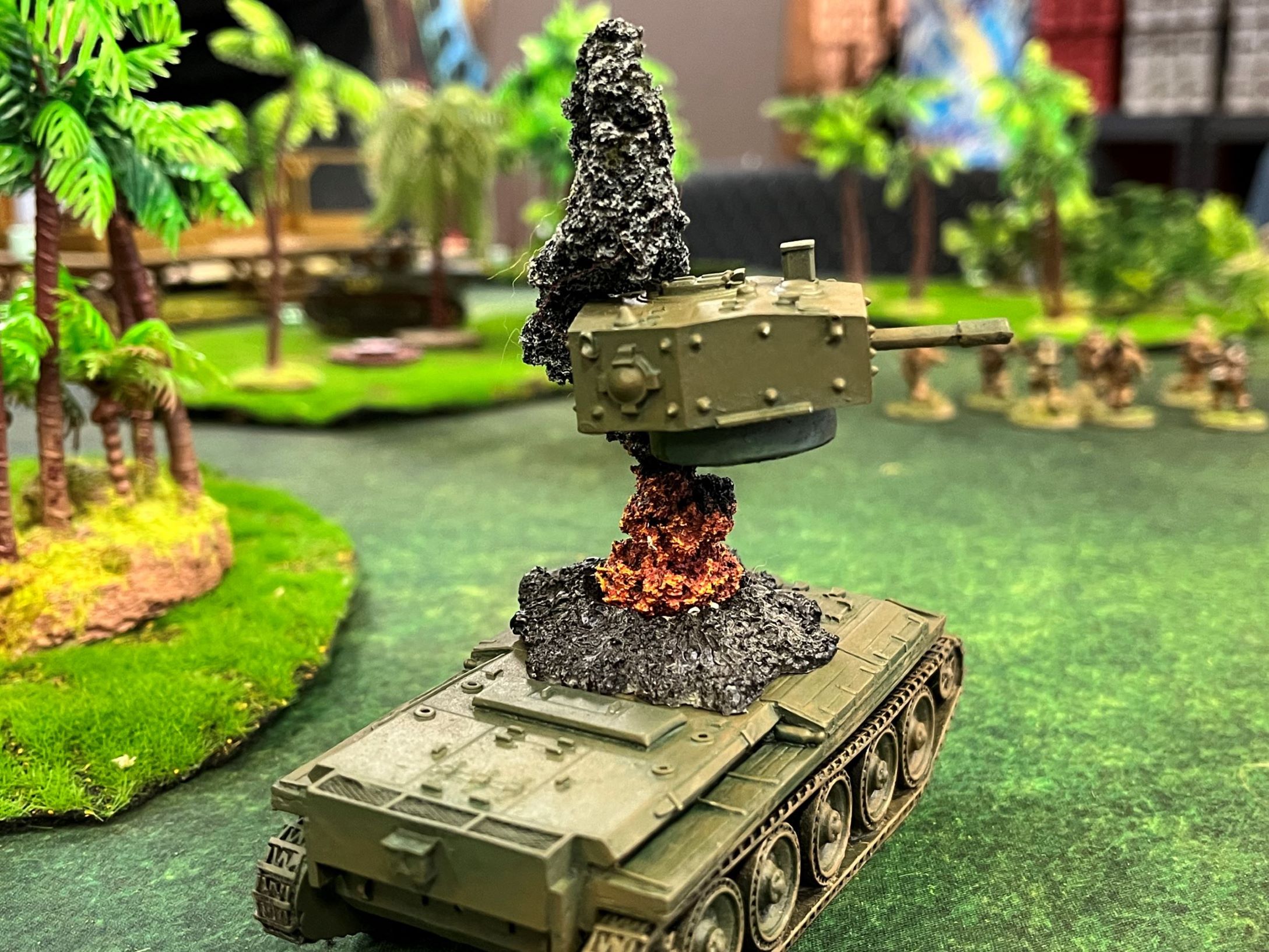
Brandon’s Centaur has a most unfortunate first round.
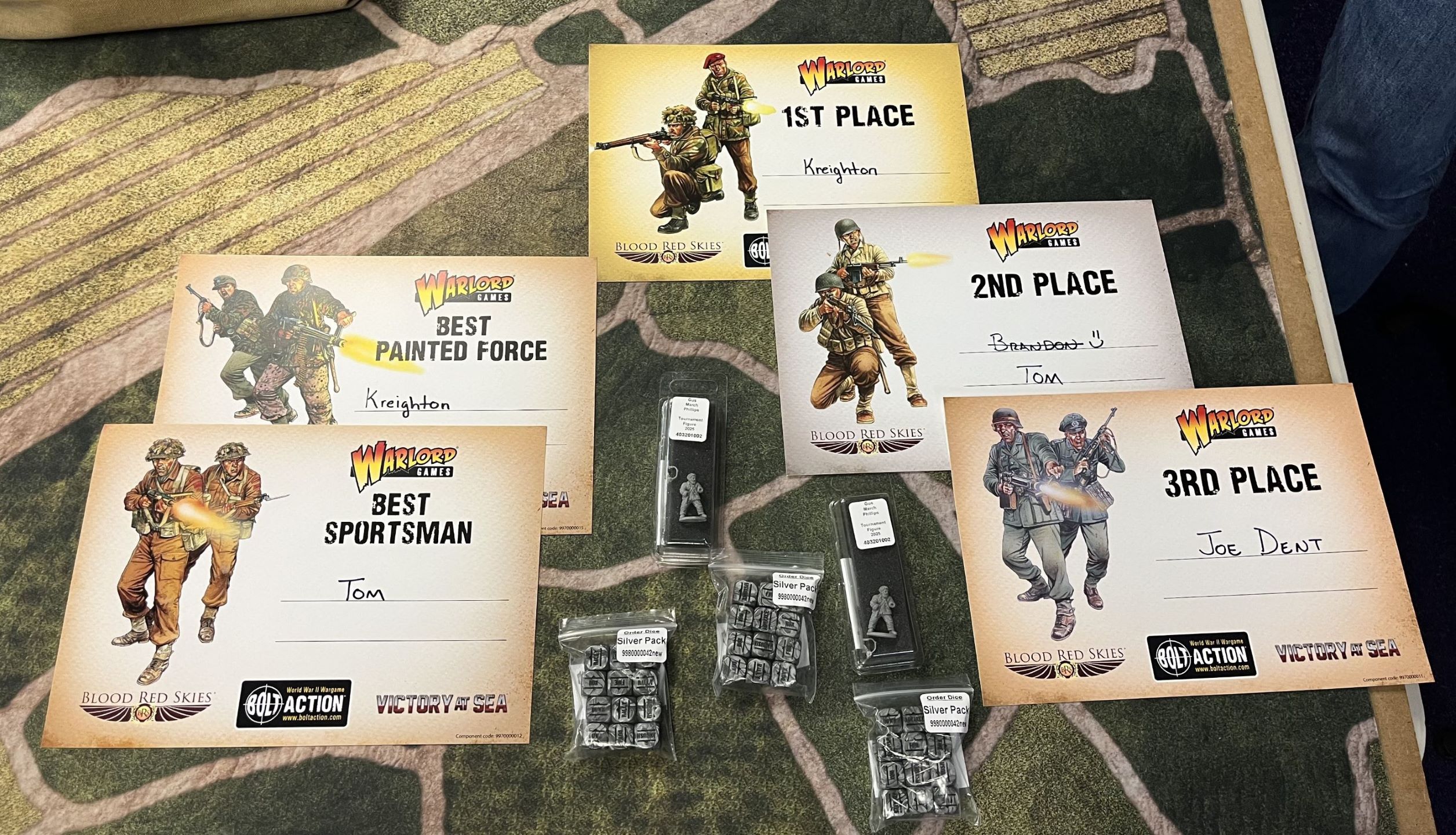
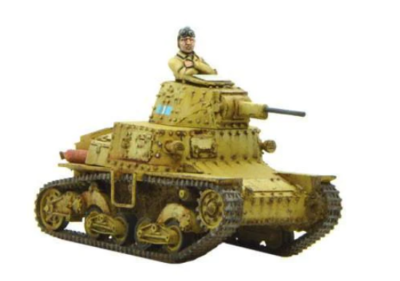
After finishing the day with two wins and a loss, I took home first place. My Italians pleasantly surprised me with how well they played following a disappointing few months before replacing three L6/40s with two M15/41s. The M15/41s worked well as they put out up to four pins per turn, if they divided their fire and had targets to engage, and even succeeded in knocking out three vehicles during the day. Fingers crossed that I can replicate this success at my next tournament at the end of May. The highlight of the tournament for me was having the opportunity to see so many well-painted armies on great looking tables. I’m a sucker for the aesthetics of this hobby and when players put effort and pride into armies that go on tables similarly decorated, I can’t help but have a great day.
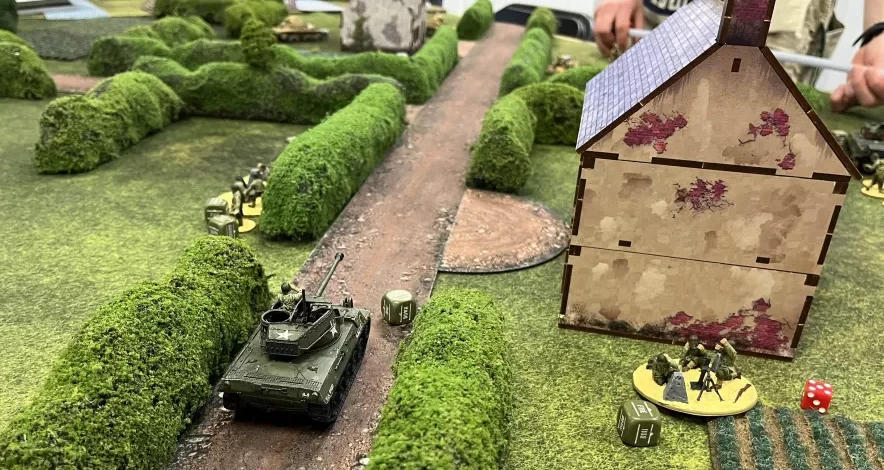
My Italian infantry advance under the cover of an M15 and a light mortar.
The second place finisher was Tom Slook, who also finished with two wins and a loss. Tom’s highlight from the tournament was his Hellcat advancing out of cover, hitting and knocking out his opponents Centaur with the first order die of the first turn of the first game. That gave Tom a notable morale boost early which carried him through the remainder of the tournament. His most valuable unit was the M5 Stuart with hedgerow cutters. The 5+ upgrade allowed the Stuart to open holes in the bocage in his second game which gave him a distinct advantage over his opponent. Tom also took home the award for Best Sportsman. Congrats Tom!
Tom’s Hellcat, laying in wait on Ambush, moments before knocking out an Italian M15. Photo by Tom Slook.
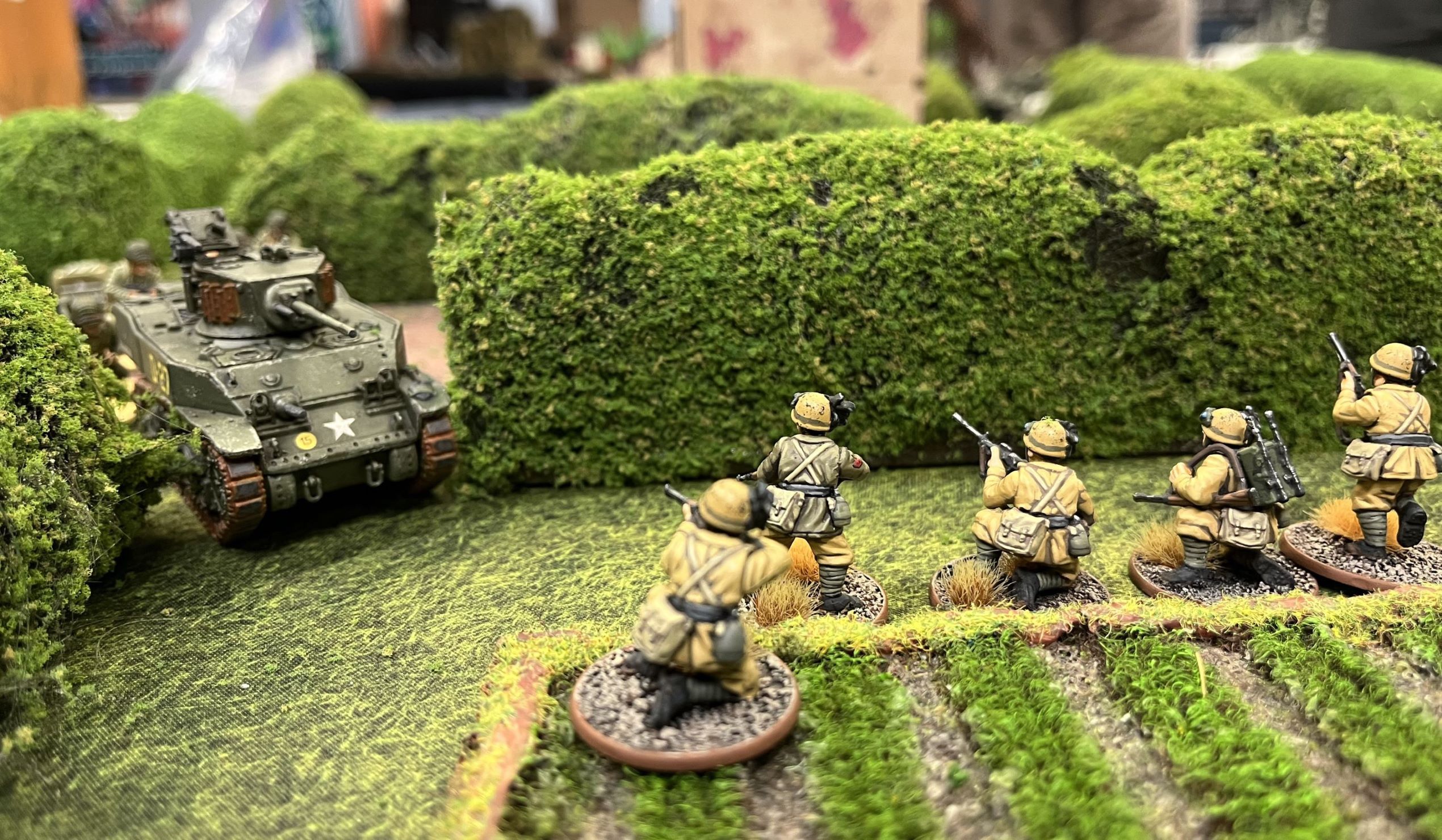
Tom’s Stuart, upgraded with hedgerow cutters, hunts down my Italians on the bocage table.
Joe Dent took home third place with a record of 1-1-1. Joe’s highlights from the tournament featured the paint jobs of the armies present. The tables themselves were also a treat for the players. The tables were well designed and decorated and each presented a unique challenge for players. Joe remarked how when seeing the tables he didn’t think, “oh god I hope I’m not on that one.” Joe’s most valuable units were his Regular German Grenadiers and his Veteran Panzer IV G with Panzer Ace. Joe brought five identical Grenadier squads and used the one LMG per squad to reach out and put pins on units to force his opponents to take Order Checks. Working together, the squads stacked pins on units even pinning out an enemy squad in the third round. Joe’s Panzer Ace Panzer IV was a real menace. As a Veteran tank, it ignored pins that could not penetrate it’s armor which kept it active throughout the game and it’s murderous Pen 6+1+D6 make quick work of any target it landed it hit on. It knocked out enemy armor in and survived all three rounds. After eliminating the enemy’s armor, the Panzer IV became a mobile machine gun bunker reliably putting pins on two enemy units per round of firing. Congrats Joe!
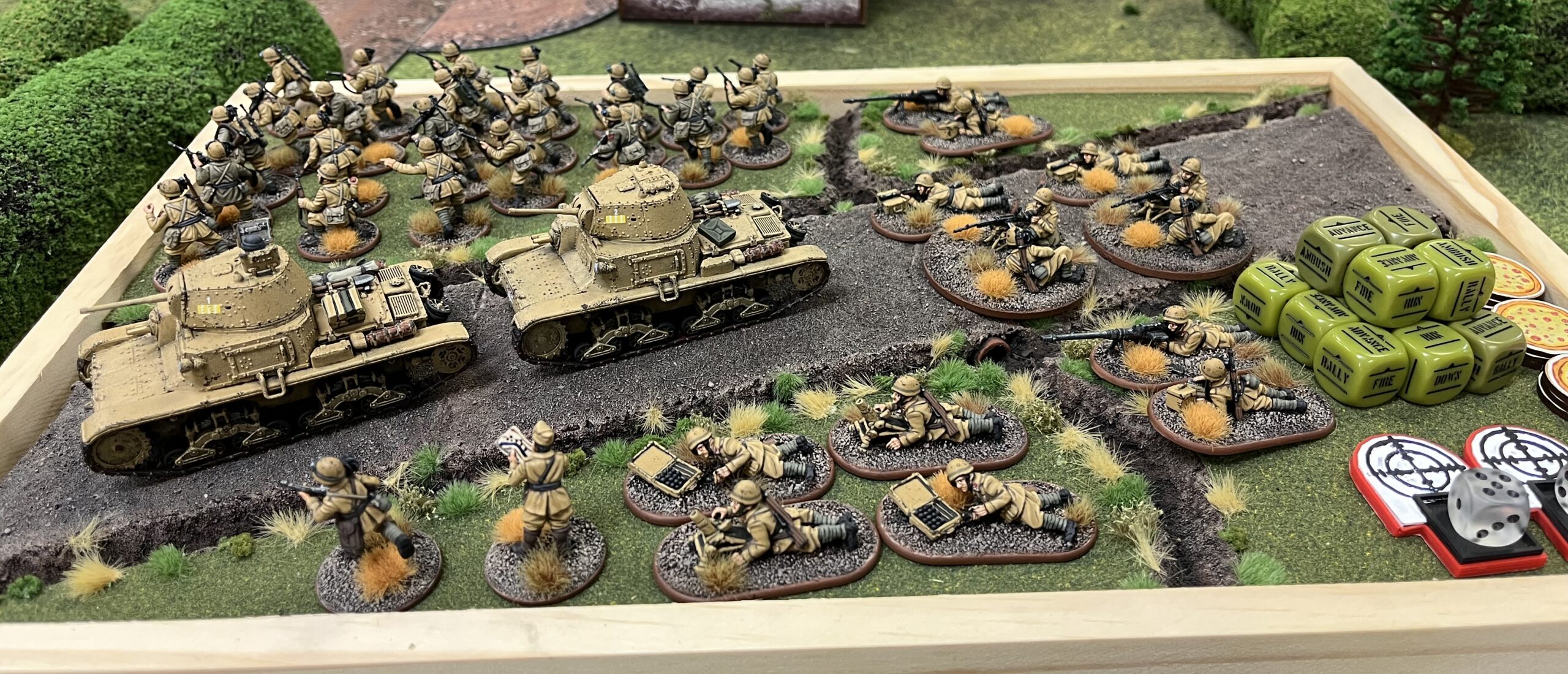
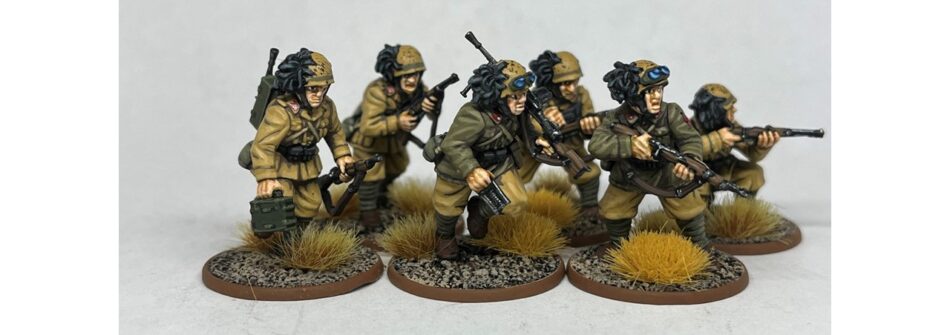
The Best Painted Army award went to my North African Italians. Josiah emphasized how the judge had to make several laps around the armies during the lunch break due to the caliber of submissions. This was my first foray into desert themed armies and I ended up enjoying the change of color schemes. The tan and ochre colors help my units stand out compared to the more common European themed armies which I believe will help them stand out during future painting competitions.
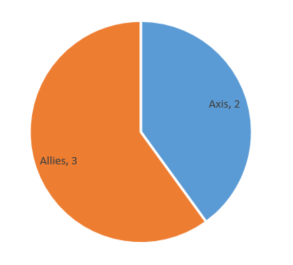
My North Africa Italians. The desert scheme certainly helped them stand out compared to the European themed armies.Of the five lists shared, there was a near even split between Axis and Allies with the Allies taking a slight advantage.
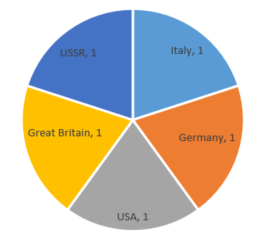
Of the five lists shared, there was an even distributions of different factions. This created a pleasantly diverse crowd at the event.
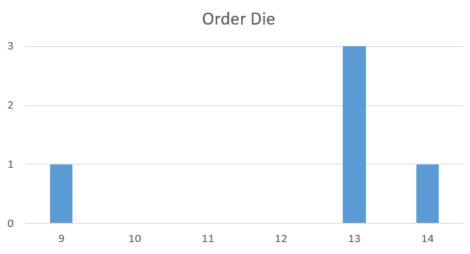
The most common order die amount at 1000 points was 13.
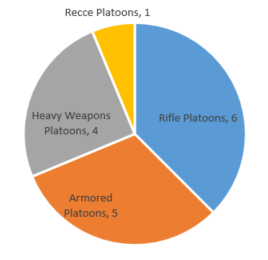
All five companies featured an armored platoon and almost all of them saw their infantry supported by a heavy weapons platoon.
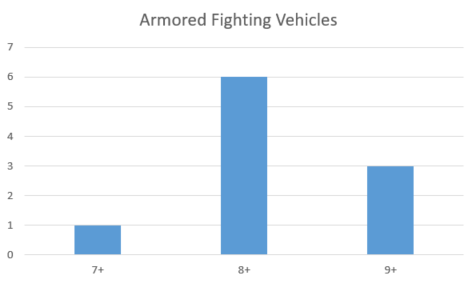
Every list shared featured an armored platoon with the most common armor value 8+. Armies without anti-tank capabilities would have struggled.
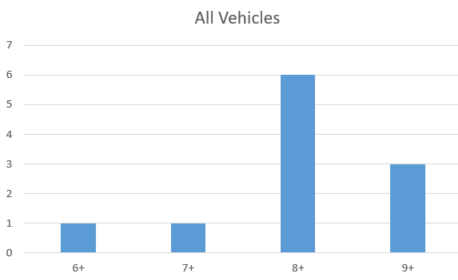
Of the five lists shared, there was only one vehicle that was not an armored fighting vehicle. That one was a soft skin gun platform. No transports were present which made the last mission, Breakthrough, more difficult as infantry had to slog their way across the table on foot.
Your Hobby Place, Fredericksburg, is planning on hosting another tournament in July. Keep an eye out for advertising for that tournament. Josiah is taking a break and will not run that tournament but plans on being back in his TO chair in November.
Thank you to the sponsors — Warlord Games and Your Hobby Place. Warlord Games provided a prize support package and Your Hobby Place the entry costs into store credit for the first and second place finishers.
With my first Bolt Action Third Edition specific army mapped out it was time to get out the sprue cutters, glue, and paints. My first target was to test out how I wanted to build and paint my Bersaglieri infantry.
I prefer the look of the helmets rather than the XXX for the Bersaglieri, so I started with one sprue’s worth of infantry with helmets. After considering available options I decided that my infantry would start with an NCO with a rifle, and LMG team, and additional riflemen.
Bolt Action Third Edition. Photo from Warlord Games.
With the recent release of Bolt Action Third Edition and the last round of Second Edition tournaments I set my sights on the future. Warlord’s timing of their Third Edition release complimented by natural project schedule perfectly. Over the last several years I’ve fallen into a routine build around Kalissa Skibicki’s Bolt Action tournament at the October Call to Arms convention in Williamsburg, VA. Once that tournament concludes I begin planning, building, painting, and training with a new army with the goal of being battle ready in time for the next Call to Arms tournament. In this manner I’ve built, competed with, and placed using Romanians, Italians, and Soviets in my last three appearances. With the release of Third Edition I have the added challenge of adapting the new force structure and implementing the new ruleset.
Warlord has truly done a phenomenal job of tempting me with their recently released kits. I snagged a box of Winter Americans with the Third Edition rulebook and was hard pressed to not do the same with their Winter Fallschirmjager. My bank account was disappointed when they also released their German Veterans kit and I couldn’t help but snag the army box with my pre-order of the Armies of Germany Third Edition book. Despite these temptations, I’m going to take my first dedicated Third Edition army in a different direction — somewhere notably warmer.
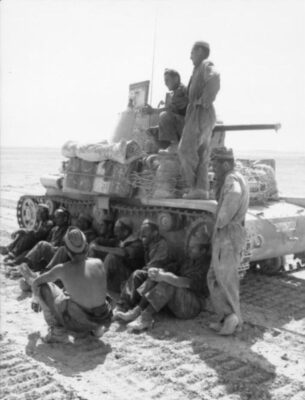
Italian tankers rest alongside their M13/40 tank. Photo from Wiki Commons.
In 2023 I captured first at Kalissa’s Call to Arms tournament and as I won it with my Italians I decided to claim a box of Bersaglieri for my prize. It seemed appropriate enough as I was riding a high after surprising wins with a force I did not anticipate to be as competitive as it ended up being. That kit sat in my box of shame for the last year and once Third Edition was announced my mind kept wandering to that simple box of plastic. For my first dedicated Third Edition army I am going to create an Africa Campaign themed Italian army using the Bersaglieri as the core of infantry.
With this project I have three goals in mind. The first is that I want to challenge myself to leave my comfort zone by painting and basing an army outside of my typical temperate Europe theme. By painting my army for the North African theater I will accomplish that. The second goal is to make it thematic. I will accomplish this by ensuring that whatever I put in this army makes sense within the scope of the Italian contribution to the North African campaign. Considering that this is the theater that the Italians featured heavily I imagine this one will be fairly simple to pull off. The third goal is to balance it between competitive and fun. This is the area I am the most nervous about pulling off. I want to avoid any units that break the game (looking at you Second Edition Dakka Stuarts/Panzers) while simultaneously keeping my list interesting and fun for me to take to games. As I do like to win I hope that I can temper my competitive edge to keep my list enjoyable for me to play, and more importantly here, fun for my opponent to play against.
After committing to building my first Bolt Action Third Edition army around the Italian army in North Africa I started to map out how the company would be structured. Some quick poking around online revealed that six Bersaglieri regiments served in North Africa so I can rest easy that we’re checking the box for historical accuracy (National Army Museum, New Zealand). Since I already had a box of Bersaglieri in my box of shame the infantry component was decided. Light Machine Guns will feature heavily in my squads due to the decreased point cost and that the Bersaglieri will play as Veterans which will give them more survivability to keep that LMG firing. So that’s the infantry platoon worked out.
Photo from Warlord Games.
For the second platoon I envisioned some tankettes or light tanks to support my infantry. Daydreaming in the twilight of Second Edition I wanted a platoon of tankettes to harass my opponents with. The L3/33s looked like fun little mobile, armored, MMG teams that were cost effective and could be a real pain for my opponent to deal with if I used them correctly. With the Third Edition change to vehicle mounted machine guns halving their rate of fire I was reluctantly turned away from the idea of a tankette swarm. Instead I began looking at other light tanks of the Italian army — and in drove the L6/40. In Third Edition, I can field a number of Regular L6/40s with a turret light auto-cannon in an 8+ hull with two negative rules (Vulnerable and One-Man Turret) offset by one positive (Recce). For 100 points, that doesn’t sound like a terrible deal and the fact that this light tank will find itself outgunned and outmaneuvered by most other tanks fits my idea of the Italian armored forces frequently finding itself behind the curve in North Africa.
The L6/40s first arrived in North Africa in December, 1941 for testing and soon after began arriving for combat duty. The 133rd Armored Division featured three squadrons of the light tank and served in the successful Axis siege of Tobruk in 1942 and continued to serve through the Third Battle of El Alamein (Tank Encyclopedia). This one example of L6/40s in North Africa, alongside the presence of Bersaglieri, checks the second historical accuracy box in my planned list. Considering the affordable cost of this cute little guy I will start with three in the tank platoon and will likely alternate between two and three in my company depending on the point maximum of the game.
Photo from Warlord Games.
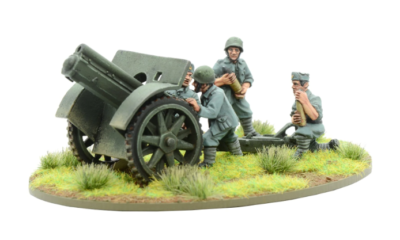
With LMGs and autocannons in my arsenal I decided my third platoon would need some heavy hitting power. To accomplish this I turned to the Armored Platoon. Fielding a number of artillery pieces will give my army some penetrating power to stall enemy armor and to knock out infantry squads. Medium howitzers in Third Edition hit with a 3″ template and +3 penetration. This level of howitzer can make quick work of Veteran infantry and can even destroy buildings with a lucky shot and the +3 penetration allows you to threaten medium armored vehicles and their 9+ armor. Against the front armor of a medium tank (9+ armor), the +3 penetration is a poor substitute for a dedicated anti-tank gun requiring a roll of 6 to penetrate. However, it is enough to force pins on Veteran 9+ vehicles and Inexperienced and Regular armored vehicles regardless of armor value. And in my experience, pouring pins onto an armored vehicle with howitzers, while not likely to destroy it, can force it to take increasingly difficult order tests and possibly invest a turn rallying. The indirect fire option is always a handy option when conducting counter-battery operations or trying to force dug in enemy units to displace. At 90 points apiece for a medium howitzer with a gun shield I plan on picking up three for a healthy battery presence and again will likely fluctuate between two and three depending on point maximums.
I dug around online and struggled to find organic Bersaglieri artillery batteries. Instead, I often found references to Bersaglieri working alongside divisional artillery assets in the form of the 100/17 Modello 14s which are treated as Medium Howitzers in Bolt Action (Comando Supremo Italy in WWII). At the time of writing this I have not stumbled onto evidence of Bersaglieri manning 100/17 Modello 14s as these guns were typically Divisional assets manned by regular Army gunners. Therefore, in keeping with my goal of making my list as historically accurate as I can I decided to purchase Warlord Games Italian Army 100/17 Modello 14 medium artillery kits rather than the Bersaglieri variants. If anyone can find a source verifying that Beraglieri troops served as gunners of these medium howitzers I would love to be proven wrong before adding these guns to my holiday wish-list.
For a first draft I feel confident that my Bersaglieri Company, made up of an infantry, armored, and artillery platoon, will be able to respond to most threats. The combination of mobility and firepower this list provides will hopefully end up being as fun to play in reality as it is in my head. Keeping my list realistic to what was available to Italian forces in North Africa will hopefully create a thematic and cohesive looking army that will look good on the table and be grounded enough to be fun for my opponent to play against. The next step is to start picking up the kits I need to make this happen and to add them to my painting queue. More to follow.
On Saturday, 12 October 2024, Kalissa Skibicki organized a Bolt Action tournament at the Call to Arms convention in Williamsburg, Virginia. Sixteen players brought their armies and positive attitudes for one last Bolt Action Second Edition tournament. Due to the travel involved for me to get down to Williamsburg, this tournament feels like a Bolt Action geek reunion where I have the pleasure of catching up with like minded people on an annual basis. I caught up with familiar faces and made some new friends throughout the weekend. Overall, the tournament appeared to have been a success with plenty of laughs and jokes to compliment the friendly competition of the day.
Kalissa’s highlight from the tournament was the influx of new players. She commented that around six of the sixteen players had recently started playing Bolt Action and that this was their first tournament. Moving forward, Kalissa, as well as her players, will need to become familiar with the revised rules of Third Edition which will require a not-too-small investment in revamping the tournament packs for Kalissa’s future tournaments.
After three rounds of games including Double Envelopment, Demolition, and No Man’s Land, the players gathered around Kalissa to hear the final results of their efforts. Due to all sixteen players tying in the second round, the final push to secure a place on the podium came down to secondary points. In this tournament, the secondary points resulted from order dice claimed minus order dice lost. After all the scores were tabulated, the winners were announced with one order dice separating first place from second.
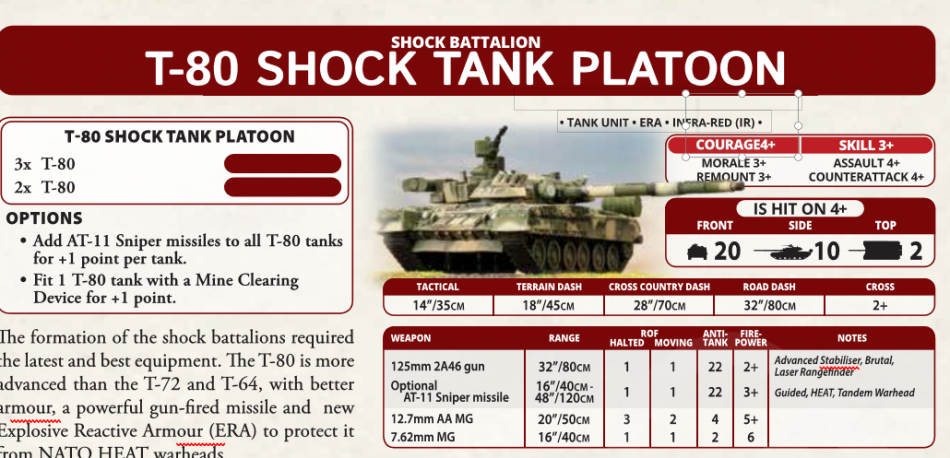
When Battlefront published WORLD WAR III TEAM YANKEE SOVIETS https://www.flamesofwar.com/hobby.aspx?art_id=7154 four years ago, they introduced Soviet units with NATO capabilities – the Shock T80 company. The backstory was that one of the regiments of 4th Guards Tank Division was permitted to experiment with Western-style tactics. The regiment created a special ‘shock’ battalion pairing shock tank companies with shock motor rifle companies.
Some consider the story inflated or perhaps fantasy. The truth is the Soviets had units that trained beyond the NORMs for motor rifle and tank formations and some that mimicked NATO tactics. The problem is that they weren’t equipped with T80s or BMP-3s.
This is their story, and PART II will be discussion of how to represent these units in casual gaming.
T80 Shock Platoon
Independent Regiments for Border Screening
Soviet troops patrolled the Inner German Border (IGB) from 1946. When the East Germans established their own military, they quickly established their own border troops – the Grenztruppen. These were lightly armed paramilitary police units. While effective at patrolling the border, they offered no security against a NATO attempt to forcibly reunify Germany. The Soviets backed these troops up with tank battalions augmented with their own infantry. These were called border screening troops, and distinct from KGB units. Their purpose was to protect the Soviet (and later Volksarmee) units deploying from garrison.
After Khrushchev ended the Soviet heavy tank family, STAVKA had the problem of repurposing heavy tank organizations. Many retained their original identities, even as they were re-equipped with Standard Tanks (the Soviet name for what the West called Main Battle Tanks or MBT). However several became parent HQ for collections of border screening units.
Some heavy tank battalions were fed into the screening organizations or used to give independent tank battalions to motor rifle divisions in the Group of Soviet Forces Germany (GSFG), Central Group of Forces (CGF) and others. By 1980 this process was complete, leaving GSFG with seven Independent Tank regiments for Border Screening. 5th Independent Tank Brigade’s conversion into the 138th Independent Tank Regiment ended the process.
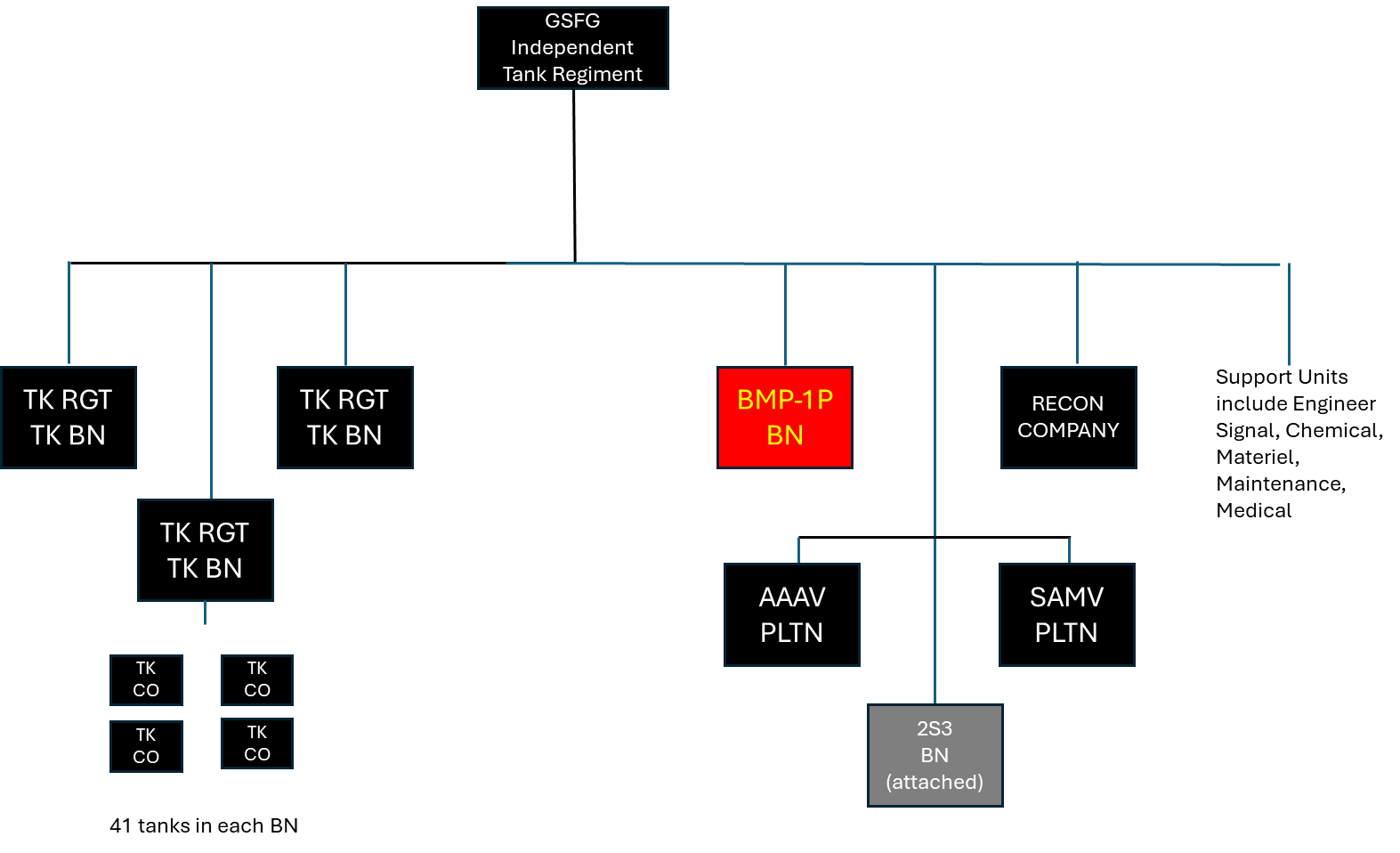
Figure 1 GSFG Independent Tank Regiment
These new regiments initially retained their old tanks until fielding of the T64 made T62s available. When T62s were withdrawn, they were re-equipped with T64As upgraded in East German workshops to T64B armor standards. According to ex-Soviet tankers corresponding on TANKNET, the T64s were in place by 1983.
These units’ peacetime function was providing collective training for other Soviet units in their area. They were encouraged to adopt Western style tactics, so that the beneficiaries of their attention became familiar with how NATO forces would respond. While not as sophisticated as the National Training Center experience, it was different than the typical Soviet exercise.
The incidental effect was these units were better trained than the typical Soviet unit, and able to copy NATO tactics. Put differently, they were virtually a match for BF’s description of ‘shock’ units.
In wartime, the role of the border screening regiments mirrored NATO’s covering forces with one significant difference – in short notice scenarios these regiments were expected to roar across the border and screen it from 20-30 kilometers deep in NATO territory, preventing NATO artillery from shelling border crossing points.
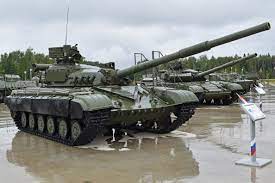
T64A, mainstay of Border Screening Regiments in 1985
The organization differed from the standard tank regiment. Each battalion had FOUR companies with a total of 41 tanks each, giving the regiment 124 tanks. The regiment had a full BMP battalion with 45 BMPs (BMP-1P after 1983). Some sources claim the reconnaissance company had an extra tracked recon platoon. One oddity was the absence of an artillery battalion.
To keep Western intelligence guessing about the wartime purpose of these units, the artillery battalions stationed separately and the TANKNET correspondents claimed they would be augmented by 2S3 Acacia battalions (Coincidentally, seven Soviet divisions in GSFG had an extra 2S3 battalion).
A New (Old) System of Maneuver
In the late 1970s Soviet military thinking focused on two concepts designed to break up NATOs evolving Forward Defense/Active Defense strategy. At the tactical level the concept was called Forward Detachments(FD) and at the operational (Army and Front) the method was the Operational Maneuver Group (OMG).
These techniques had been the cornerstone of Soviet success in WWII. However, as the Soviet Army mechanized, the techniques seemed less relevant. Both techniques exploited the speed differential between motorized units and the largely foot-mobile and horse-drawn formations fighting on the Eastern Front.
Soviet military theorists reconsidered the relevance when NATO moved from MASSIVE RETALIATION to FLEXIBLE RESPONSE in the mid-60s. NATO’s operational level implementation was Forward Defense – essentially lining the IGB with conventional forces using fixed defenses punctuated with large reserves to contain a Soviet breakthrough.
This system’s weakness was displayed during the Yom Kippur War in 1973. Both the Syrians and Egyptians broke through Israeli fixed defenses. The Israelis ‘won’ the war suffering heavy losses. The USA observed the war and concluded Forward Defense would fail. They began moving to a different operational method – Active Defense.
Active Defense visualized the Soviet breakthrough being ‘swarmed’ by thinning the Main Line of Resistance (MLR) to commit local reserves in small packets. Soviet strategists saw opportunities in the Active Defense technique. This raised potential for smaller Soviet forces to penetrate the remaining cordon on the MLR, as well as counter elements of the ‘swarm.’ This was the job of FDs.
The other opportunity was penetration in operational depth – i.e. to the NATO corps rear boundary – of a large, combined arms force while the main breakthrough was contending with the ‘swarm.’ This penetration would disrupt NATO logistics over a wide area and be too big for the remaining local reserves. This was the mission of the OMG.
FDs were combined arms units created at the division and regiment level as opportunities arose. Ideally, the units had teamed together in training. An OMG had to be preplanned. Training exercises in the mid-70s showed that ad hoc ‘Corps’ comprising two divisions had the combat power necessary for the mission, but the long logistics tail of the corps and the ad hoc nature of the arrangement reduced efficiency. Also the bigger the OMG, the longer the response time.
Ultimately the Soviets created specialized units to perform as OMGs at the TVD level, but at Front/Army levels repurposed existing formations to improve response time. This gave new life to independent tank regiments and independent tank brigades.
I’ve already discussed the border screening regiments of GSFG. Once their screening mission was complete, they assumed the role of normal independent tank regiments – a quick response OMG for their army. Each GSFG army had at least one.
Frontal Tank Brigades had disappeared from the GSFG by 1980, but the resources remained.
Hiding In Plain Sight – Tank Training Centers
By 1980 GSFG had consolidated most of its tank training units into two tank training centers operated by the 41st and 101st Tank Training Regiments. These were large organizations, providing both individual and collective training to GSFG units.
They each had several battalion sets of tanks, although most were T55s – cheaper to operate. They also had advanced tanks for familiarization and transition training.
With hostilities imminent, they would close. Western intelligence theorized that they could become the missing Frontal Tank Brigades, operating a mix of advanced (T80 or T64) tanks and T55s.
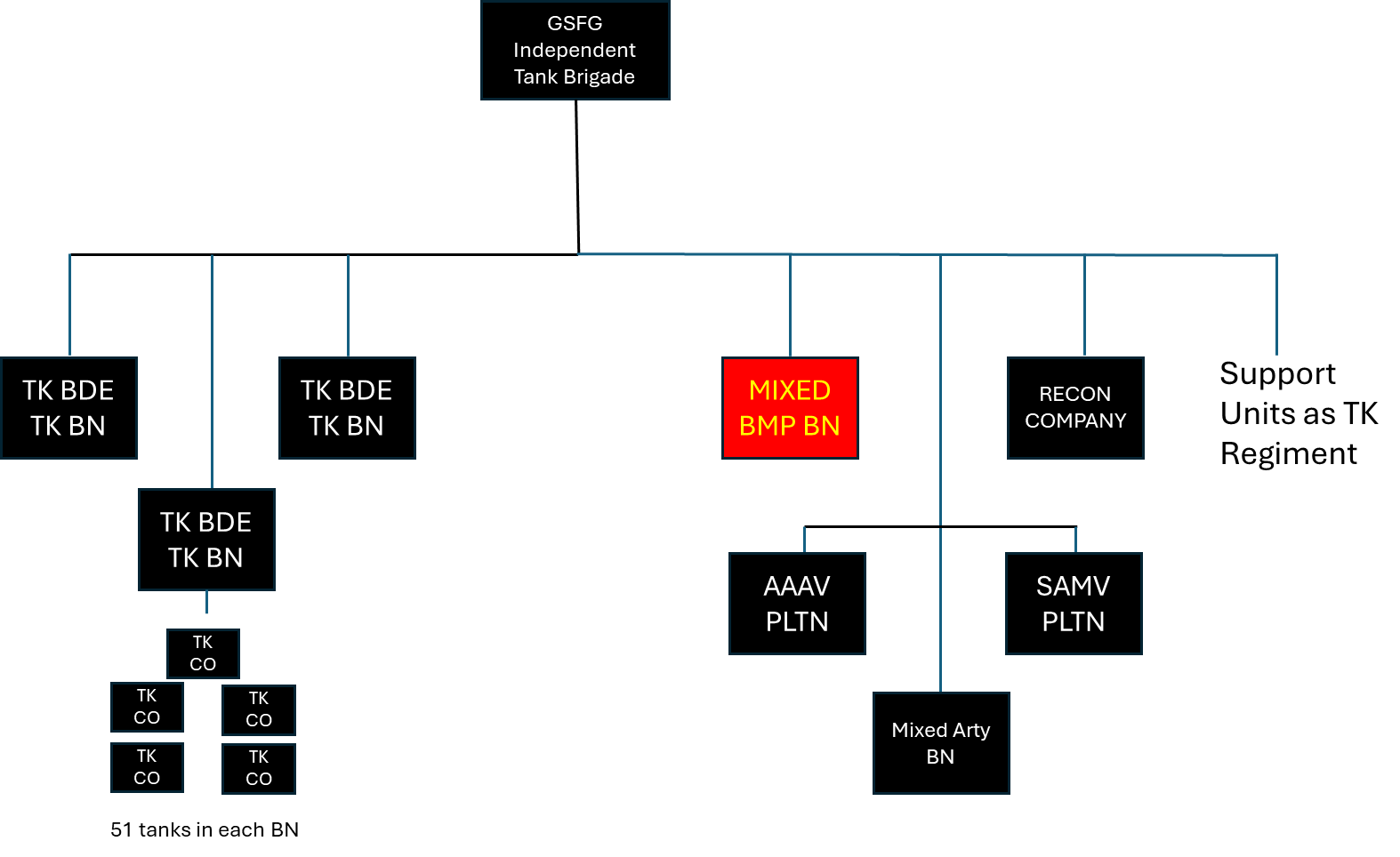
Figure 2 GSFG Independent Tank Brigade
The Tank Brigade TOE (Table of Organization and Equipment) was like the tank regiment, with tank battalions having five companies instead of four, for a total of 154 tanks. Both tank training centers easily met this threshold, and 101st Regiment had two training areas and could easily have fielded a fourth tank battalion. These centers had a mix of self-propelled artillery, likely fielding a mixed battalion. Again BMPs would provide the transport, although the riflemen would come from reserve units activating in the USSR.
While T55s seem odd in this role, remember the OMG’s purpose was a quick penetration of the NATO MLR and exploitation into the logistics areas. The T55 was easily a match for the equally old M48s that populated the West German Heimatschutzkommando brigades charged with Rear Area Combat Operations (RACO). Any tank – including the airborne ASU-85 – was deadly to the logistics units targeted by the OMG. And T55 fuel requirements were significantly lower than T64 or T80.
These units would have a high proportion of experienced praporschik (warrant officers) to command platoons thus being better able to operate independently. If the GSFG transitioned to war maintaining this proportion, these units could also qualify as ‘elite.’
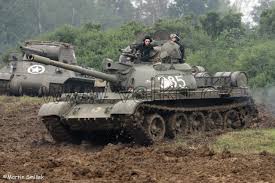
T55 with Laser Rangefinder – typical of gunnery training tanks
Combined (Unified) Army Corps
In 1980 the Soviets began experimenting with a new formation, variously called the Combined or Unified Army Corps. This was a revival of the Soviet mechanized corps of World War II, not a Corps in either the Western sense or the Soviet usage (Soviet corps of the late Cold War were multidivisional territorial commands directly subordinate to a military district, and usually found protecting the external borders. They lacked most of the support services normally found in a combined arms army).
Three divisions initially participated in this experiment – the 24th (Iron) Motor Rifle Division (MRD) at Lvov, the 120th (Rogachev Guards) Guards MRD at Minsk, and the 5th Guards (Don-Budapest) Tank Division (TKD) at Kyakhta.
In 1982 STAVKA authorized the 120th Guards MRD and the 5th Guards TKD to proceed with the next phase of the experiment. The 24th MRD was frozen. Western intelligence theorized that this was because the Soviets couldn’t afford the attack helicopter and air assault regiments demanded by the new TOE.
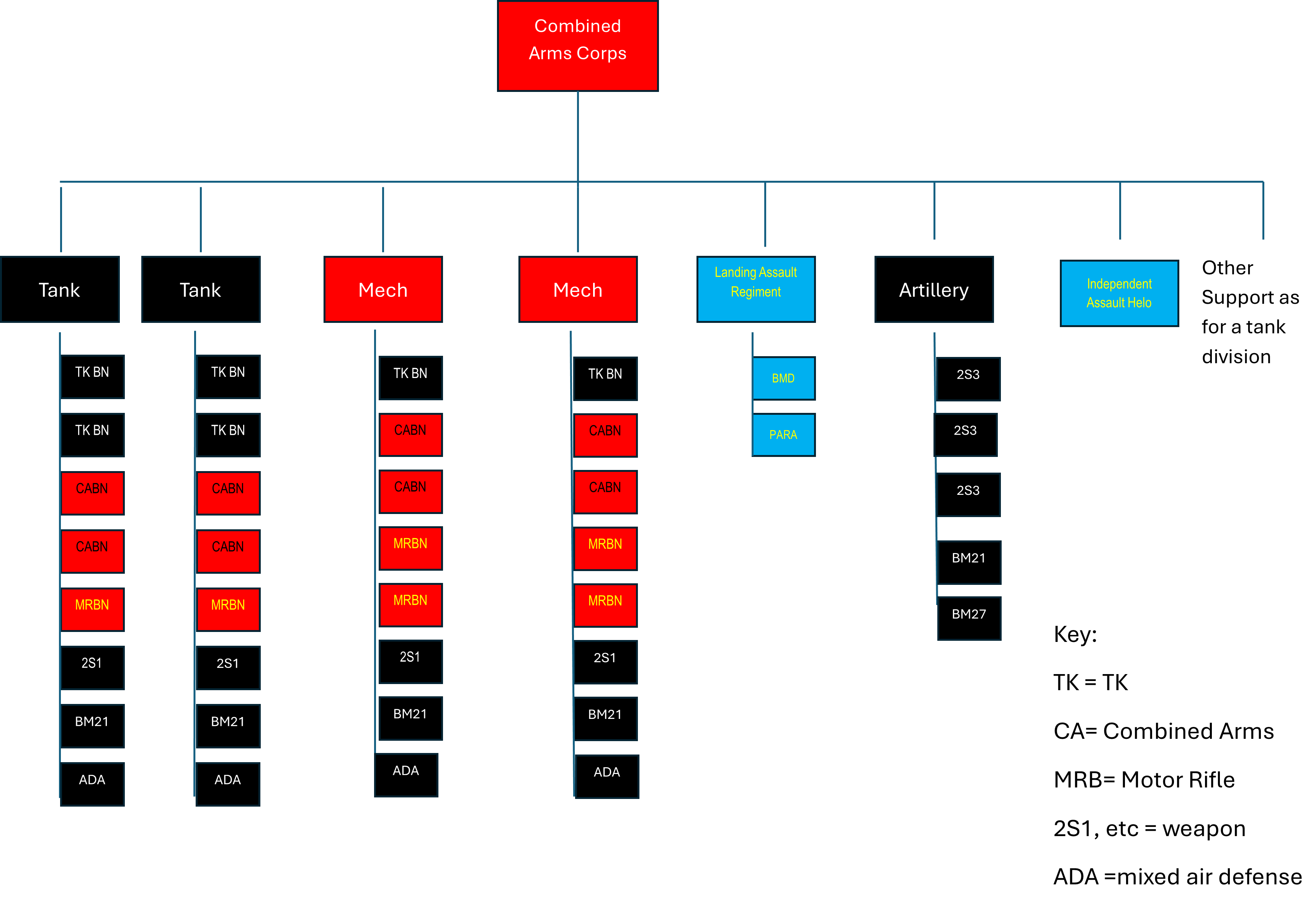
120th Guards MRD now became the 5th Combined Army Corps (CAC). 5th Guards TKD became the 48th Guards CAC. The organization developed through 1983. The CIA reported that the new organization was four brigades of five battalions each. Figure 3 shows the Corps organization around 1985.
The brigades had an organic BM-21 rocket artillery battalion, doubled the size of their air defense company and later added a battery of eight SA-8 Geckos changing the ADA unit into a battalion. The Corps air defense regiment eventually had five batteries of SA-11 Gadfly. The Corps had a BM-27 battalion in addition to ‘divisional’ BM-21s. The Artillery Regiment expanded to three 2S3 Acacia battalions.
Figure 3 Combined Army Corps c. 1985
The other unusual feature of these units was the Combined Arms Battalion (CAB). There were at least two in each brigade. Originally, two tank and one motor rifle battalion completed a Tank Brigade, and the companion Mechanized Brigade added one tank and two motor rifle battalions.
Both Corps had organic air assault capabilities, with a Landing Assault Regiment (including a BMD battalion) and an Independent Assault Helicopter Regiment.
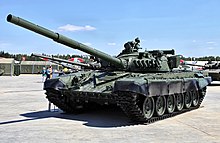
T72A – primary tank for 5th CAC 1983-1985
The number of CABs and subunit organization varied between the two Corps and from year to year. The baseline CAB appears to have been two tank companies and two motor rifle companies, but at times there were as many as five companies with Tank CAB having 3 tank companies plus 2 motor rifle companies and Mechanized CAB having the reverse.
The baseline organization would have 462 tanks and up to 566 BMPs, 45 BMDs, 72 2S1, 54 2S3, 90 BM21s, 18 BM-27s, 32+ ZSU-23 or Tunguska, 32+ SA-13, 32 SA-8, and 20 SA-11. As the organization fluctuated, the tank strength approached 500 tanks.
One feature of this experiment was NATO-style task forces combining tanks and BMPs on a habitual basis, to the extent of putting them in the same motor pool. Training exceeded the norms for the regular forces.
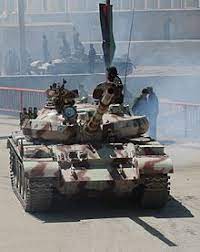
T62M in Desert Camouflage primary tank for 48th Guards CAC until 1987
Initially the 5th CAC fielded T72s and the 48th CACs fielded T62s. As experimental units they had first call on newer equipment (T72B and T62M) and trained intensively.
The Soviets started the experiment with other units (notably 32nd Guards TKD and 90th Guards TKD) but they did not get as far as 24th MRD.
Next article will cover the ways to represent these units in Team Yankee.
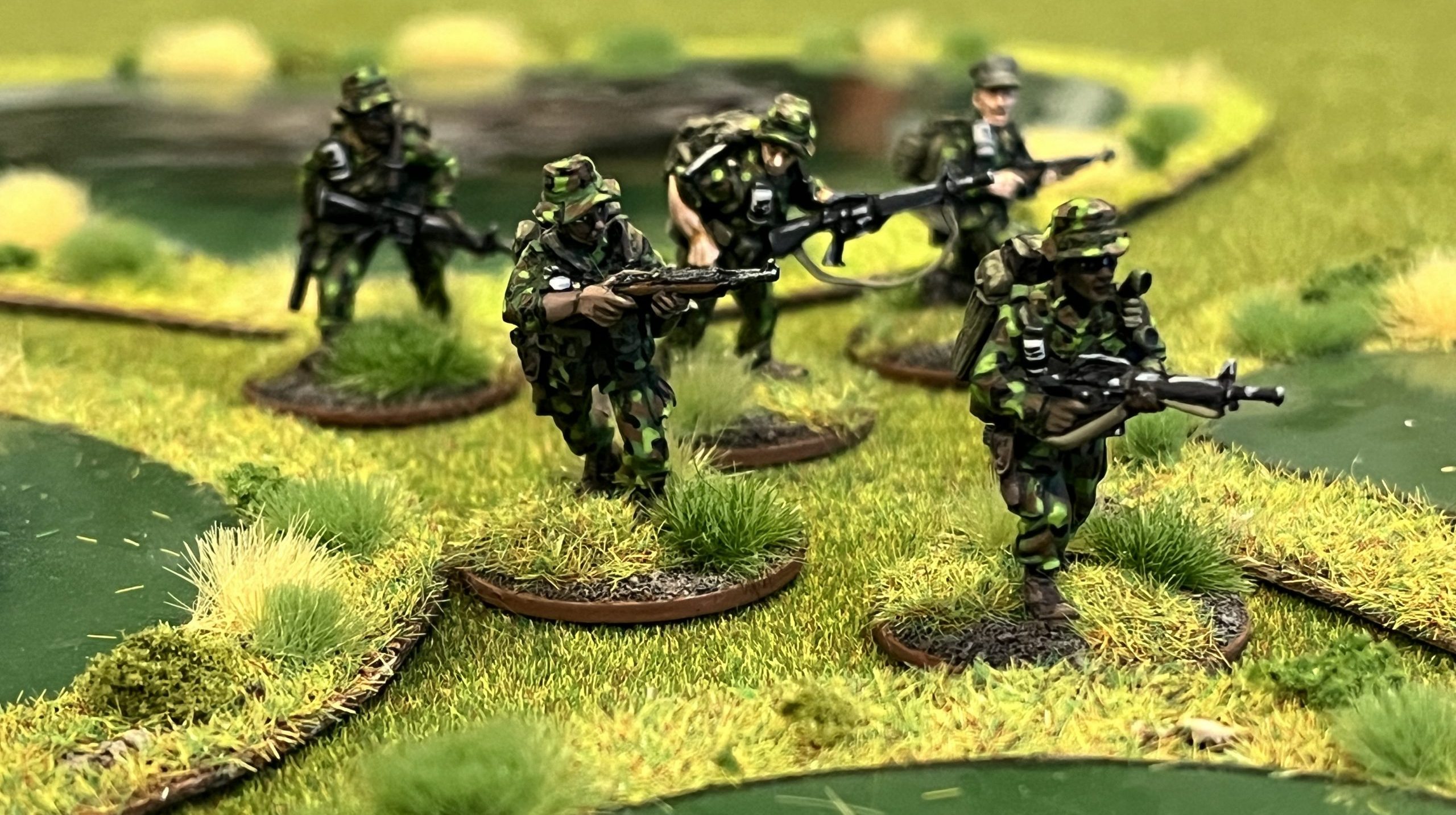
For the last year I’ve had a squad of Vietnam War USMC Recon primed and sitting in my queue. Every time a new project would join them and pass them up I could feel their crayon-craving stares boring into my soul. Eventually I could take no more of their non-verbal harassment and promoted them from my queue to my painting desk.
After some brief investigating I decided to paint them in the ERDL lowland camouflage that was commonly worn by USMC Recon during the Vietnam War. While replicating the complex pattern shown below in detail is beyond my skill level and patience I endeavored to replicate the colors well enough to represent the camouflage patter.
The paints I used are Vallejo’s Black (950), USA Uniform (922), German Cam. Medium Brown (826), Golden Olive (857), and Pale Sand (837).
On 21 September, twenty-six players gathered at Titan Games and Hobbies in Timonium, Maryland for another Bolt Action tournament (2nd Edition) organized by Michael Kehs. Mike was pleased to see his tournament crowd grow since the last tournament back in April to include recurring players from as far away as Ohio and a new player who ventured down from Connecticut. Mike credits a level of his growing popularity to his success in reaching out to vendors for prize support. In addition to healthy rewards for the top finishers, Best Painted Army, and FUBAR, players also can look forward to raffle drawings between rounds. Well-earned credit needs to go to the Assistant TOs, Rob and Chris, for providing invaluable support with setup, break-down, raffles, and pictures.
The three scenarios chosen for this tournament were Meeting Engagement, Key Positions, and Sectors. This tournament included a new gimmick from the previous one. While last time players could find their turn ending prematurely if two odd colored Order Dice were pulled from the bag, this time players needed to keep an eye on Secret Objectives distributed prior to each game. The Secret Objectives forced players to adjust strategies and to think more tactically to score up to an extra ten points, five per objective, each round. From what I was able to overhear, the feedback from the Secret Objectives was mostly positive, and Mike confirmed that he will look into incorporating them at future events. One improvement he plans on making is to specifically assign certain objectives to pair with certain scenarios and to balance them with each player receiving one hard and one easy objective. In my three games, the Secret Objectives did present opportunities for me to play the game differently than I normally would, and added an extra level of intrigue to the game. For example, in my final game, I had an opportunity to finish off one of my opponents units but instead moved my unit into my opponents half of the table to accomplish my Secret Objective of finishing the game with all my surviving units on my opponents half of the table. While that choice had no true impact on the outcome of the game, the choice I faced did make it a little more interesting for me and bagged me an additional five points to my overall score.
When Battlefront published RED DAWN and the Airborne Assault Missions Pack 18 months ago, I found one casual comment disturbing. Page 46 says “WARSAW PACT armies (Czechoslovakian, East German, and Polish) lacked dedicated airborne infantry (as opposed to airborne raiding troops) …”
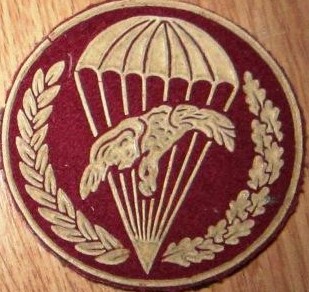
6th Polish Airborne Division Patch
This is a distinction without a difference, and a dismissal. I intend to correct the record and give some ideas how these MIA units can be incorporated into the game in casual play.
I’m going to follow the sequence in WARSAW PACT in this discussion but start with a unit found in all PACT armies.
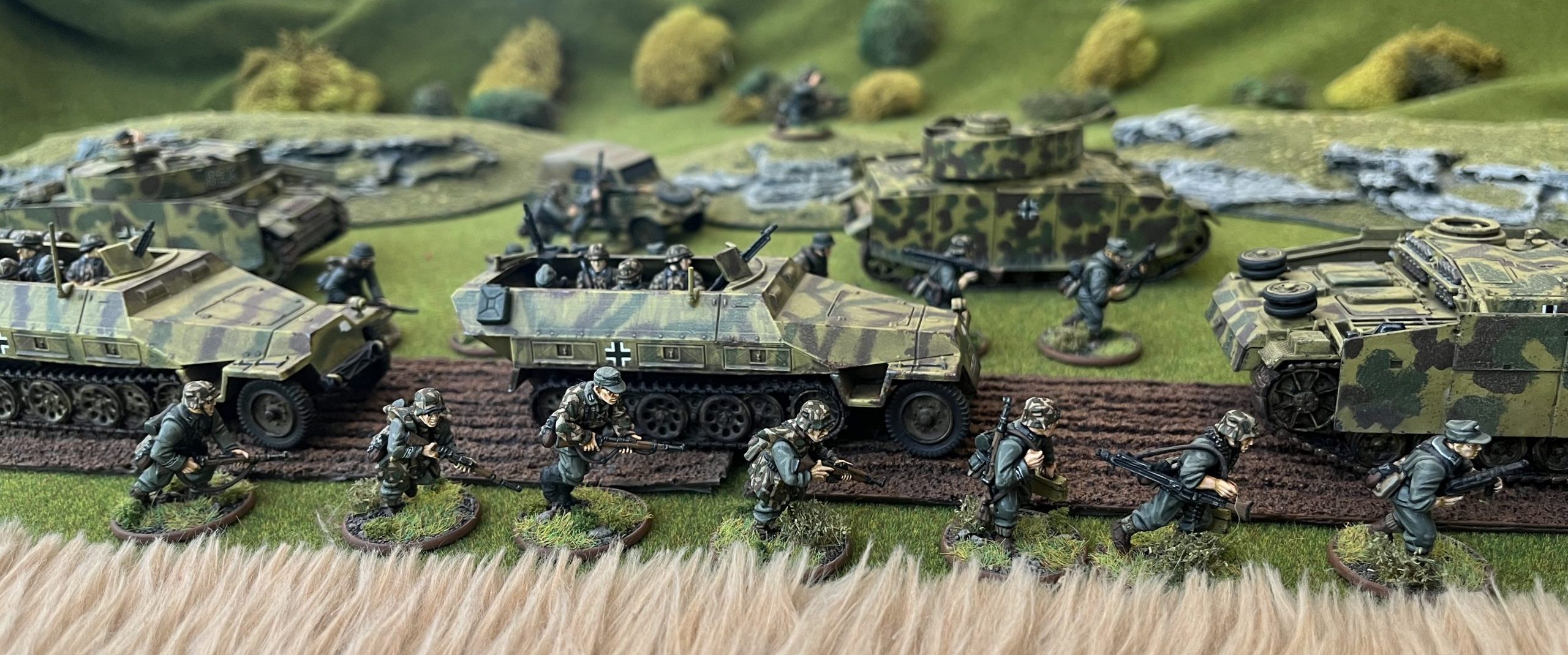
Within the next few weeks the 3rd Edition rulebook of Warlord Games’ WWII platoon skirmish game will hit store shelves and mailboxes around the world. We here at No Dice No Glory were given the opportunity to peruse the upcoming rulebook and I personally scrolled straight to the Armies of Germany section to see what notable changes Warlord Games has in store for the Wehrmacht.
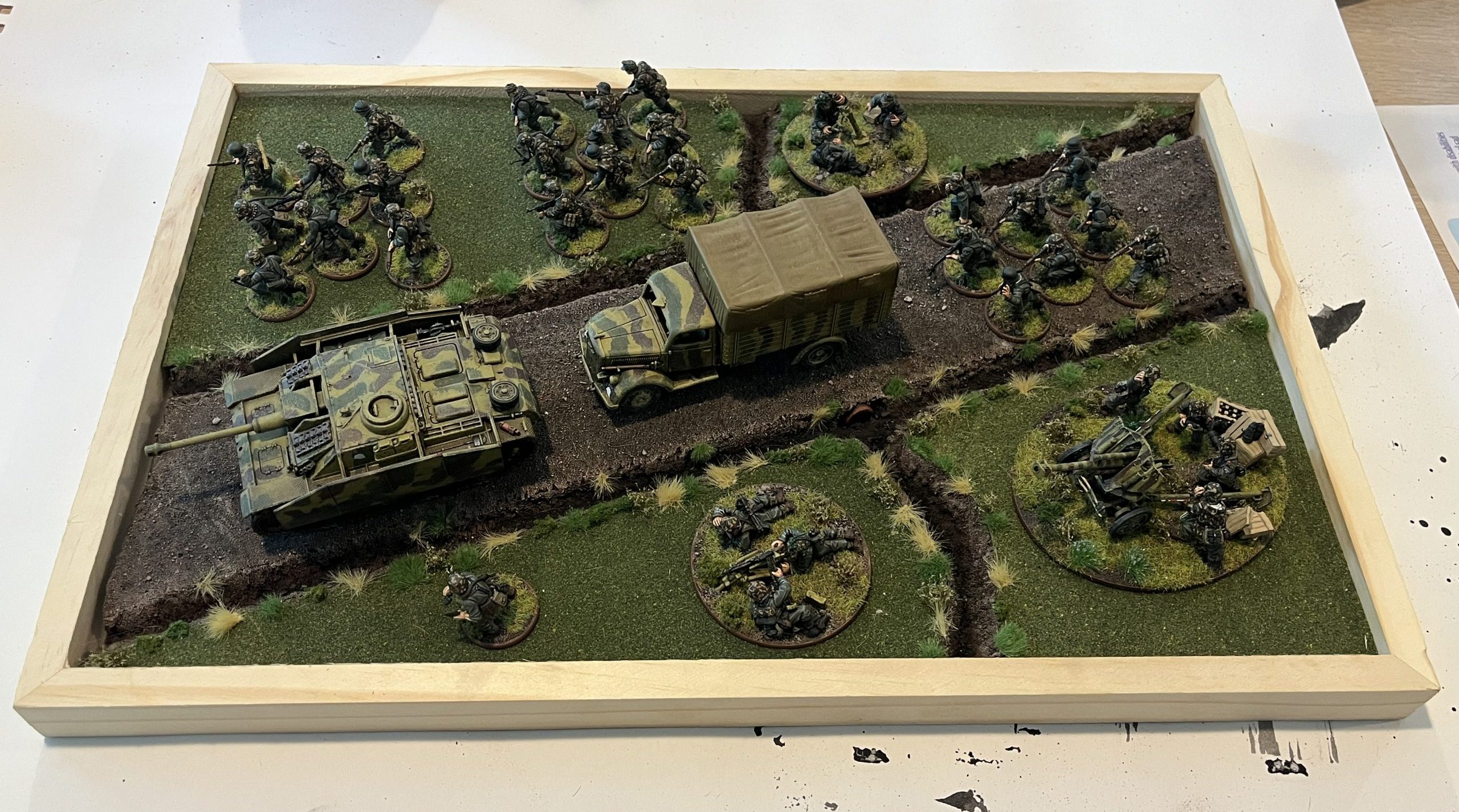
At this past April’s Operation Roundup Tournament I eagerly competed in the Best Painted Force finishing towards the top but not high enough to place. The category that hurt my score the most was my lack of a display board. Historically, I’ve avoided building a display board as I would rather invest the time, energy, and resources into painting miniatures and terrain.
Humbled, I decided that I can’t win unless I play the game and this game requires a display board. Driven by spite I committed myself to investing some of my summer break into building my first display board. As this is my first attempt at a display board the unofficial motto from the start was “good enough”.