
In Memory of Walt Langhans

By Dennis “Wachtmeister” Jensen

On Sunday, January 19th, 2020 the gaming world unexpectedly lost Walt Langhans, an industry professional, and dear friend.  Along with his wife Michele, Walt was one of the owners of and it’s lead designer.

Walt’s designs were excellent and showed what MDF terrain could aspire to.  He was one of the first people to integrate non-MDF elements in his projects, to include drinking straws, acrylic elements and PVC pipes.

Walt also took steps to minimize visible lugs in his terrain, often using other pieces of MDF to cover visible lugs and seems.  He always had excellent customer service.

I remember one time I wrote him to say that a terrain piece I had ordered didn’t come with the plastic drinking straws but I was good to go because I pulled one out from my painted pipe set.  Walt almost shipped out an extra drinking straw because of the error.  I couldn’t accept this of course, but it just goes to show how great his customer service was.
Do-it-yourself Hills: how to create good looking hills for your tabletop games

If you play 3d wargames, you will want to have awesome battlefields. And which scenario could happen without some hills? The ones made by producers like Battlefront or Games Workshop are wonderful, but if you need a number they can become quite expensive. So, here is how we can do easy, scenic, beautiful hills with very affordable costs.

Black Seas: Painting the British Fleet

By Igor “Tadcaster” Torgeson

Choosing your Colours
After Matt Varnish’s , I’ve been tasked with British painting. Warlord’s new line of ships from the Age of Sail is close to my heart, as I spent some time as crew aboard HMS Rose, a replica of the British frigate from the Revolutionary war. Many of you will be familiar with HMS Rose, as she was purchased by 20th Century Fox and renamed Surprise for the film Master and Commander.

When it comes to painting British ships, I have good news and bad news. The good news is by the time of the Napoleonic wars, the colours of ships in the Royal Navy were mostly standardized. The bad news is I said “mostly.” Royal Navy captains had great latitude in the painting and upkeep of their ships, whether it was the hull, the sticks (masts and yards), or the brightwork (decoration).

Black Seas: How to Paint your French ships

by Dennis ‘Matt Varnish’ Campbell

Hey everyone, what’s going on? As if I didn’t need a new project, but I’ve jumped right into Black Seas, by Warlord Games. This is their 2nd naval game, hot on the heels of Cruel Seas, Black Seas takes place in the Age of Sail, 1770-1830, including the Napoleonic Wars.   With my good buddy Scott ‘Obsidian23′ Roach picking the British, I would once again be painting blue and playing the French, much like my Black Powder army. I’ve decided to use Warlord Games’ suggested French Navy paint set, with a few tweaks of course.


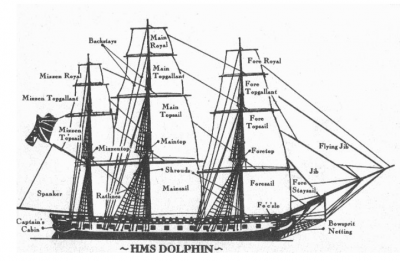
Easy diagram showing the names of the masts and sails

The King of Jordan Royal Tank Museum – Part 1

By Scott Roach

Photos by the Author

The Royal Tank Museum of Jordan

For most of us as gamers in the world of miniatures, I think for the majority of us we love sitting at a desk painting up our latest acquisition, be it a Leopard 2 for our Team Yankee West Germans, or a Cromwell for that added punch to a British Bolt Action Platoon.  Either way, we always take the time to look at pictures on Google, drag a book of the shelf or reach out to the forums for advice.

For me, I have been fortunate enough to travel.  This has provided excellent opportunities to get to those out of the way Museums around the world and actually reach out and touch some of this living history.  The aim of this article is to allow me to share one of those opportunities with you.

50 Shades of Green: Battlefront Colours of War book

By Paolo Paglianti

Images courtesy BattleFront

Whatever you play sci-fi Warhammer 28mm games or 15mm historical ones, half of our hobby is painting miniatures. If you are like me, you have tons of unpainted metal and plastic miniatures in the hobby room. Those Orks you bought because that fantasy soccer was so good. The space marines you collected because sooner or later you’ll do that WH40K army. And obviously boxes of WW2 tanks and Alexander phalanxes in 15mm.

Something that can’t miss in the wargamer’s shelf is a book about painting techniques. Before the Internet, they were precious as gold. Although you can now find plenty of online written and video tutorials, a good colour reference book is still quite useful.

In my painting “career” I have read books from Games Workshop and the awesome , but Battlefront’s is something unique, because it’s one of the few (actually the only one, as far as I know) totally focused on 15 mm armies. As one of the best and most inspiring lines in the book, it would be crazy to paint a full Russian 15mm WW2 army with the same definition as a 54 or even a 28 mm miniature. Colours of War is totally aimed for your twentieth century armies.

Team Yankee: Syrian Painting Guide

By Matt Varnish

Hey everyone, as I mentioned in the podcast and on my Syrians article, Battlefront neglected to show off the cool Syrian paint schemes and left newer players high and dry in terms of cool pictures.   I am here to fix that.   We will look at building a killer HQ tank with ERA armour blocks, then general painting of vehicles and the 3 main schemes, then infantry at the end.   All paints are Vallejo unless otherwise noted.   Yalla, let’s go!

Starting with the standard plastic T-55, I added side skirts, the modern HMG and some old Mine plows I had left over from the T-72s. Used the flat front hull, not the up-armoured one.

Basing with Baking Soda and CA Glue

by Troy A. Hill

Wait? CA glue?

That stuff we curse at every time we instantly bond our fingers to the model we’re holding? And what’s this about baking our bases?

No worries, mate! Just a lesson I learned from “Uncle Atom” over at the Table Top Minis YouTube channel. You can catch

Painting a FOW Army: how to field totally unique tanks and vehicles

D-Day is coming! In June (could be any another month?) Battlefront will publish army lists for the Normandy landings, effectively starting the Late WW2 period. After years fighting with “hit on 3+” and “test morale on 5+”, US troops will finally get much better, with tanks able to worry the German counterparts. For this reason, I began to assemble my new US army, with a mix of Mechanized infantry, Shermans, M3 halftracks, 105mm artillery, and M10s to punch enemy armour. But I also wanted a “personal” army, something really unique. Each tank with a different layout, each infantry base with a personal touch.

In this first half of the US Late Army painting guide, we will see how to customize your tanks (they can be German or Russian, obviously) with some tricks and advice to have flags, sandbags, and nets where you want.