The Italian Flames of War Nationals in Milan!

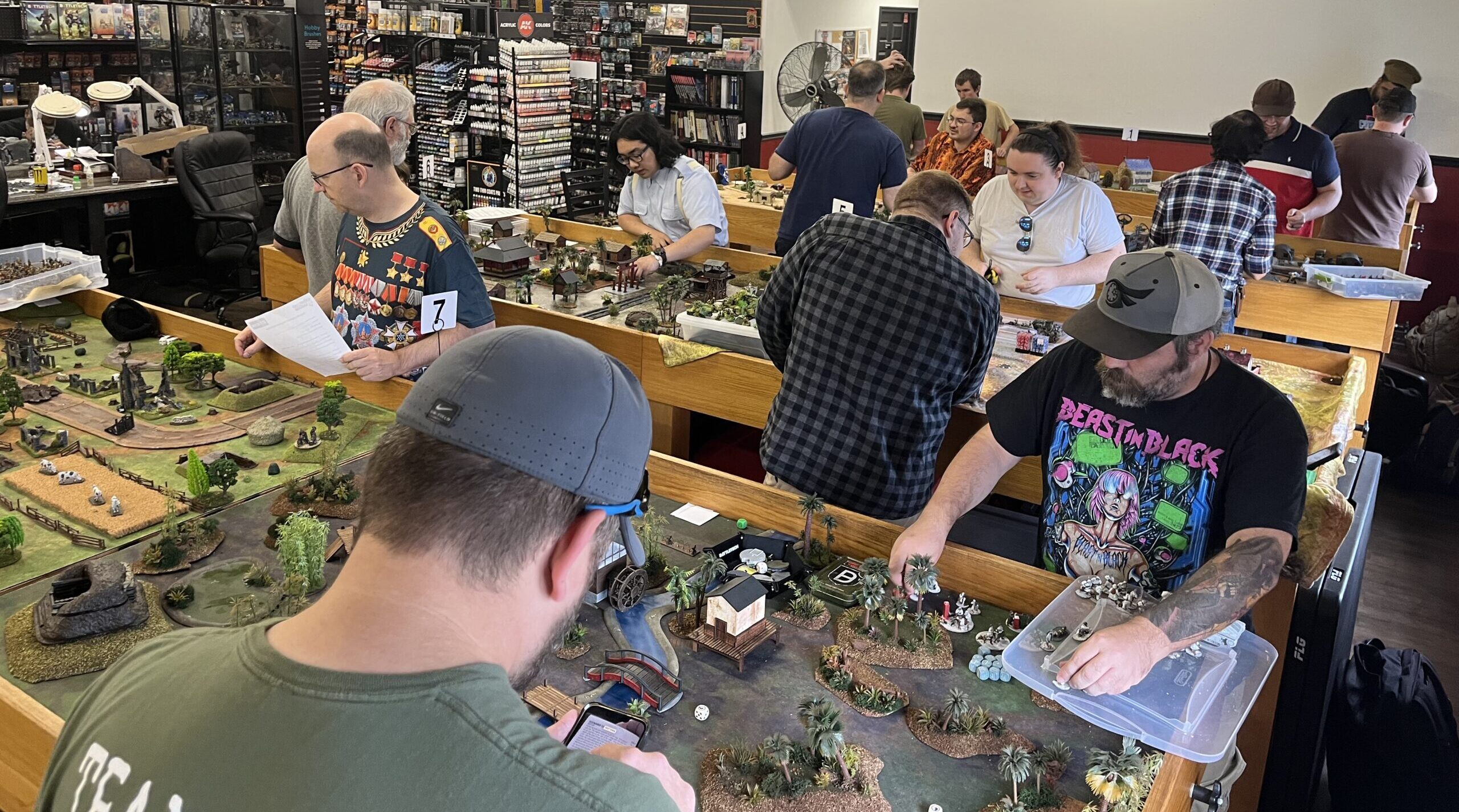
Players in Conaredo Italy, inside an athletic facility, play wargames on a basketball court.
More than 50 players under the same “roof” in Cornaredo, my hometown, where I organize various tournaments each year

By Paolo Paglianti

Although I have been organizing tournaments in Milan for various Wargames for over twenty years, this year’s Flames of War tournament was very special. First of all, I organized it again with the support of Battlefront and the Austrian store S-Games.at, both of them generously provided us with prizes. Moreover, it is the first time I have organized the Italian Nationals, a true honor for me. And finally, we had some foreign guests – and what guests!

A Retrospective of the Civilization Board Games (Part One)

By Patrick S. Barker

Civilization: The Board Game (1980)

– The Game of the Heroic Age

The first Civilization board game was created by Francis Tresham, a former British Royal Air Force radio instructor. Tresham first thought of the idea for the game while browsing a historical atlas at his base library. The idea was further sparked by Tresham’s experience playing strategy games like Risk and Diplomacy. Tresham found playing Diplomacy to be rather averse and thought to design a game that stressed winning through cultural and technological progress rather than military force.

Tresham’s game begins with the appearance of early farmers circa 8,000 BCE (approximately 4000 years before the start of recorded history) and ended with the rise of Rome in 250 BCE. Players controlled various real civilizations from around the Eastern Mediterranean Sea.  As the turns and time passed, the players’ starting settlements grew and expanded into neighboring areas and generated additional resources. Designed for between two to seven players, the game could take up to eight hours to complete.

Dynamic Points Come to Team Yankee

Opinion Piece By Jim Naughton

DYNAMIC POINTS: IF ENOUGH CUSTOMERS WHINE, THEY’RE RIGHT

A recent FACEBOOK post called attention to a BF plan to introduce DYNAMIC POINTS into Team Yankee.  It referred the reader to the Team Yankee website.  Since then, there has been a lot discussion in the various TY Groups on social medium.  

Couple years back, dynamic points were invented for Flames of War. The ostensible ‘reason’ for this was FOW tournament players had reacted to the Army Point (AP) values of the bread-and-butter tanks of MIDWAR by choosing Lend-Lease Tanks for the Soviets and spamming armored cars. Armored cars worked because they had enough armor and lots of machine guns to tank-assault many infantry units. Lend-Lease tanks like the M3 medium had an extra shot compared to T34s.

Connections Wargaming Conference 2024

By Mitch Reed

Another Connections Wargaming Conference is in the books and this last event was yet another benchmark performance. Held in Carlisle PA, the host Army War College Conflict Studies Laboratory exceeded what they did when they last hosted the event in 2019. We have covered this event over the last few years, and it is the premier event where wargamers from defense, industry, academia and the hobby community gather to talk about how to make wargaming better and what the next generation of wargaming looks like.

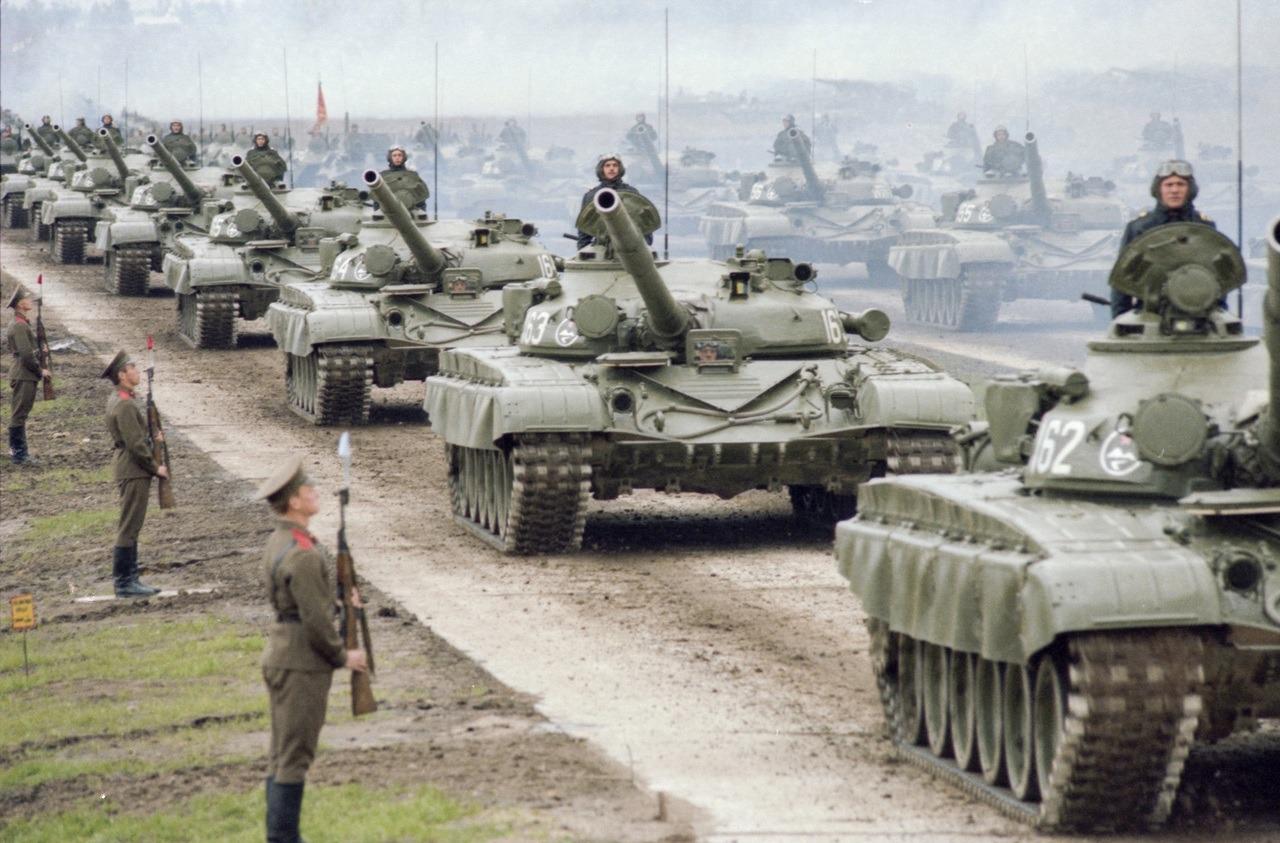
Vehicle identification and standard markings on Danish Vehicles

By Morten

In this article I will talk about markings used on Danish Vehicles in the 80s and 90s.
Most of these have been in use since the 60/70s and are still in use to this day, although with some variations and updates.

For some markings there are Army standards that needs to be obeyed, and are generally placed on the same location on all vehicles, although slight variation in placement could occur, because they were put on the vehicle by either the crew themselves or the mechanic echelons on base.

Let’s start with the “easy” parts that are present on all vehicles: License plates, Vehicle numbers and weight classification (for heavier vehicles).

Retrospective of Civilization III

“Dominate the world through diplomatic finesse, cultural domination, and military prowess.” -Giant Bomb

By Patrick S. Baker

Introduction

After, shall we say, the mixed critical and commercial reception of 1999’s Civilization II: Test of Time, which has an aggregate of only 66% on Metacritic, famed game developer Sid Meier and his company, Firaxis, immediately set to work on another Civilization game. Originally, the development of the game that would become Civilization III (Civ III) was given to Brian Renyolds, the man behind the highly successful base Civilization II game. However, Renyolds left Firaxis before development really got rolling to start his own company, so the assignment was handed to game designer Jeff Briggs and game programmer Soren Johnson.

Briggs was an experienced game designer, and one of the three founders of Firaxis, along with Reynolds and Meier. Briggs had previously helped design such games as Colonization and Civilization II. He also held a PhD of Music Theory and had written the original music for many of Microprose games.

Johnson had gone to work at Firaxis after an internship at Electronic Arts (EA). He was assigned as the primary game programmer for Civ III under Briggs direction. Johnson joined the development team with just 16 months left to finish the game. Still, he rewrote much of the game’s code, with his main focus was on the its Artificial Intelligence (AI).

D-Day Upon Us – D-Day+10 Battle Report Part I

By Michael Rafferty

This year marks the 80th anniversary of Operation Overlord and the Battle for Normandy. To commemorate this my local group, the Nerds of War, wanted to run a D-Day themed mega battle. It’s been a few years since we’ve run a mega battle at our FLGS The Game Room and not at AdeptiCon, so we wanted to start things off with something big and flashy.

We have a logo and a banner, we’re official!

I really enjoy running large games for people and I’ve always enjoyed playing in something larger and more cinematic. It’s a good feeling to be maneuvering whole tank companies about the battlefield instead of a platoon. That’s what got me started running big games a decade or so ago.

If other people weren’t going to run the kind of games I like, I would do it myself. These games also motivate me to complete modeling projects. Setting a date means I need to have things ready by then and I work better with firm, external deadlines. Big games both keep me recharged in the hobby and progressing along my projects, a win-win!

AdeptiCon is Moving on Up

By Michael Rafferty

Recently, AdeptiCon announced that it was moving to the Baird Center in Milwaukee. While Schaumburg and the Greater Chicago area has been great to us, we’ve epically outgrown the Schaumburg convention center. Three years ago, we expanded to the facilities at the Hyatt Regency, moving historicals and a few other events there. By the last convention, even this extra space was full and then some. This doesn’t even factor in all the hassle of being at two hotels. While I’m a big advocate for the Hyatt and our historical space, it was packed this year. AdeptiCon has been pushing at the limits of Schaumburg, and it was time to look at bigger spaces.

The Baird Center at night

Remembering the Fantastic Fours: The SPI Quad Games Revisited

By Mitch Reed

I guess I am an old time wargamer, I started with Avalon Hill’s Tactics II in 1978, then Gettysburg by the same company. Soon after I purchased my first game from Simulations Publications Inc (SPI) which was their quad game, Blue and Gray II which contained four great battles of the American Civil War.

This purchase solidified me becoming a grognard, and now forty-plus years later I still wargame. Recently someone posted a picture of some of the quad games and I thought about how much these games probably brought so many people into the hobby such as it did for me. I also thought how much these games meant to our hobby and I wanted to revisit and discuss these great games.